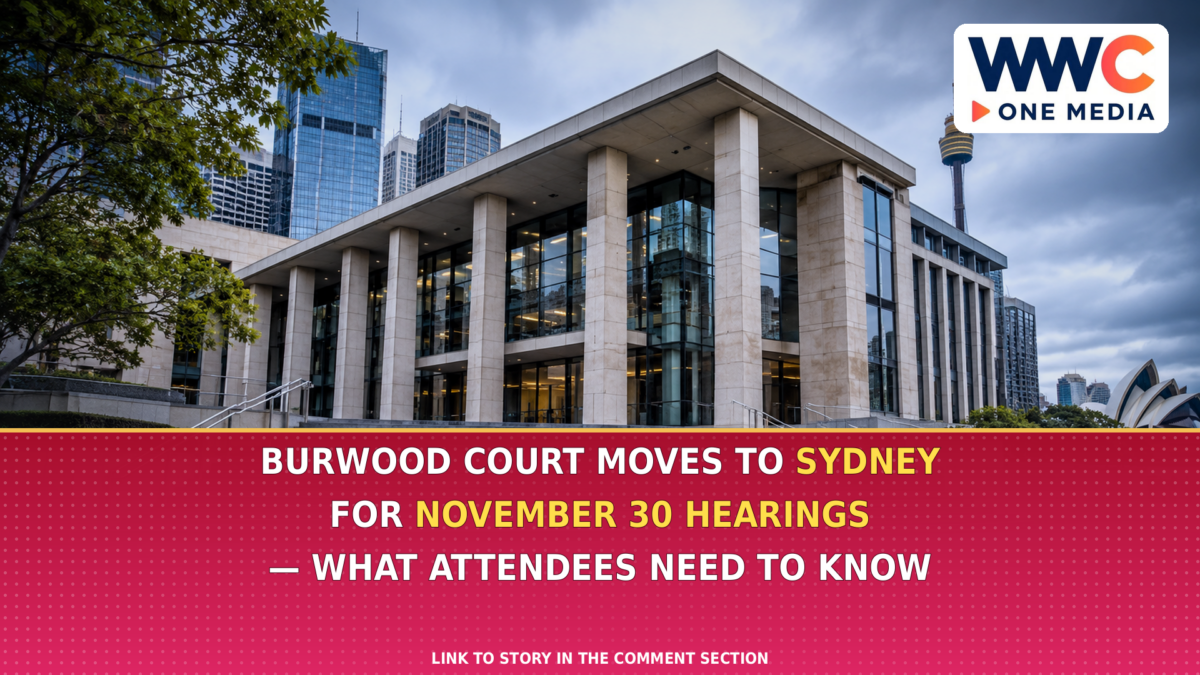
SYDNEY, Australia, Nov. 29, 2026 — People scheduled to attend Burwood Local Court on Monday, November 30, will need to take note of a temporary change in venue, with court sittings and registry services operating from John Maddison Tower in central Sydney during refurbishment works.
The New South Wales court administration has set the temporary arrangement to continue until Friday, December 11, with the Burwood courthouse scheduled to reopen on Monday, December 14. The move makes the correct hearing location an important detail for defendants, lawyers, witnesses and other court users preparing for the next sitting day.
The change also highlights why checking a court listing involves more than confirming a date. A matter may remain scheduled while its physical location changes, and the published list can be updated as court arrangements develop.
Burwood court relocation: the temporary Sydney address
The official Burwood Local Court location notice identifies the usual courthouse at 7–9 Belmore Street, Burwood. However, the same notice says sittings and registry services have been temporarily relocated to John Maddison Tower, 86–90 Goulburn Street, Sydney.
The temporary arrangement began on Tuesday, October 6, and is scheduled to run through Friday, December 11, because of refurbishment works at the Burwood courthouse.
The registry is operating from Level 4 of John Maddison Tower, between 9 a.m. and 4:30 p.m. on weekdays. The court’s listed telephone and postal contact details remain unchanged.
For anyone attending a matter associated with Burwood, the distinction is practical. The court name may still appear as Burwood Local Court in a case reference or administrative record, but the physical venue during the relocation period is in Sydney.
Court users should therefore confirm the location assigned to their specific matter before travelling. Going to the former courthouse without checking the latest arrangements could result in unnecessary travel or a missed appointment.
Why the published court list needs checking
New South Wales operates an online court-list service covering several jurisdictions, including the Local Court, District Court and Supreme Court.
The system allows users to search by case number or party name and refine results using the court, jurisdiction, location, presiding officer and listing type. The Online Registry says listing information is updated every 60 seconds.
That frequency matters because court schedules are not necessarily fixed once first published. A hearing may be moved, a courtroom may be assigned later, or a matter may be affected by developments in another proceeding.
The court administration advises users to check the list regularly rather than relying solely on an earlier copy or a third-party summary.
The distinction between a court’s own records and external reproductions is important. An independent website may reproduce information from published lists, but the official court listing remains the authoritative reference when details differ.
WWC ONE MEDIA has previously explained why a scheduled criminal trial must not be confused with a finding of guilt in its coverage of the legal questions surrounding the Beau Lamarre-Condon trial. A calendar entry establishes a procedural event, not the outcome of the case.
A court listing is not a finding of guilt
Court schedules can contain criminal, civil and administrative matters. The appearance of a person’s name on a daily list does not, by itself, establish that the person has been charged with an offence, convicted or found liable.
A listing may identify a hearing, mention, directions appointment, bail-related matter or another procedural step. Each description has a distinct function in the court process.
A mention, for example, is generally a procedural appearance rather than a trial or final determination. A hearing may involve the consideration of an issue, while a trial is a separate process in which evidence and legal arguments are considered under the applicable rules.
The actual significance of an entry depends on the case record and the type of proceeding. It would be inaccurate to describe every person appearing in court as an accused person or to imply that a scheduled matter has already produced a judicial finding.
That principle applies across jurisdictions. WWC has also examined how a Japanese court calendar identifies a pending judgment without revealing the outcome in advance. The same basic reporting discipline applies: a scheduled date is not a verdict.
What court users should confirm before travelling
People with a matter listed for November 30 should check the current NSW Online Registry listing and confirm the location, time and courtroom information available for their case.
The registry’s guidance says court users can search by name or case number. It also warns that listing details may change, making a fresh check important even when a person has already received an earlier schedule.
For some matters, the location displayed in the online system may depend on whether a courtroom has been assigned. The Online Registry explains that civil matters may initially appear under Sydney before being assigned to John Maddison Tower. Criminal Local and District Court matters may appear under Sydney Downing Centre before a courtroom is assigned.
This is one reason a search using only the word “Burwood” may not provide the full picture during the temporary relocation. Users should consider the case number and the latest location details, and contact the relevant registry if the information remains unclear.
The court’s published location notice also states that the temporary registry operates from Level 4 of John Maddison Tower. That is the address court users should take into account during the refurbishment period, subject to the latest directions for their individual matter.
WWC’s previous reporting on Sydney police investigations and subsequent court proceedings has also highlighted why initial announcements and later court developments must be treated as separate stages of the legal process.
What happens next
The current relocation timetable identifies December 11 as the final day of the temporary arrangement and December 14 as the scheduled reopening date for Burwood Local Court.
Until the reopening, court users should rely on the latest official listing and the court’s relocation notice when planning attendance. The timetable is the published arrangement, but individual case listings remain subject to change.
The immediate priority for anyone due in court on November 30 is to verify the assigned location and time rather than assume that the hearing will take place at the Belmore Street building.
The broader lesson is straightforward: a court date is only one part of an appearance. The correct venue, courtroom and current listing details are equally important.
Frequently asked questions
Where will Burwood Local Court hearings take place on November 30, 2026?
The temporary location is John Maddison Tower, 86–90 Goulburn Street, Sydney. Court users should still check the latest listing for their individual matter.
Why has Burwood Local Court moved?
The court’s sittings and registry services have been temporarily relocated because of refurbishment works at the Burwood courthouse.
When will Burwood Local Court reopen?
The official location notice schedules reopening for Monday, December 14, 2026.
How can people check their NSW court hearing?
They can use the NSW Online Registry court-list search, which supports searches by case number, party name, court, jurisdiction, location and listing type.
Does appearing on a court list mean someone is guilty?
No. A court listing only indicates that a matter is scheduled. It is not a conviction, finding of guilt or final decision.