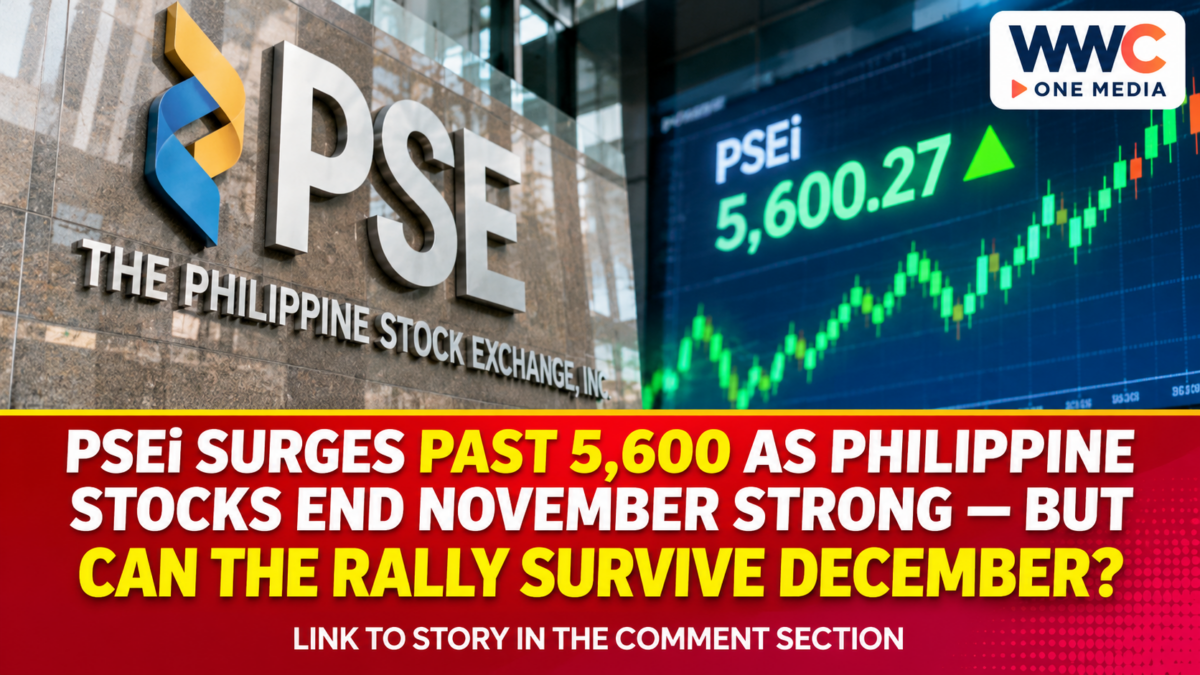
MANILA, PHILIPPINES — Philippine equities delivered a strong finish to November 2026 as the benchmark Philippine Stock Exchange index (PSEi) surged 121.84 points, or 2.22%, to close at 5,611.97 on Friday, Nov. 27.
The broader All Shares index also advanced by 1.39% to 3,095.48, while every major sector recorded gains ahead of the extended holiday weekend.
The PSEi November rally coincided with preparations for an international equity index rebalancing and the release of new Philippine merchandise trade statistics showing record export activity.
However, a record trade deficit and a relatively narrow advantage in the number of advancing stocks suggest that investors should distinguish a strong benchmark performance from a sustained market recovery.
The next major test will come when trading resumes in December, with fresh inflation figures expected during the first week of the month.
PSEi November Rally Pushes Benchmark Above 5,600
The Philippine stock market closed its final November trading session with total transactions valued at approximately ₱29.17 billion.
The benchmark’s 121.84-point increase lifted the PSEi from its previous closing level of 5,490.13.
While the headline performance was encouraging, the distribution of gains across individual securities presented a more balanced picture.
Advancing stocks numbered 81, compared with 79 declining issues and 75 unchanged securities.
The market recorded 102,235 transactions involving approximately 1.72 billion shares.
The relatively small difference between advancing and declining stocks illustrates why a substantial improvement in the benchmark index does not necessarily mean that most listed companies experienced significant gains.
For investors, examining individual company fundamentals remains important even during a broadly positive trading session.
Services and Mining Lead Philippine Stock Market Gains
The services sector delivered the strongest performance among the exchange’s six major sector indices, advancing by 5.42%.
Mining and oil followed with a 3.01% increase, while industrial stocks gained 1.21%.
Financial shares advanced by 0.98%, holding firms increased by 0.44%, and property stocks recorded a more modest gain of 0.33%.
The differences in sector performance demonstrate that investors experienced substantially different market outcomes depending on their portfolio composition.
Within financial services, corporate lending and infrastructure investment remain important business considerations, as examined in BPI’s expanding loan portfolio and renewable energy financing strategy.
However, one positive trading session does not independently establish stronger future earnings for the banking sector or other listed businesses.
Window Dressing or Genuine Market Recovery?
The timing of the November rally raises questions about whether temporary portfolio adjustments contributed to the improvement in share prices.
Window dressing refers to the practice of adjusting investment portfolios near the end of a reporting period, potentially improving the appearance of their disclosed holdings.
Fund managers may also undertake routine month-end adjustments to comply with investment mandates, manage portfolio allocations or respond to changes in benchmark indices.
These activities can create temporary differences between market prices and underlying corporate developments.
However, the Philippine Stock Exchange’s closing statistics do not establish the specific motivations behind individual transactions.
Consequently, the entire November 27 rally cannot conclusively be attributed to window dressing.
The sustainability of the gains will become clearer once additional trading sessions provide evidence of whether buying interest continues beyond the month-end reporting period.
MSCI Index Rebalancing Adds Another Market Consideration
International index provider MSCI announced its November equity index review results on Nov. 11, with changes scheduled for implementation at the close of Nov. 30.
The Philippine market will be closed on that date in observance of Bonifacio Day.
Under MSCI’s market closure policy, relevant index changes are reflected on the following day using prices from the preceding trading session when an affected market is closed on the scheduled implementation date.
Index rebalancing can influence trading activity because investment funds that track benchmarks may need to adjust their holdings to reflect revised index compositions.
Nevertheless, the existence of a scheduled index review does not establish how much of Friday’s trading activity resulted from such adjustments.
Portfolio valuation changes can have consequences beyond equity markets, as illustrated by Chile’s pension fund exposure to international interest-rate movements.
Both developments highlight the importance of distinguishing market-driven valuation changes from improvements in underlying financial performance.
Record Philippine Exports Mask a Growing Trade Deficit
Preliminary merchandise trade figures released on Nov. 27 provided additional economic context for the stock market rally.
Philippine goods exports reached approximately US$10.57 billion in October 2026, while imports amounted to US$17.52 billion.
The resulting US$6.95-billion trade deficit was the largest recorded since the statistical series began in 1991.
Electronic products remained the country’s leading export category, generating US$7.40 billion and accounting for 70% of total merchandise exports.
Between January and October, Philippine merchandise exports reached US$84.71 billion, representing year-on-year growth of 20.1%.
The figures demonstrate the continuing importance of electronics manufacturing to the country’s international trade performance.
However, rising imports indicate that export growth alone cannot provide a complete assessment of the economy’s external position.
The developments are particularly relevant to APEC economies, which collectively accounted for 88.6% of Philippine merchandise exports and 88.2% of imports in October.
December Inflation Figures Could Test Investor Confidence
The Philippine Statistics Authority’s official release calendar schedules the November 2026 inflation report for Dec. 4.
The announcement will provide updated information about consumer price pressures as businesses approach the final month of the year.
Core inflation, which excludes selected food and energy products, increased to 5.4% in October from 4.8% in September.
Persistent inflation can influence household purchasing power, corporate operating expenses and financing conditions.
For businesses seeking new capital, the relationship between borrowing costs and investment returns remains important, including for listed companies pursuing expansion through instruments such as Alternergy’s ₱2-billion green corporate notes programme.
The December inflation announcement could therefore provide important context for assessing whether the November equity rally is supported by improving economic conditions.
What Happens Next for Philippine Stocks?
The Philippine Stock Exchange is scheduled to resume regular trading after the Nov. 30 holiday.
Investors will have an opportunity to assess whether the benchmark can maintain its position above 5,600 after month-end portfolio adjustments and international index changes.
Subsequent corporate disclosures, economic statistics and changes in financing conditions will also help determine the market’s direction.
Friday’s strong performance represents a positive development for the benchmark, but it does not establish that a prolonged recovery has begun.
The bigger question for December is whether Philippine equities can sustain their gains through broader buying participation and improvements in underlying economic and corporate performance.
Frequently Asked Questions
Why did the PSEi rise on November 27, 2026?
The PSEi increased by 2.22% amid positive sector performances, ahead of scheduled international index changes and following the release of merchandise trade statistics. The exact contribution of each factor has not been independently established.
What was the PSEi closing level?
The Philippine Stock Exchange index closed at 5,611.97 on Nov. 27, gaining 121.84 points.
Which Philippine stock market sector performed best?
Services led the market with a 5.42% increase, followed by mining and oil at 3.01%.
What is stock market window dressing?
Window dressing involves adjusting investment portfolios near a reporting deadline to improve the appearance of their disclosed holdings. It should be distinguished from ordinary portfolio rebalancing.
When will the Philippines release November 2026 inflation figures?
The official release calendar schedules the November inflation report for Dec. 4, 2026.