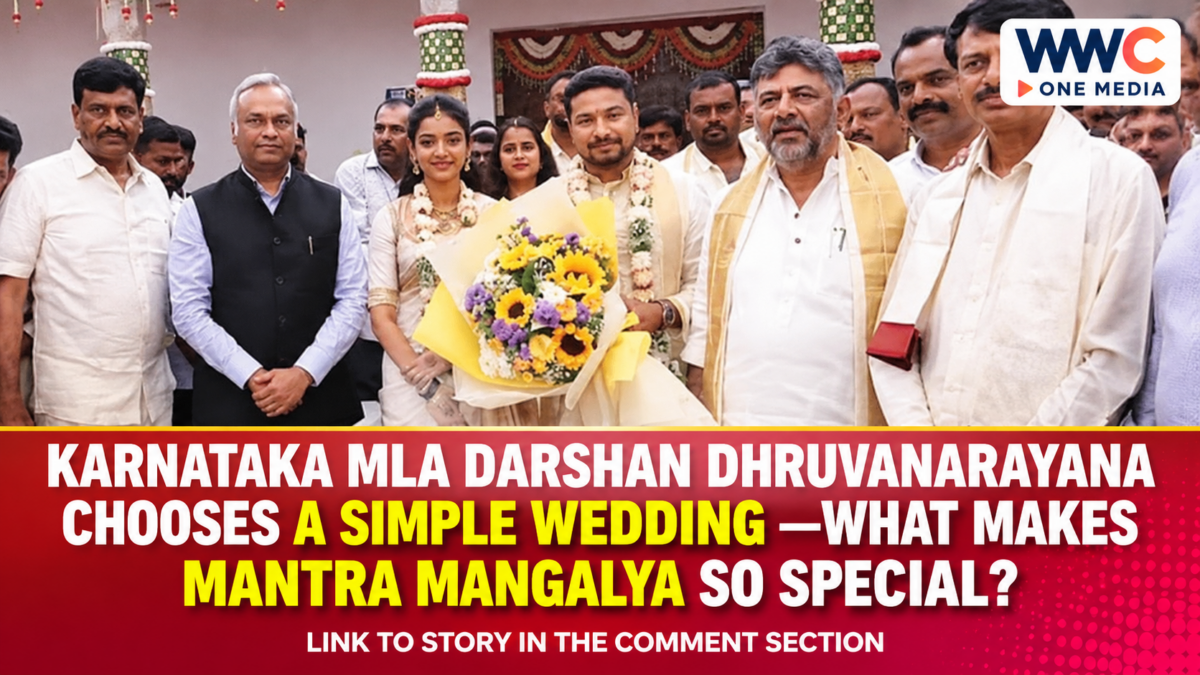
KARNATAKA, India — Nanjangud lawmaker Darshan Dhruvanarayana has reportedly married Dr. Srinidhi in a Mantra Mangalya wedding, bringing renewed attention to a distinctive marriage tradition associated with Kannada literary icon Kuvempu.
The wedding was reported to have taken place on November 26, 2026, at Janapada Loka near Ramanagara, Karnataka.
Rather than making extravagant celebrations the central attraction, the Mantra Mangalya approach invites couples to place greater emphasis on their commitment to married life.
The reported ceremony offers an opportunity to revisit a cultural tradition that continues to connect Kannada literature with contemporary society.
Mantra Mangalya Wedding: A Tradition Rooted in Kannada Literature
Mantra Mangalya is associated with Kuvempu, whose literary legacy continues to be preserved by the Rashtrakavi Kuvempu Pratishthana in Kuppali.
The marriage tradition presents an alternative to elaborate wedding celebrations, placing simplicity at the heart of the occasion.
Its continuing relevance extends beyond Kannada-speaking communities.
In 2019, the Kuvempu Trust published an English translation of Mantra Mangalya to make the work accessible to readers unfamiliar with Kannada.
The publication reflected growing interest in the marriage format beyond its original linguistic community.
While prominent personalities frequently attract attention for their marriage announcements, including the upcoming wedding of South Korean entertainment personalities Ji Ye-eun and Vata, the Karnataka wedding story draws attention to the cultural philosophy behind the ceremony itself.
Who Is Darshan Dhruvanarayana?
Darshan Dhruvanarayana represents the Nanjangud constituency in the Karnataka Legislative Assembly.
He was elected in 2023 as a member of the Indian National Congress.
Nanjangud is located within Karnataka’s Mysuru district and is identified as constituency No. 214 in the state’s legislative electoral records.
As a member of the Legislative Assembly, commonly referred to in India as an MLA, Dhruvanarayana serves as an elected representative at the state level.
His reported marriage introduces a personal dimension to his public profile while creating an opportunity for wider discussion about Karnataka’s literary and cultural traditions.
The marriage should nevertheless be understood as a personal occasion rather than an announcement of government policy or a political initiative.
Janapada Loka: A Cultural Landmark Beyond Ordinary Wedding Venues
The reported wedding venue, Janapada Loka, occupies a distinctive place in Karnataka’s cultural landscape.
Located near Ramanagara along the Bengaluru–Mysuru highway, the institution is dedicated to preserving and presenting the state’s folk heritage.
Its collections include traditional artwork, puppets, masks, agricultural implements, household objects and representations of regional folk dances.
Janapada Loka also maintains a library documenting Karnataka’s cultural practices and traditions.
The institution’s founder, H. L. Nage Gowda, devoted considerable effort to documenting folk communities and preserving their cultural expressions.
Against this background, a Mantra Mangalya wedding at Janapada Loka would bring together two elements of Karnataka’s identity: its literary heritage and its living folk traditions.
Can Simplicity Change the Way People View Weddings?
Wedding celebrations can take many forms, reflecting different religious beliefs, family traditions, personal preferences and financial circumstances.
The Mantra Mangalya concept provides another way of approaching the occasion.
Its appeal lies in the possibility of celebrating marriage without making elaborate arrangements the defining feature of the event.
For couples considering their own celebrations, simplicity does not necessarily mean abandoning cultural identity or family participation.
It can instead mean prioritising the elements of a ceremony that carry the greatest personal significance.
Across Asia-Pacific societies, individual wedding stories often reveal different approaches to commitment and family life.
The experience of a couple who proceeded with their wedding despite a flooded church offers another example of how circumstances and personal priorities can shape marriage celebrations.
Although the circumstances are entirely different, both stories provide opportunities to reflect on what makes a wedding meaningful beyond its physical arrangements.
Kuvempu’s Cultural Legacy Reaches New Audiences
The publication of Mantra Mangalya in English demonstrates how a regional literary work can become accessible to people from different linguistic backgrounds.
This is particularly relevant for international audiences interested in India’s diverse cultural heritage.
Marriage practices need not follow a single model, and the continued publication of works such as Mantra Mangalya helps preserve alternative perspectives for future generations.
Public interest in personal milestones is not limited to political figures. The announcement of Edward Barber’s engagement and new chapter beyond entertainment similarly illustrates how marriage-related developments can introduce audiences to the personal values and priorities of familiar personalities.
In Karnataka, Mantra Mangalya offers a distinctive cultural framework through which marriage, literature and personal commitment can intersect.
What Happens Next?
The reported marriage of Darshan Dhruvanarayana and Dr. Srinidhi has placed the Mantra Mangalya tradition in the public conversation.
Whether this attention encourages more couples to consider similar ceremonies remains to be seen.
The tradition’s wider cultural significance, however, extends beyond any individual wedding.
Its preservation through literary publications ensures that future generations can continue exploring Kuvempu’s approach to marriage.
At the centre of the discussion is a straightforward question: should the significance of a wedding be measured by the scale of its celebrations or by the commitment it represents?
For couples exploring the Mantra Mangalya tradition, the answer may lie in finding a ceremony that reflects their own values.
Frequently Asked Questions
What is a Mantra Mangalya wedding?
Mantra Mangalya is a marriage tradition associated with Kannada literary figure Kuvempu that emphasises simplicity.
Who is Darshan Dhruvanarayana?
Darshan Dhruvanarayana is an Indian National Congress politician elected to represent Nanjangud in the Karnataka Legislative Assembly in 2023.
Who developed the Mantra Mangalya tradition?
The tradition is associated with Kannada writer Kuvempu, whose literary works are preserved and promoted by the Rashtrakavi Kuvempu Pratishthana.
What is Janapada Loka?
Janapada Loka is a cultural institution near Ramanagara, Karnataka, dedicated to the preservation and exhibition of regional folk heritage.
Is Mantra Mangalya available in English?
Yes. The Kuvempu Trust published an English translation of Mantra Mangalya in 2019 to make the work accessible to non-Kannada readers.