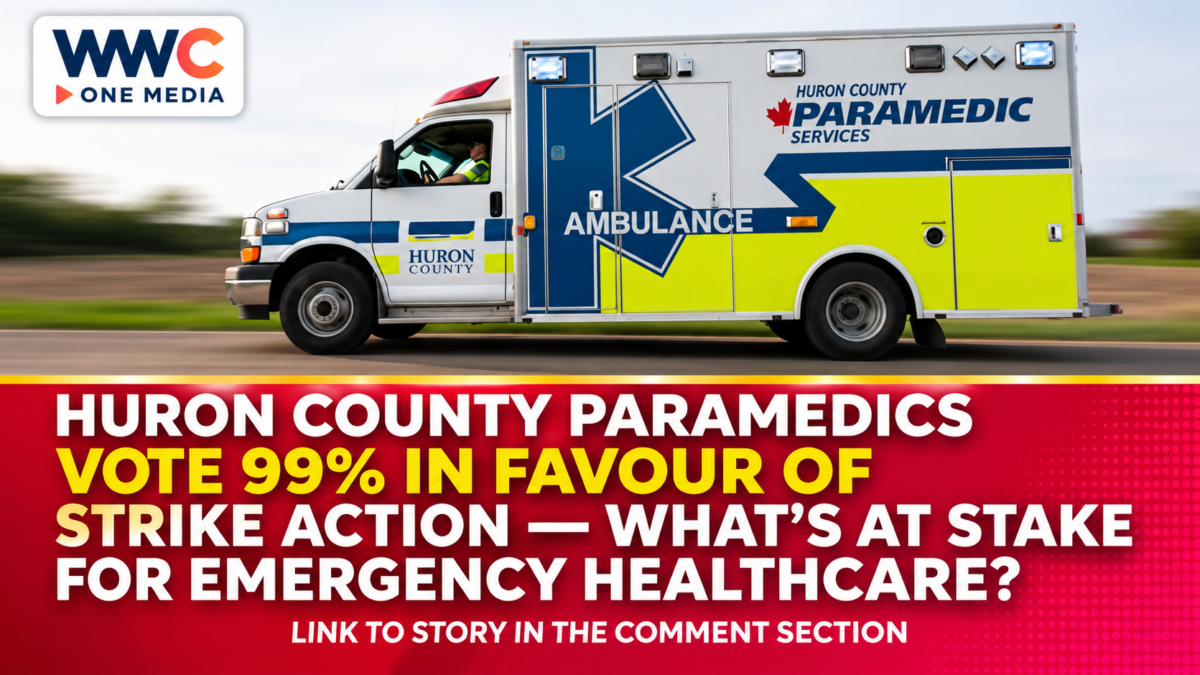
HURON COUNTY, Ontario — Huron County paramedics have placed wages, employee benefits and mental health support at the centre of a significant labour dispute involving emergency medical personnel in southwestern Ontario, Canada.
The Canadian Union of Public Employees (CUPE) announced on Nov. 2, 2026, that 99% of participating members supported strike authorisation, marking the first such vote among paramedics represented by Local 4513.
All 112 union members participated.
The overwhelming result highlights the importance of addressing employment conditions while maintaining essential emergency medical services for residents and visitors.
Huron County Paramedics Push for Better Employment Conditions
The union’s bargaining priorities include improved compensation, stronger mental health benefits and employment conditions that remain competitive with neighbouring emergency medical services.
Kelsy Long, president of CUPE Local 4513, has emphasised the importance of establishing sustainable working arrangements that recognise the demands placed on frontline emergency responders.
The union maintains that improved employment conditions are necessary to retain experienced personnel.
Its concerns reflect a broader issue within healthcare employment: maintaining reliable services requires attention to the welfare of the employees responsible for delivering them.
Similar workforce concerns have emerged across the Asia-Pacific, including IHH Healthcare’s restructuring involving employees in Singapore, Malaysia and Hong Kong.
Although the circumstances differ, both developments demonstrate the importance of employment arrangements and workforce sustainability within healthcare institutions.
Emergency Medical Services Cover More Than 3,400 Square Kilometres
Huron County’s paramedic service plays an important role in providing medical assistance before patients reach hospitals.
The county’s published operational profile lists 13 ambulances, four rapid response vehicles and one duty superintendent unit serving an area of 3,402 square kilometres.
The service responds to approximately 10,000 emergency calls annually.
Its responsibilities include responding to medical emergencies, assessing patients, administering necessary treatment and transporting individuals requiring hospital care.
Paramedics also coordinate with other emergency responders, including firefighters, police personnel and emergency dispatch services.
The geographical coverage and range of responsibilities make adequate staffing an important operational consideration.
Maintaining reliable emergency medical coverage requires not only suitable vehicles and equipment but also qualified personnel capable of responding when assistance is needed.
Mental Health Support Becomes a Central Bargaining Issue
The union has identified mental health assistance as one of its most important negotiating priorities.
Emergency medical personnel routinely encounter demanding situations involving serious illness, accidents and other emergencies.
Access to appropriate workplace support can form an important component of maintaining a sustainable emergency response workforce.
However, the effectiveness of any new employment agreement would depend on its actual provisions, including benefit eligibility and the practical accessibility of support services.
No specific new mental health benefit amount has been independently established through the available collective bargaining documents.
Employee protection is also receiving attention elsewhere in the Asia-Pacific, including discussions surrounding occupational safety and worker protection during emergencies.
These developments involve different legal frameworks but share an important concern about balancing operational requirements with employee welfare.
Why a Strike Vote Does Not Automatically Mean a Work Stoppage
Authorising industrial action gives union representatives a mandate to pursue further labour action if bargaining fails to produce an acceptable outcome.
It does not automatically establish that employees have stopped working.
Collective bargaining may continue after a strike vote, allowing employers and union representatives additional opportunities to address unresolved employment issues.
The distinction is particularly important for emergency healthcare services, where labour disputes can have consequences extending beyond the employees and employers directly involved.
A tentative settlement, if reached, must also be distinguished from a formally ratified collective agreement.
Until the relevant approval procedures have been completed, proposed employment terms should not be represented as final contractual commitments.
Comparable issues involving wage negotiations and public services have featured in France’s recent labour demonstrations and demands for improved purchasing power.
Why the Final Employment Agreement Matters
The financial and operational implications of a collective agreement depend on its specific provisions.
For paramedics, these may include salary adjustments, employee benefits, scheduling arrangements and access to workplace support.
For municipal authorities, employment agreements also carry financial implications that must be considered alongside public service requirements and available resources.
The Huron County dispute illustrates the interconnected responsibilities of maintaining emergency response capabilities and providing sustainable employment conditions.
The terms of any new settlement must be assessed against the actual agreement rather than assumptions based on bargaining demands.
A commitment to improve employee welfare is not necessarily equivalent to a specified wage increase or an established benefit entitlement.
What Happens Next?
The next important development will be the publication of independently confirmed information concerning the outcome of collective bargaining between Huron County and CUPE Local 4513.
For emergency medical personnel, the important questions concern whether the eventual agreement addresses their compensation and mental health priorities.
For residents, maintaining dependable emergency medical coverage remains a central consideration.
People experiencing a medical emergency in Huron County should continue to contact 911 for assistance.
The long-term significance of the negotiations will depend on whether the resulting arrangements support both workforce sustainability and reliable emergency healthcare delivery.
Frequently Asked Questions
Who represents Huron County paramedics?
The paramedics involved in the collective bargaining dispute are represented by the Canadian Union of Public Employees, Local 4513.
How many Huron County paramedics supported strike action?
The union announced that 99% supported strike authorisation, with all 112 members participating in the vote.
What are the paramedics’ main demands?
Their bargaining priorities include improved wages, employee benefits and mental health support.
How many emergency calls does Huron County Paramedic Services handle?
The county’s published service profile indicates approximately 10,000 calls annually.
Does a tentative labour agreement automatically become a final contract?
No. A tentative agreement generally remains subject to the applicable approval and ratification procedures before its terms become final.