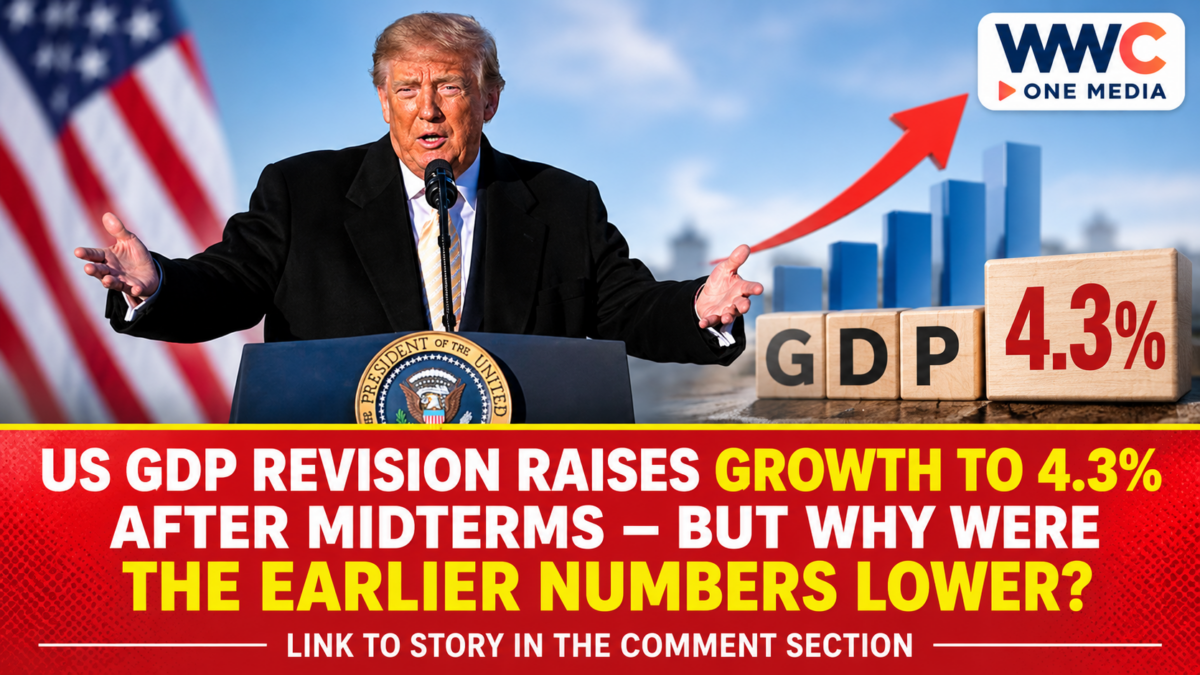
WASHINGTON, UNITED STATES — The American economy expanded faster than initially estimated during the third quarter of 2026, with updated government figures raising annualised economic growth from 3.4% to 4.3% on Nov. 25.
The US GDP revision has placed federal economic statistics under renewed political scrutiny following the November midterm elections.
However, government records reveal that the revised release had been scheduled before the elections and that updated information concerning business investment and household spending contributed to the higher growth estimate.
For businesses, investors and policymakers, the controversy highlights a fundamental question about economic statistics: does a substantial revision indicate that an earlier estimate was inaccurate by design, or simply that more comprehensive information has become available?
US GDP Revision Reveals Stronger Economic Expansion
The initial estimate released on Oct. 29 placed third-quarter real gross domestic product growth at an annualised rate of 3.4%.
The second estimate, published on Nov. 25, raised that figure to 4.3%, representing an upward adjustment of 0.9 percentage point.
The revised estimate also indicates stronger economic expansion compared with the second quarter, when real GDP increased at an annualised rate of 2.2%.
On a non-annualised quarterly basis, the latest estimate puts third-quarter growth at 1.1%, compared with the original quarterly estimate of 0.8%.
The difference between quarterly and annualised growth is important when comparing American economic performance with other countries. The 4.3% figure does not mean the economy expanded by that amount within three months.
The statistical revision has also become the subject of political controversy, previously examined in WWC ONE MEDIA’s coverage of the dispute surrounding US GDP figures.
The published economic records do not establish that the earlier figures were deliberately manipulated.
What Drove the Higher GDP Estimate?
Updated investment and consumer spending calculations accounted for most of the upward adjustment.
The investment revision was particularly influenced by intellectual property products, including software.
Meanwhile, updated estimates of household purchases indicated stronger spending on several categories of goods, including pharmaceutical products, recreational goods and energy-related products.
Not every component was revised upwards. Updated information also resulted in lower estimates for healthcare-related spending.
These changes demonstrate how newly available business surveys, pricing information and industry statistics can alter the measurement of economic activity after a quarter has ended.
The revised figures suggest that the private domestic economy performed more strongly than the initial estimate indicated.
For companies assessing American demand, the composition of that growth may be just as important as the headline GDP figure.
Domestic Demand Strengthens, but Inflation Remains Relevant
Real final sales to private domestic purchasers increased at an annualised rate of 5.8% during the third quarter, compared with the initial estimate of 4.9%.
This measure focuses on household consumption and private fixed investment, providing additional insight into underlying domestic demand.
The latest figures also show a downward adjustment in the gross domestic purchases price index, from 3.0% to 2.7%.
However, quarterly annualised inflation measured through the personal consumption expenditures price index remained unchanged at 2.1%.
The corresponding measure excluding food and energy remained at 2.5%.
Stronger economic growth does not automatically establish that households are experiencing lower living costs. Economic output and consumer prices measure different aspects of financial conditions.
The distinction remains particularly important as Washington considers additional trade measures, including new US tariff proposals targeting 14 economies.
For businesses, assessing domestic demand alongside pricing pressures provides a more comprehensive picture than relying on GDP growth alone.
Corporate Profits Increase by US$206 Billion
The November economic release also provided an updated assessment of corporate profitability.
Profits from current production increased by US$206 billion in the third quarter, following an increase of US$384 billion during the preceding quarter.
Although corporate profits continued to rise, the dollar increase was smaller than in the second quarter.
These figures reflect national accounting measures of corporate earnings rather than the combined headline earnings reported by publicly listed companies.
The distinction matters because economic growth and corporate profitability do not necessarily increase at the same pace.
Individual businesses may experience different outcomes depending on operating expenses, financing conditions, customer demand and exposure to international trade.
Why GDP Estimates Change After Publication
The United States publishes quarterly GDP estimates in three principal stages.
The advance estimate provides an early assessment using information available shortly after the quarter ends.
The second estimate incorporates more complete economic information, while the third estimate provides another opportunity to improve the measurement.
The October 29 release explicitly identified November 25 as the scheduled publication date for the second estimate.
Consequently, the timing of the November release followed the previously announced timetable.
Historical data covering 1996 through 2025 show an average absolute adjustment of 0.5 percentage point between advance and second GDP estimates.
The latest 0.9-percentage-point revision exceeds that historical average, but its size alone does not demonstrate intentional misconduct.
Establishing deliberate manipulation would require separate evidence concerning the preparation, handling or publication of the underlying statistics.
Why the US GDP Revision Matters Across APEC Economies
American economic performance is relevant to companies operating across international production networks and export markets.
Stronger domestic consumption and investment may support demand for certain imported goods and services, although the effect will vary by industry.
Trade policy remains a separate consideration. Exporters must assess actual market access conditions rather than assuming that stronger American growth will automatically result in higher sales.
These uncertainties are especially relevant amid Washington’s latest tariff proposals and their implications for Asian trade agreements.
For multinational businesses, economic growth projections must therefore be assessed alongside trade requirements, operating costs and financing conditions.
What Happens Next?
The third estimate of US third-quarter GDP is scheduled for release at 8:30 a.m. Eastern Standard Time on Dec. 23, 2026.
The forthcoming publication will include updated corporate profit statistics, industry-level GDP figures and state economic data.
The 4.3% estimate is therefore the latest available assessment, not an irreversible final figure.
For businesses and policymakers, the next release will provide another opportunity to assess whether the stronger growth estimate is maintained.
The controversy underscores the importance of transparent statistical methods and evidence-based scrutiny, particularly when economic figures become politically consequential.
Frequently Asked Questions
What is the latest US GDP growth figure?
The second estimate puts third-quarter 2026 real GDP growth at an annualised rate of 4.3%, up from the original estimate of 3.4%.
Why was US GDP revised upwards?
The adjustment primarily reflects updated calculations of private investment and consumer spending.
Does the revision prove that earlier GDP figures were deliberately falsified?
No. The revision alone does not establish manipulation. Additional evidence would be required to substantiate such an allegation.
How large was the US GDP revision?
The annualised growth estimate increased by 0.9 percentage point.
When will the next US GDP estimate be released?
The third estimate is scheduled for Dec. 23, 2026, at 8:30 a.m. EST.