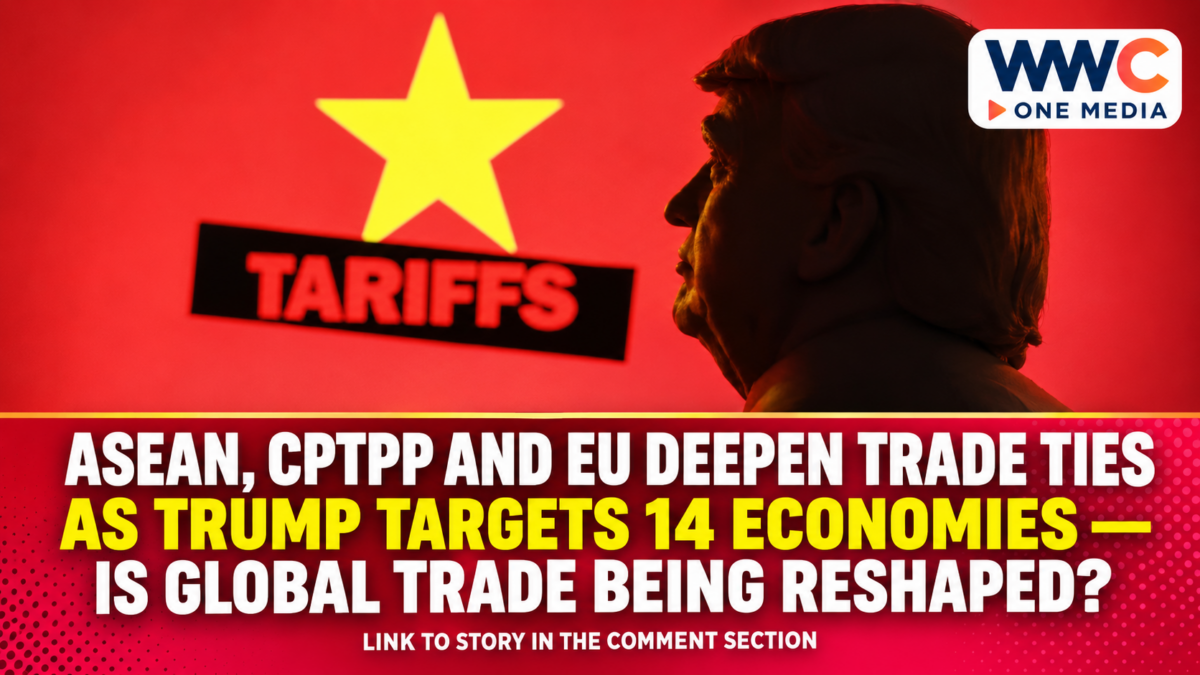
HANOI, VIETNAM — November 27, 2026 — Southeast Asian economies, members of the Comprehensive and Progressive Agreement for Trans-Pacific Partnership (CPTPP), and the European Union (EU) are advancing closer economic cooperation as the United States proposes new tariffs affecting 14 trading partners.
Two ministerial trade and investment dialogues held in Hanoi on Nov. 26 established further initiatives covering supply chain security, digital commerce, customs procedures and international trade cooperation.
The meetings came a day after US President Donald Trump’s administration announced proposed tariff measures following investigations into industrial overcapacity and manufacturing practices.
While Washington is considering additional trade restrictions, its trading partners are working to strengthen commercial connections and reduce vulnerabilities across international supply networks.
ASEAN, CPTPP and EU advance economic cooperation
The Hanoi meetings marked the second round of formal trade and investment dialogues between the CPTPP and ASEAN, and between the CPTPP and the European Union.
The discussions build on the inaugural dialogues held in Melbourne in November 2025.
Participating economies reaffirmed their commitment to predictable international trade, stronger commercial integration and cooperation within the World Trade Organization (WTO).
The latest developments also complement broader efforts to deepen ASEAN economic integration and regional business connectivity.
However, the Hanoi meetings did not establish a single free trade agreement encompassing all three economic groups.
Instead, ministers are pursuing practical measures that could improve commercial relationships without requiring an immediate comprehensive trade treaty.
Trump’s tariff proposals target 14 economies
On Nov. 25, Washington announced the results of 14 investigations conducted under Section 301 of the US Trade Act of 1974.
The Trump administration maintains that certain foreign industrial policies and manufacturing practices create excess production capacity and restrict opportunities for American businesses.
The proposed measures include tariffs affecting China, the European Union, Singapore, Switzerland, Indonesia, Malaysia, Cambodia, Thailand, South Korea, Vietnam, Taiwan, Bangladesh, Japan and India.
Vietnam faces proposed tariffs of up to 35%, although Washington is considering adjustments linked to existing duties and a potential reciprocal trade agreement.
Singapore faces a proposed rate of up to 20%, with a possible adjustment to 10% subject to qualifying trade commitments or negotiations.
For the European Union, Washington has proposed a 15% rate, accounting for specified existing duties and product exemptions.
The announcements come amid broader international disagreements over Trump’s tariff policies involving China, Brazil and Europe.
The proposed measures remain subject to consultation. They do not automatically represent additional duties payable on every shipment entering the United States.
Europe and Pacific economies establish supply chain warning network
One of the most significant outcomes of the Hanoi meetings is the establishment of the CPTPP–EU Supply Chain Early Warning Network.
The initiative will facilitate communication between participating economies when emerging disruptions threaten international supply chains.
Its first meeting is scheduled for early 2027, when officials are expected to discuss operational arrangements.
Participation will be voluntary, and the mechanism will not impose legally binding obligations.
For internationally connected manufacturers, the initiative could eventually improve access to information about disruptions affecting raw materials, intermediate components and finished products.
Earlier technical discussions involving ASEAN, the CPTPP and the EU were held in Tokyo in July 2026, laying additional groundwork for cross-regional cooperation.
Southeast Asia strengthens its international trade connections
ASEAN’s discussions with the CPTPP also focused on improving digital commerce, strengthening customs cooperation and expanding business participation in international markets.
Officials are exploring opportunities to improve the use of existing preferential trade agreements and address practices that circumvent customs duties.
These efforts come alongside developments in ASEAN–China free trade cooperation, highlighting Southeast Asia’s continuing engagement with multiple economic partners.
The Hanoi dialogue also recognised the significance of ASEAN’s Digital Economy Framework Agreement in advancing regional digital integration.
Greater compatibility between digital trading systems could help businesses manage cross-border transactions more efficiently, particularly when operating across multiple jurisdictions.
For smaller enterprises, the potential benefits include improved access to overseas customers and fewer administrative obstacles.
Australia reinforces regional economic engagement
Australian Trade and Tourism Minister Don Farrell announced his visit to Vietnam on Nov. 26 to participate in the 11th CPTPP Commission Meeting and strengthen Australia’s regional economic relationships.
Australia and Vietnam recorded A$30 billion in two-way trade in 2025, more than double their trade value in 2020.
Australian food exports to Vietnam were valued at approximately A$1.1 billion.
The visit forms part of Australia’s broader economic engagement with Southeast Asia under its economic strategy extending to 2040.
Elsewhere in the Asia-Pacific, initiatives such as the Philippines–Chile trade agreement opening new commercial connections with Latin America illustrate the wider pursuit of diversified economic partnerships.
What happens next?
Written submissions concerning Washington’s latest tariff proposals are due on Jan. 5, 2027. Public hearings are scheduled to begin on Jan. 25.
Meanwhile, CPTPP and EU officials are expected to advance their digital trade cooperation, including a joint report scheduled for delivery during the first half of 2027.
Further ASEAN–CPTPP and EU–CPTPP ministerial dialogues are also planned for 2027.
The coming months will determine how far these initiatives move from diplomatic commitments towards measurable improvements in international commerce.
For businesses across APEC economies, the immediate challenge remains navigating uncertain US tariff policies while assessing emerging opportunities in other international markets.
Closer cooperation does not eliminate existing commercial risks. However, it could provide participating economies with additional options for managing disruptions, expanding market access and strengthening economic resilience.
The Hanoi meetings represent another step towards a more interconnected trading environment, even as disagreements over tariffs and industrial policies continue.