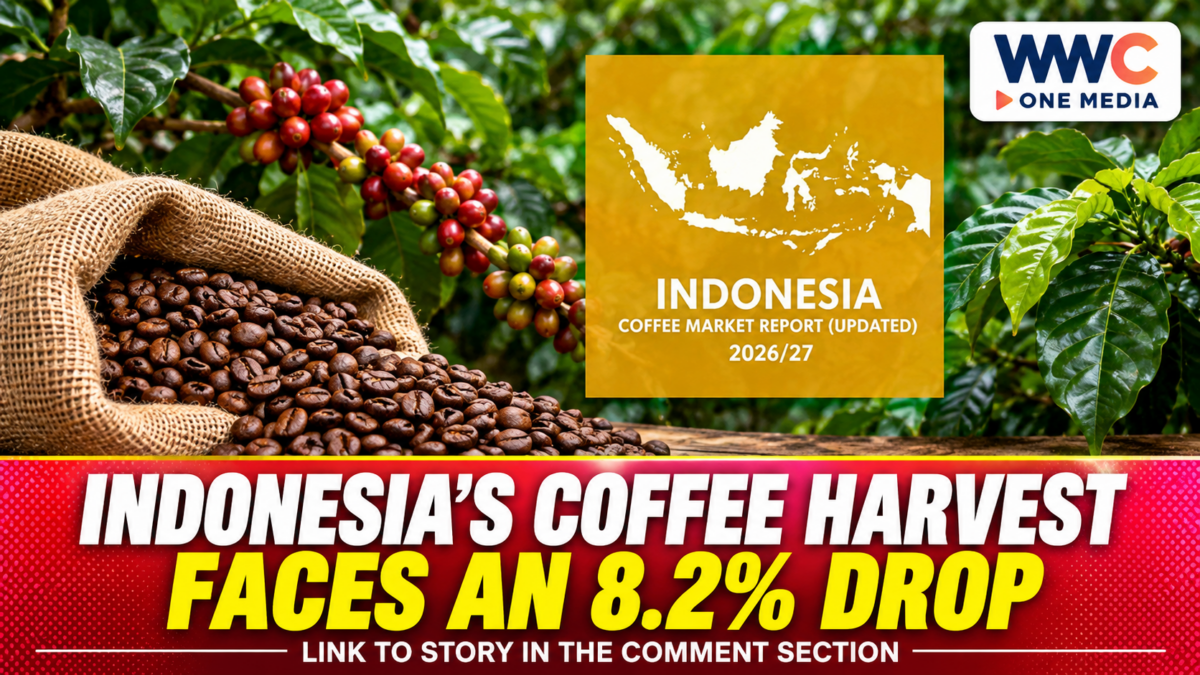
JAKARTA, Indonesia — Indonesia’s coffee industry is heading into a weaker 2026/27 marketing year, with production forecast to fall 8.2% to 11.35 million 60-kilogram bags as excessive rainfall, flooding and warmer, drier conditions disrupt growing regions.
The revised outlook raises concerns for exporters, coffee processors and international buyers that depend on Indonesian beans, particularly Robusta and specialty Arabica.
The latest assessment by the US Department of Agriculture’s Foreign Agricultural Service (USDA-FAS), published on Nov. 17, puts Indonesia’s expected production at approximately 681,000 metric tonnes of green coffee. The forecast is lower than the previous marketing year’s estimated 12.37 million bags.
The decline is not being driven by one weather event. Different producing regions have experienced different problems, from excessive rainfall during flowering to lingering damage from floods and less favourable weather during crop development.
Yet there is another important detail: Indonesia’s export forecast has been revised upward from an earlier estimate, even though shipments are still expected to decline year over year.
For the international coffee trade, that creates a complicated picture. Indonesia may have less coffee available overall, but the consequences will depend on domestic demand, exportable stocks and the availability of beans from competing origins.
Weather Disrupts Robusta and Arabica Production
Indonesia produces two major commercial coffee varieties: Robusta and Arabica.
Robusta is widely used in instant coffee, commercial blends and espresso products. Arabica is particularly important to specialty coffee markets, where origin, processing and flavour characteristics influence buyer demand.
The two varieties are concentrated in different growing areas and face different production challenges.
In southern Sumatra, excessive rainfall disrupted the flowering and fruit-development stages of Robusta crops. Heavy rain during these periods can interfere with pollination and fruit formation, reducing the number of coffee cherries that eventually mature.
The earlier USDA assessment identified southern Sumatra and parts of Java as important areas affected by excessive rainfall.
Arabica production has faced another set of problems. Flooding in November 2025 affected highland coffee-growing regions in Aceh and North Sumatra, damaging infrastructure and disrupting transport.
The effects extended beyond the farms themselves. Damaged roads, bridges, processing facilities and warehouses complicated the movement of harvested coffee.
The USDA’s earlier assessment noted that logistical recovery remained incomplete in April 2026, with transport costs elevated in affected areas.
The latest semi-annual assessment further lowered the Arabica outlook, citing continuing logistical recovery in key highland regions and warmer, drier conditions during mid-2026 that reduced crop yields.
Why Sumatra Matters to Indonesia’s Coffee Industry
Sumatra is central to Indonesia’s coffee supply.
The USDA’s May 2026 assessment estimated that the island accounted for approximately 60% of Indonesia’s total coffee-growing area.
Southern Sumatra is particularly important for Robusta. Lampung, South Sumatra and Bengkulu form the country’s largest Robusta-producing belt.
Northern Sumatra, especially Aceh and North Sumatra, is a major Arabica-producing region.
This geographic concentration means that weather disruptions in Sumatra can have consequences for national production and export availability.
The industry’s structure adds another layer of vulnerability. Smallholders account for approximately 98% of Indonesia’s total coffee-growing area, with many typically operating farms of only one to two hectares.
For these producers, a poor flowering season or damaged transport infrastructure can have consequences beyond a smaller harvest. It can also affect the ability to deliver beans on time, access buyers and recover production costs.
The scale of smallholder participation makes agricultural support, farm rehabilitation, better planting materials and reliable transport infrastructure important to the industry’s longer-term resilience.
Exports Are Still Expected to Decline
Indonesia’s lower production forecast has implications for international trade.
The latest USDA-FAS assessment projects green coffee exports at 7.3 million bags in 2026/27, approximately 7% below the previous marketing year’s estimated shipments.
However, this is an upward revision from the earlier export forecast of 7 million bags.
That difference is important. It shows that a weaker production outlook does not necessarily translate into an equally large downward revision in exports. Export availability also depends on stocks, domestic consumption, imports and the amount of coffee retained by producers and traders.
The United States remains an important destination for Indonesian Arabica. European buyers and other Asian markets also form part of the country’s international trading network.
For exporters, the challenge is balancing available supply with customer commitments. A smaller harvest can make quality consistency, delivery schedules and long-term purchasing arrangements more difficult to manage.
WWC ONE MEDIA has examined how Vietnamese farmers are changing their crop choices as coffee competes with more profitable agricultural opportunities. Indonesia faces a different problem, but both cases highlight the economic pressures affecting coffee-growing communities across Southeast Asia.
Will the Production Decline Push Coffee Prices Higher?
A smaller Indonesian harvest could tighten supplies of particular origins and grades, especially where buyers depend on Indonesian Robusta or specialty Arabica.
But it would be premature to conclude that global coffee prices must rise.
The USDA’s July 2026 global coffee outlook forecast world production at a record 189.7 million bags for 2026/27. Higher output in Brazil, Vietnam, Ethiopia and Uganda was expected to more than compensate for production losses in Indonesia and India.
Vietnam’s production was forecast to reach a record 32.5 million bags, while Brazil’s combined Arabica and Robusta output was projected at 71.9 million bags.
The International Coffee Organization’s October 2026 market report also showed that global coffee-price movements were not uniform. Its Composite Indicator Price averaged 261.26 US cents per pound, down 0.3% from September. Arabica indicators increased, while the Robusta indicator declined by 2%.
These figures demonstrate why origin-specific shortages do not automatically translate into a broad market rally.
Coffee prices are influenced by production in major origins, inventories, currency movements, shipping costs, demand and expectations about future harvests.
Indonesia’s production decline may therefore affect particular suppliers and purchasing contracts more directly than the entire global coffee market.
Domestic Demand Adds Another Supply Consideration
Indonesia is not only a major coffee producer and exporter. It is also an important domestic consumer.
Local roasters, processors and cafés require dependable access to beans, including higher-quality Arabica varieties.
When exportable supplies tighten, domestic buyers may face stronger competition for available coffee. Import requirements can also change as processors seek varieties or quality grades that local production cannot adequately provide.
This creates a balancing act for the industry: maintaining export commitments while ensuring that domestic businesses can secure sufficient raw materials.
The broader regional coffee market is also changing. WWC has reported on the expansion of coffee development programmes in Mindanao, where improving productivity and supporting smallholder farmers are important goals.
The challenges are not confined to production volumes. Farmers need suitable planting materials, technical assistance, post-harvest facilities and access to reliable buyers.
WWC’s coverage of Thailand’s agricultural preparations for El Niño also highlights the wider risks that changing rainfall patterns can create for crop production across Southeast Asia.
What Happens Next?
Indonesia’s coffee outlook will depend on how producing regions recover and how weather conditions develop during the next stages of the crop cycle.
The country’s exporters will also need to manage the difference between available production and actual exportable supplies.
The USDA’s latest forecast points to a smaller harvest, but the upward revision to export expectations shows that the trade picture is more complicated than the production headline alone suggests.
For international buyers, the immediate concern is securing reliable supply and maintaining quality consistency. For Indonesian farmers, the longer-term challenge is recovering productive capacity while reducing exposure to weather disruptions.
Coffee-growing regions also need infrastructure that can withstand flooding and maintain access to farms during difficult seasons. In highland areas, damaged roads and processing facilities can continue affecting trade even after the immediate weather event has passed.
The wider specialty-coffee market will continue to depend on how producing countries manage quality, sustainability and reliable delivery. WWC’s feature on Chiang Mai’s mountain coffee communities illustrates another side of that market: the value of origin, local production and distinctive coffee experiences.
Indonesia’s smaller harvest may not be enough to push the entire global market higher, but it raises a more immediate question for coffee buyers: how much dependable Indonesian supply will remain available when the next round of contracts is negotiated?