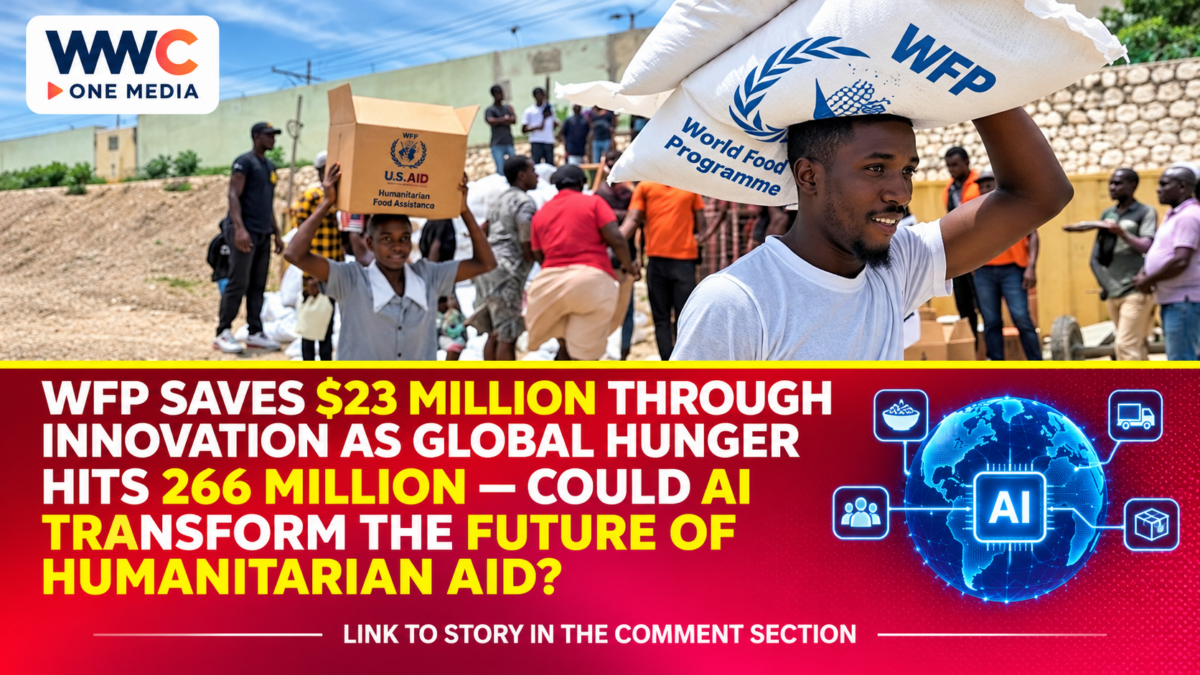
The United Nations World Food Programme (WFP) is accelerating the use of artificial intelligence, blockchain technology and digital financial systems to improve humanitarian assistance as funding constraints threaten global efforts to combat hunger.
The WFP innovation strategy builds on technological initiatives that generated US$23 million in savings for the organisation in 2025, while supported innovations reached 132.5 million people across 75 countries.
The push comes at a critical moment for the international humanitarian community.
An estimated 266 million people worldwide face acute hunger, while WFP requires US$12.1 billion to assist 91 million people in 2027.
With humanitarian needs competing for limited financial resources, the organisation is increasingly focusing on reducing operational expenses, improving aid delivery and expanding technologies that have demonstrated measurable results.
WFP Innovation Strategy Puts Technology at the Centre of Humanitarian Aid
The WFP Innovation Strategy 2026–2028 establishes a framework for integrating technological and operational improvements throughout the organisation.
Rather than concentrating exclusively on developing new technologies, the strategy prioritises expanding proven solutions, empowering country-level operations, strengthening partnerships and securing sustainable financing.
The WFP Innovation Accelerator provided financial and implementation assistance to 85 innovations in 2025.
These initiatives generated US$301.8 million in reported savings across the broader humanitarian and development ecosystem, in addition to the US$23 million reported for WFP itself.
Since 2015, innovations supported by the programme have also helped mobilise US$383.3 million in additional resources.
The figures highlight the growing importance of operational efficiency in international food assistance, particularly as governments confront competing spending priorities.
Similar concerns about strengthening food systems and translating policy commitments into practical programmes have emerged in ASEAN’s regional food and energy security initiatives.
Artificial Intelligence Is Reshaping Humanitarian Supply Chains
One of the technologies being deployed by WFP is SCOUT, an artificial intelligence-enabled tool designed to improve supply-chain planning.
The system supports decisions involving food procurement, storage, transportation and delivery.
For humanitarian organisations, these decisions can determine how effectively limited financial resources are converted into assistance for vulnerable communities.
Purchasing food at a competitive price is only one component of the process. Transportation requirements, delivery schedules, warehouse capacity and changing operational conditions must also be considered.
AI-assisted planning can help humanitarian teams evaluate these interconnected factors before making procurement and distribution decisions.
WFP has also established a Global Artificial Intelligence Strategy covering 2025–2027, providing an organisational framework for integrating AI and machine learning into its operations.
However, the adoption of advanced technology also increases the importance of protecting digital infrastructure.
The challenges surrounding cybersecurity risks in the United States food supply system illustrate the broader relevance of maintaining secure and dependable digital systems throughout food distribution networks.
Blockchain Helps Humanitarian Organisations Coordinate Assistance
WFP is also using blockchain technology through its Building Blocks platform.
The system allows humanitarian organisations to coordinate different forms of assistance through shared digital infrastructure.
Building Blocks has been deployed in humanitarian operations involving refugees in Jordan and Bangladesh, as well as communities affected by conflict in Ukraine.
Since 2022, the platform has helped prevent US$324 million in unintended overlapping assistance and coordinated support for 6.3 million households.
In 2025, 159 organisations used the platform across Palestine, Syria and Ukraine.
Unlike speculative cryptocurrency applications, the humanitarian blockchain system focuses on coordinating assistance and improving the allocation of resources.
Its purpose is to help participating organisations identify unintended overlaps in assistance without unnecessarily exposing beneficiaries’ personal information.
The distinction is important because preventing unintended duplication does not necessarily mean reducing the amount of support available to a household. It can instead enable organisations to distribute resources more effectively.
Emergency Cash Assistance Within 72 Hours
Another initiative involves the Rescue Card, a reloadable prepaid payment solution designed to accelerate emergency cash assistance.
The system enables WFP to deliver financial support within 72 hours, including to beneficiaries who lack access to conventional bank accounts.
During 2025, the initiative reached more than 88,000 people across five countries.
WFP recorded operational savings ranging from 70% to 85% during the first three months of an emergency through the initiative.
These figures apply to the programme’s operational performance and should not be interpreted as an organisation-wide reduction in humanitarian spending.
Digital financial systems can provide an alternative delivery mechanism when traditional banking arrangements are difficult to establish following emergencies.
The effectiveness of these systems, however, still depends on practical conditions, including access to merchants, reliable payment infrastructure and the availability of essential goods.
WFP is also digitising school meal monitoring through its School Connect platform, which helps participating institutions monitor food deliveries, inventory and meal consumption.
The initiative generated US$2 million in savings during 2025.
Global Hunger and Climate Risks Increase Pressure on Humanitarian Budgets
Technology is only one part of WFP’s response to growing humanitarian challenges.
Conflict, economic disruption and extreme weather remain major contributors to acute food insecurity.
In July 2026, WFP introduced its Global Anticipatory Action Strategy 2026–2029, which emphasises preparing for predictable hazards before they develop into humanitarian emergencies.
The approach seeks to protect vulnerable communities and their livelihoods through earlier interventions.
On Nov. 12, 2026, the United Nations also launched a Disaster Risk Financing Platform at the COP31 climate conference to improve access to financing ahead of foreseeable disasters.
WFP reported that it had helped secure nearly US$211 million in pre-arranged financing to protect up to 9.6 million people across more than 50 countries in 2026.
For agriculture-dependent communities, timely assistance can be particularly important in protecting productive assets and supporting food availability.
The importance of delivering agricultural support effectively has also featured in wider regional discussions, including the implementation challenges surrounding Cebu City’s farmer assistance programme.
What Happens Next for the World Food Programme?
WFP’s Digital Business Transformation Plan is expected to generate savings of up to US$259 million over five years.
The projected savings represent a potential opportunity to improve the allocation of humanitarian resources, rather than money that has already been realised.
The organisation’s innovation programme must therefore continue demonstrating that its technologies deliver measurable improvements under different operational conditions.
For governments, development organisations and technology companies across APEC economies, humanitarian innovation represents an emerging area of cooperation involving logistics, financial inclusion, disaster preparedness and responsible artificial intelligence.
Nevertheless, technological efficiency cannot eliminate the need for adequate humanitarian funding.
With WFP seeking US$12.1 billion for its 2027 operations, the central challenge remains whether technological improvements and sustained international financial commitments can work together to reach communities facing severe food insecurity.
Innovation can make humanitarian assistance more efficient. Whether it can help close the wider funding gap remains a much larger question.
Frequently Asked Questions
How much money did WFP save through innovation?
WFP reported US$23 million in innovation-related savings during 2025.
How does WFP use artificial intelligence?
WFP uses AI-enabled tools such as SCOUT to improve food procurement, storage, transportation and humanitarian supply-chain planning.
How many people face acute hunger worldwide?
WFP’s November 2026 global outlook identified 266 million people facing acute hunger.
How much funding does WFP need in 2027?
WFP requires US$12.1 billion to provide assistance to 91 million people in 2027.
Can technology replace humanitarian funding?
No. Technology can improve operational efficiency and reduce costs, but humanitarian organisations still require adequate financing to purchase food, maintain operations and deliver essential assistance.