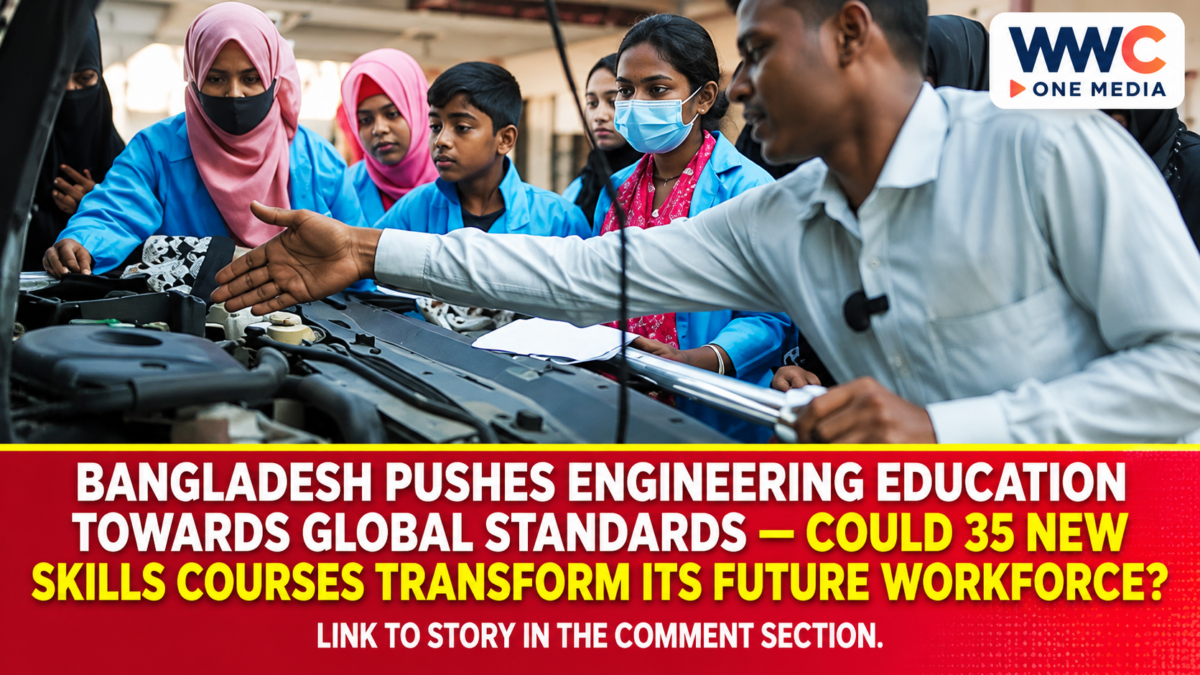
DHAKA, BANGLADESH — Bangladesh is advancing its efforts to strengthen engineering education and develop a technology-ready workforce, with the Military Institute of Science and Technology (MIST) pursuing 35 skills development courses alongside initiatives expected to increase its academic capacity by approximately 27%.
Education and Primary and Mass Education Minister Dr. A N M Ehsanul Hoque Milon highlighted the importance of producing graduates equipped with scientific expertise, technological knowledge and professional responsibility during institutional events held on November 25, 2026.
The developments place practical skills, research capabilities and educational quality at the centre of Bangladesh’s efforts to prepare students for increasingly sophisticated industries.
For international education markets, the initiative raises an important question: Can Bangladesh develop an engineering education ecosystem capable of competing internationally while meeting domestic workforce requirements?
Bangladesh engineering education enters a new phase
The developments were highlighted during the 23rd Council Meeting of MIST at its campus in Mirpur Cantonment, Dhaka.
Milon, who also chairs the MIST Council, participated in the institution’s policy discussions and subsequent graduation ceremony.
The council examined several areas of institutional development, including academic performance, research quality, infrastructure, administration and future educational priorities.
The meeting also addressed measures intended to strengthen higher education and technological instruction.
The direction reflects an approach that considers educational quality and professional competence alongside the expansion of academic opportunities.
For engineering institutions, producing qualified graduates requires more than increasing enrolment. Academic programmes must also provide opportunities to apply scientific principles to practical problems.
The relationship between education and emerging industries is increasingly important, particularly in discussions surrounding South Korea’s semiconductor industry and changing engineering career choices.
MIST pursues 35 skills development courses
One of the most significant developments is MIST’s initiative to introduce 35 additional skills development courses across various subject areas.
The courses are intended to strengthen practical competencies and improve students’ preparation for professional employment.
Rather than treating academic qualifications as the sole indicator of readiness, the initiative places additional emphasis on knowledge that can be applied in industrial and professional environments.
The specific benefits will depend on curriculum design, instructor expertise, access to equipment and the extent to which training reflects actual workplace requirements.
Industry-oriented education could also create opportunities for collaboration between universities and commercial organisations.
Internships, applied research and professional mentorship are among the approaches that institutions can consider when connecting academic instruction with employment requirements.
Similar educational questions are explored in regional initiatives connecting university students with practical digital career opportunities.
However, the November 25 government announcement did not provide a complete list of the 35 courses, their individual fees or implementation schedules.
Academic capacity could increase by approximately 27%
MIST is also pursuing changes to its academic admission arrangements.
Beginning with the next academic session, the institution intends to accommodate a new group of students who completed their Higher Secondary Certificate examinations in 2026, alongside its existing four student batches.
The arrangement is intended to shorten the waiting period between admission examinations and the start of university-level instruction.
It also aims to improve alignment between secondary and tertiary academic schedules.
Together, the initiatives are expected to expand the institution’s academic capacity by approximately 27%.
The figure represents an institutional projection rather than an increase that has already been achieved.
Managing additional academic capacity will require careful consideration of teaching resources, laboratory availability and student support.
Expansion must ultimately be accompanied by mechanisms that maintain educational quality as more students enter the institution.
More than 3,600 graduates demonstrate MIST’s educational reach
The institution’s 19th graduation ceremony recognised students who completed their degrees between 2020 and 2025.
The graduating population consisted of:
- 2,718 civilian students
- 943 military students
- Seven international students
The combined total reached 3,668 graduates.
The figures demonstrate that MIST’s educational activities extend beyond military personnel and include substantial civilian participation.
During the ceremony, Milon distributed academic awards and certificates while encouraging graduates to contribute their scientific knowledge and professional capabilities to national development.
A newly constructed sports complex was also inaugurated during the day’s activities, expanding the institution’s facilities for physical development and extracurricular participation.
Robotics, engineering research and technological competitiveness
MIST already operates academic and research facilities that provide a foundation for further engineering education development.
Its Department of Mechanical Engineering, established in January 2003, offers undergraduate and postgraduate qualifications, including doctoral-level studies.
The department maintains 12 laboratories supporting practical instruction in areas such as robotics, automotive engineering, computer-aided design, materials testing and thermal engineering.
Its testing facilities also support practical engineering services, including hydraulic pump assessments and vehicle performance evaluation.
These existing capabilities illustrate how universities can combine academic instruction with technical services and applied research.
For Bangladesh, expanding these connections could help engineering graduates develop competencies relevant to domestic industries.
The relationship between technological advancement and workforce preparation also features in broader regional discussions about artificial intelligence, skills development and changing employment requirements.
The challenge is ensuring that technological education produces measurable professional competencies rather than simply introducing new academic subjects.
Bangladesh’s international higher education ambitions
The latest developments build upon earlier initiatives intended to strengthen Bangladesh’s tertiary education sector.
In June 2021, Bangladesh received approval for US$191 million in international development financing under the Higher Education Acceleration and Transformation Project.
The programme was designed to improve educational connectivity, strengthen institutional capabilities and encourage regional academic collaboration.
Its objectives also included supporting women’s access to higher education and creating opportunities for students to participate in cross-border academic programmes.
The initiative provides an existing framework through which Bangladesh can pursue deeper educational cooperation with other countries.
However, the 2021 financing approval is separate from the November 2026 MIST announcement. It should not be interpreted as newly announced funding for the institution’s 35 skills development courses.
What happens next?
The next stage will involve translating MIST’s planned courses and capacity expansion into measurable educational outcomes.
Important developments to monitor include the publication of course curricula, admissions arrangements, laboratory expansion and the availability of qualified instructors.
International recognition will also depend on academic quality, research performance and appropriate professional accreditation.
For students, the most meaningful test will be whether expanded engineering education creates stronger opportunities for employment, further study and professional advancement.
Bangladesh’s educational ambitions are becoming increasingly connected to its technological development. Whether these initiatives can deliver internationally competitive outcomes will depend on their implementation over the coming academic years.
Frequently asked questions
What is Bangladesh doing to improve engineering education?
Bangladesh is pursuing stronger academic quality, research capabilities and practical skills development, including initiatives announced at MIST’s November 25, 2026 council meeting.
How many new skills development courses is MIST planning?
MIST has undertaken initiatives to introduce 35 skills development courses intended to strengthen professional competencies and practical knowledge.
How much could MIST’s academic capacity increase?
The institution expects its initiatives to increase overall academic capacity by approximately 27%.
How many students graduated from MIST between 2020 and 2025?
A total of 3,668 students graduated during that period, comprising 2,718 civilian students, 943 military students and seven international students.
Has Bangladesh already achieved world-class engineering education?
International competitiveness remains an educational objective. Its achievement must be assessed through measurable academic outcomes, research quality and relevant accreditation rather than policy announcements alone.