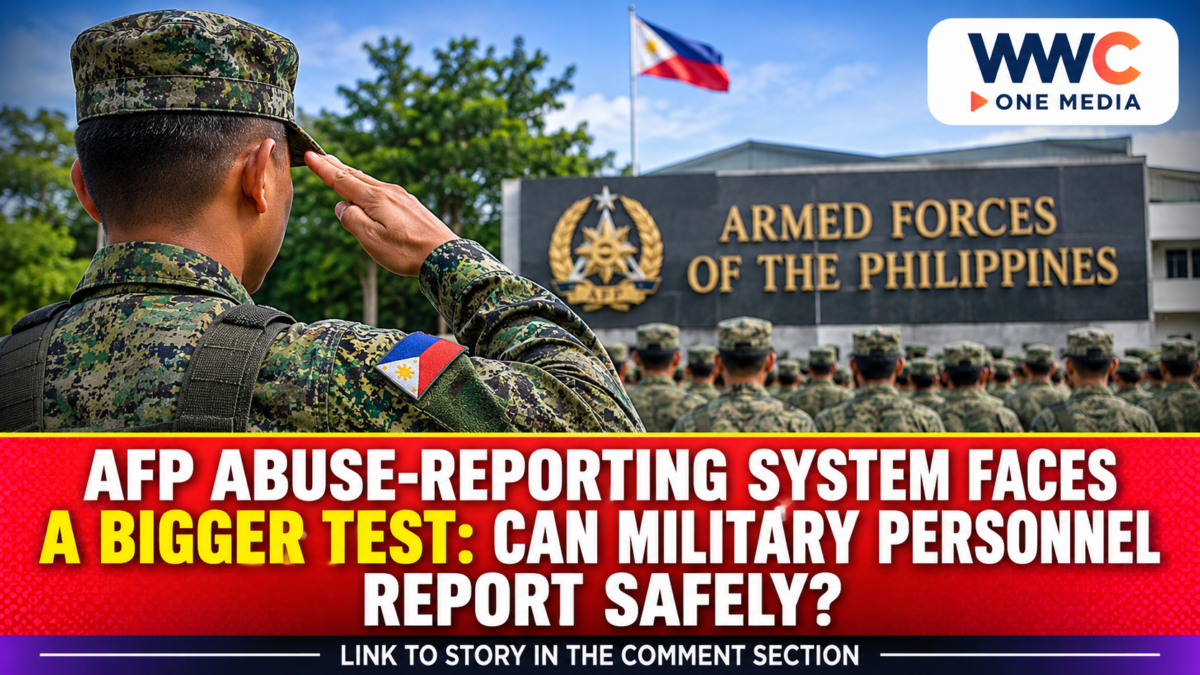
MANILA, Philippines — November 26, 2026 — The Armed Forces of the Philippines has renewed its public commitment to preventing violence against women, while its 2026 Citizen’s Charter sets out procedures for receiving and referring complaints involving sexual harassment, rape and other sex-related offences.
The framework places responsibility on designated military offices to receive complaints, handle records and refer cases to the appropriate authorities. Its effectiveness, however, depends on more than the existence of written procedures: personnel must be able to access them, understand where to seek help and trust that complaints will be handled confidentially and without retaliation.
AFP Chief of Staff General Antonio G. Nafarrete led a military commitment activity against violence against women on November 9. The AFP also conducted a gender and development executive briefing on November 11, focusing on gender mainstreaming and the Women, Peace and Security agenda.
The developments put renewed attention on a practical question for a large uniformed institution: how does a person move from being encouraged to report abuse to having a complaint properly received and acted upon?
AFP abuse reporting: What the military’s own charter provides
The AFP’s 2026 Citizen’s Charter identifies complaint services under the Office of the Ethical Standards and Public Accountability, or OESPA.
Its Investigation and Intelligence Division is assigned responsibilities involving complaints under Republic Act No. 9262, the Anti-Violence Against Women and Their Children Act of 2004, as well as complaints involving rape, sexual harassment and other sex-related offences.
The charter describes a service for receiving and investigating complaints involving sexual offences. It says the process is intended to ensure confidential handling and proper coordination with the appropriate authorities.
For sexual harassment complaints covered by Republic Act No. 11313, or the Safe Spaces Act, the charter identifies the alleged victim as someone who may avail of the service. For rape and other sex-related offences, it also allows a person with personal knowledge of the circumstances to seek assistance.
A separate complaint-referral service is listed for cases that need to be sent to the appropriate office or agency for investigation.
These provisions matter because a reporting system needs a defined entry point. Without an identified receiving office, complainants may face uncertainty about where to submit documents or which unit is responsible for handling the next step.
What happens after a complaint is filed?
The charter outlines a sequence that begins with the submission of a complaint or referral letter. The receiving personnel record the submission, encode the complaint and assign a case number.
The process then includes preparation of a case folder, evaluation of the complaint and supporting documents, preparation of referral documents, approval and dispatch to the concerned office or unit.
For the referral service involving rape, sexual harassment and other sex-related offences, the charter states a total processing time of 10 working days and 20 minutes.
That figure needs to be understood correctly. It describes the listed administrative process for referring a complaint. It does not mean that the underlying investigation, disciplinary proceedings or criminal case must be completed within 10 working days.
The charter also identifies the Investigation and Intelligence Division as the responsible office for the service. This gives complainants and their representatives a clearer institutional reference point than an informal instruction to report misconduct.
Confidentiality and protection against retaliation matter
A formal procedure can still fail if people fear that reporting will expose them to humiliation, career consequences or pressure from colleagues and superiors.
The Safe Spaces Act requires employers and persons with authority in workplaces to take steps to prevent and address gender-based sexual harassment. Its workplace provisions include an independent internal mechanism or committee to investigate complaints, observe due process, protect complainants against retaliation and preserve confidentiality to the greatest extent possible.
The law also recognises that harassment can occur between peers or from a subordinate toward a superior. This is important in institutions with established chains of command: workplace harassment cannot be assessed only through the rank relationship between the people involved.
The AFP’s charter expressly describes confidential handling for the complaint services it lists. But the public document does not, by itself, establish how many complaints were received, how many were resolved, how many resulted in disciplinary action or whether complainants experienced retaliation.
Those are separate measures of performance. Publishing a process is an important administrative step; demonstrating that it works requires transparent, appropriately anonymised reporting on implementation.
Why the issue extends beyond the military
The AFP’s anti-violence commitment is part of a broader national campaign. The annual 18-Day Campaign to End Violence Against Women runs from November 25 to December 12.
The campaign takes place against a continuing protection challenge. The Philippine Statistics Authority’s 2025 National Demographic and Health Survey, as cited by the Department of Social Welfare and Development, found that 15.4 percent of women aged 15 to 49 who had ever had a husband or intimate partner experienced emotional, physical or sexual violence committed by their current or most recent husband or partner.
The figure is not a measure of abuse within the military. It is national context showing why prevention and access to reporting channels remain important across workplaces and communities.
Recent cases involving public personnel have also drawn attention to the importance of proper complaint handling. WWC has examined a Pasay police officer facing a complaint over alleged partner abuse and two Cagayan de Oro police officers placed under investigation over alleged harassment of criminology interns. These are separate cases involving the police, not the AFP, and their allegations should not be treated as findings of guilt.
The reporting challenge is also visible in health facilities. Southern Philippines Medical Center’s reported protection-unit caseload illustrates the demand placed on services that receive and document cases involving women and children. Hospital records and military complaint records measure different things, but both underline the need for functioning referral systems.
What happens next
The next test for the AFP is implementation. The public record already identifies complaint-receiving and referral procedures, the office responsible for those services and the steps involved in processing a submission.
The information that would help the public assess progress includes anonymised complaint totals, the time taken to refer cases, the number of investigations completed, the disposition of administrative proceedings and safeguards against retaliation.
Such reporting must protect complainants’ identities and respect due process for people accused of misconduct. Transparency does not require publishing sensitive personal details; it requires showing whether institutional procedures are being used and whether they lead to appropriate action.
The AFP’s November activities signal that gender equality and protection against violence remain part of its stated institutional agenda. The more consequential measure will be whether personnel can use the complaint system with confidence and whether every properly filed complaint receives the attention required by law and military procedure.
Frequently asked questions
1. Where can an AFP-related sexual harassment complaint be filed?
The AFP’s 2026 Citizen’s Charter identifies the Office of the Ethical Standards and Public Accountability, through its Investigation and Intelligence Division, as responsible for complaint services involving rape, sexual harassment and other sex-related offences.
2. Does the AFP have a formal complaint-referral process?
Yes. Its 2026 Citizen’s Charter describes receiving, recording, evaluating and referring complaints to the appropriate office or agency for investigation.
3. How long does the AFP complaint-referral process take?
The charter lists a total processing time of 10 working days and 20 minutes for the specified referral service. This is not the deadline for completing the underlying investigation or criminal case.
4. Does the Safe Spaces Act apply to workplace harassment?
Yes. Republic Act No. 11313 covers gender-based sexual harassment in workplaces and requires employers and persons of authority to establish mechanisms for handling complaints, observing due process and protecting complainants against retaliation.
5. Does the AFP’s public commitment prove that all complaints are resolved?
No. A public commitment and a published procedure do not establish the number of complaints received or resolved. Those outcomes require separate implementation data.