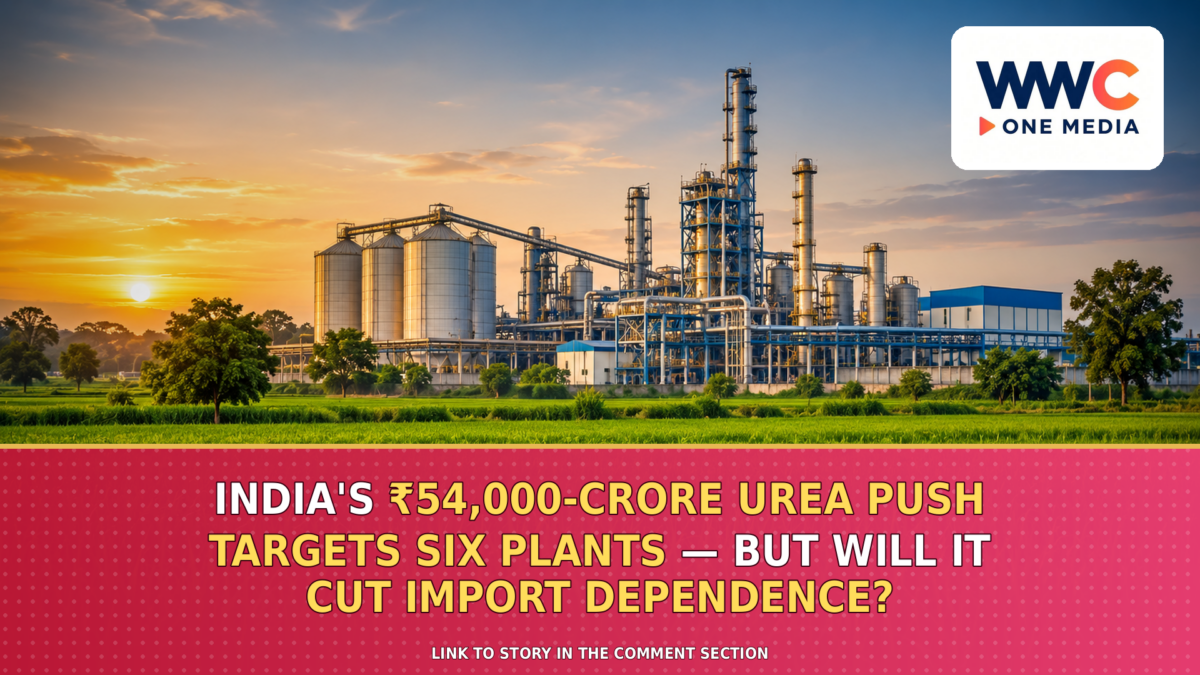
NEW DELHI — India’s Department of Fertilizers has taken forward six brownfield urea manufacturing projects under the National Investment Policy for Urea-2026, with an estimated investment of approximately ₹54,000 crore. The projects, announced on November 25, 2026, cover facilities in Tamil Nadu, Punjab, Uttar Pradesh, West Bengal and Rajasthan.
The programme is designed to modernise older plants and expand domestic manufacturing, as India continues to face a gap between urea demand and locally available production. Its importance goes beyond industrial investment: urea is a major agricultural input, and reliable domestic supply can reduce the country’s exposure to international fertilizer markets.
But the announcement is not the same as six completed factories. The projects still have to move through development, financing, construction and commissioning before their planned capacity can contribute to actual supply.
India urea projects: where the six plants are planned
The six projects involve public-sector, cooperative and private-sector participants.
The government-listed projects are:
- MFL-Madras, Chennai, Tamil Nadu: A public-sector brownfield replacement project with planned annual installed capacity of 12.7 lakh metric tonnes (LMT).
- NFL Nangal, Punjab: A public-sector replacement project, also planned at 12.7 LMT annually.
- KFL-Shahjahanpur, Uttar Pradesh: A cooperative-sector expansion associated with KRIBHCO, with planned annual installed capacity of 12.7 LMT.
- Matix-Panagarh, West Bengal: A private-sector brownfield project with planned annual installed capacity of 12.7 LMT.
- CFCL Gadepan, Rajasthan: A private-sector expansion at the existing complex, with planned annual installed capacity of 12.7 LMT.
- IIPL-Jagdishpur, Uttar Pradesh: A private-sector project proposing a 12.7-LMT annual capacity addition at an established plant.
At the stated capacity, the six projects represent 76.2 LMT of annual installed capacity on a combined project basis. However, two are replacement projects, so that total should not automatically be treated as an equivalent net increase in national production. Replacing an older unit can change efficiency and reliability without adding the full replacement capacity on top of the country’s existing total.
The distinction is important when assessing how much additional fertilizer will actually become available.
Why older fertilizer plants are part of the plan
The government’s announcement identifies the age and operating efficiency of existing facilities as reasons for the programme.
The MFL-Madras unit is described as more than 60 years old. The NFL Nangal project is intended to replace a legacy plant that the government describes as around 50 to 55 years old. Its existing production capacity is listed at 4.73 LMT annually, compared with the proposed modern unit’s 12.7 LMT installed capacity.
The announcement also points to energy consumption at Nangal. The existing facility is listed at 6.498 gigacalories per metric tonne of urea, compared with a weighted industry average of 5.95 and a new energy norm of 5.
Those figures help explain why replacing old equipment can matter even before considering additional output. A plant that consumes more energy per tonne can face higher production costs and greater exposure to changes in fuel and feedstock prices.
Brownfield projects can also use existing industrial land, utilities, logistics connections and technical manpower. That may reduce the need to build an entire industrial site from the beginning, although the actual schedule and cost will depend on each project’s engineering and execution.
The investment policy behind the ₹54,000-crore programme
The six projects are being taken forward under the National Investment Policy for Urea-2026, approved by India’s Cabinet Committee on Economic Affairs on July 15, 2026.
The policy is intended to encourage investment in gas-based urea manufacturing. It changes the framework used to calculate project costs and returns compared with the 2012 investment policy.
The government’s policy announcement identifies three key features: separating fixed and variable costs, introducing a return-on-equity band of 12% to 16%, and addressing foreign-exchange exposure by converting the fixed-cost component into Indian rupees after four years using prevailing exchange rates.
The government estimated that the changes could save more than ₹250 crore for each plant established under the 2026 policy compared with the earlier framework.
For the six brownfield projects, the government uses an estimated capital-cost norm of around ₹9,000 crore per project, producing the combined estimate of approximately ₹54,000 crore.
This is an investment estimate, not confirmation that the full amount has already been spent. The final capital requirement and timing will depend on project-level implementation.
Why India still needs imported urea
The scale of the investment becomes clearer when compared with the country’s fertilizer requirements.
The Department of Fertilizers puts annual urea demand or consumption at around 400 LMT. Domestic production was 293.30 LMT during the 2025–26 financial year, while the government’s reassessed indigenous production capacity stood at 269.42 LMT during 2026–27.
These are different measures and reporting periods: production records actual output over a financial year, while reassessed capacity is a measure of the industry’s recognised production capability. They should not be treated as interchangeable.
The figures nevertheless show why the government is seeking further domestic investment. When local production does not meet demand, imports help fill the supply gap. That leaves the market exposed to international prices, freight costs, currency movements and disruptions in exporting countries.
The fertilizer issue also matters to food production. Farmers need reliable access to inputs at the right time in the crop cycle. WWC has examined how fertilizer supply disruptions can add pressure to Philippine food security, illustrating how input availability can become part of a wider agricultural and food-supply concern.
What the projects could mean for supply and costs
If completed and operated as planned, the projects could strengthen India’s domestic urea manufacturing base through a combination of replacement, modernisation and expansion.
The potential benefits are not limited to the amount of fertilizer produced. More efficient equipment could reduce energy use per tonne, while better-performing plants could support more dependable output. Using existing sites may also help projects make use of established industrial infrastructure.
However, the expected reduction in import dependence will depend on more than the announced capacity. Actual production will be influenced by commissioning dates, plant utilisation, feedstock availability, maintenance, energy costs and demand.
There is also a difference between national supply security and the price paid by individual farmers. More domestic production may reduce exposure to imported supply, but it does not by itself establish how retail prices, subsidies or distribution arrangements will change.
India’s agricultural import strategy is another part of the wider picture. WWC’s report on the Philippines’ reliance on imported palm oil and plans to develop domestic production examines a similar policy challenge: how to build local supply while managing the cost and availability of imported agricultural commodities.
What happens next
The next test is implementation. The six projects must progress from policy approval and project planning to financing, construction, commissioning and sustained operation.
The government has said additional projects may follow under NIPU-2026. It has not, in the announcement reviewed for this report, provided a complete commissioning timetable for all six brownfield projects.
Investors and fertilizer users will therefore need to watch for project-level approvals, construction milestones, capital deployment and operational start dates. Actual production figures will ultimately provide a better measure of the programme’s effect than announced capacity alone.
The ₹54,000-crore plan sets out a substantial direction for India’s urea industry. Whether it meaningfully reduces imports will be determined by how quickly the projects are delivered and how reliably the plants produce fertilizer at competitive operating costs.
Frequently asked questions
How many urea projects has India taken forward under NIPU-2026?
The government announced six brownfield urea projects on November 25, 2026, across Tamil Nadu, Punjab, Uttar Pradesh, West Bengal and Rajasthan.
How much investment is expected for the six urea projects?
The estimated combined investment is approximately ₹54,000 crore, based on a capital-cost norm of around ₹9,000 crore per project.
How much capacity will the six projects have?
Each project is planned at an annual installed capacity of 12.7 LMT, or 76.2 LMT combined on a project-capacity basis. Because some projects replace existing units, this should not be read as an equivalent net addition to national capacity.
Why is India investing in brownfield urea plants?
The projects are intended to replace or modernise older facilities and expand existing industrial sites, making use of available infrastructure, utilities and technical manpower.
Will the projects end India’s urea imports?
Not immediately. The projects must be completed and operated before their output can affect supply. Import dependence will also depend on demand, plant performance, feedstock availability and actual domestic production.