
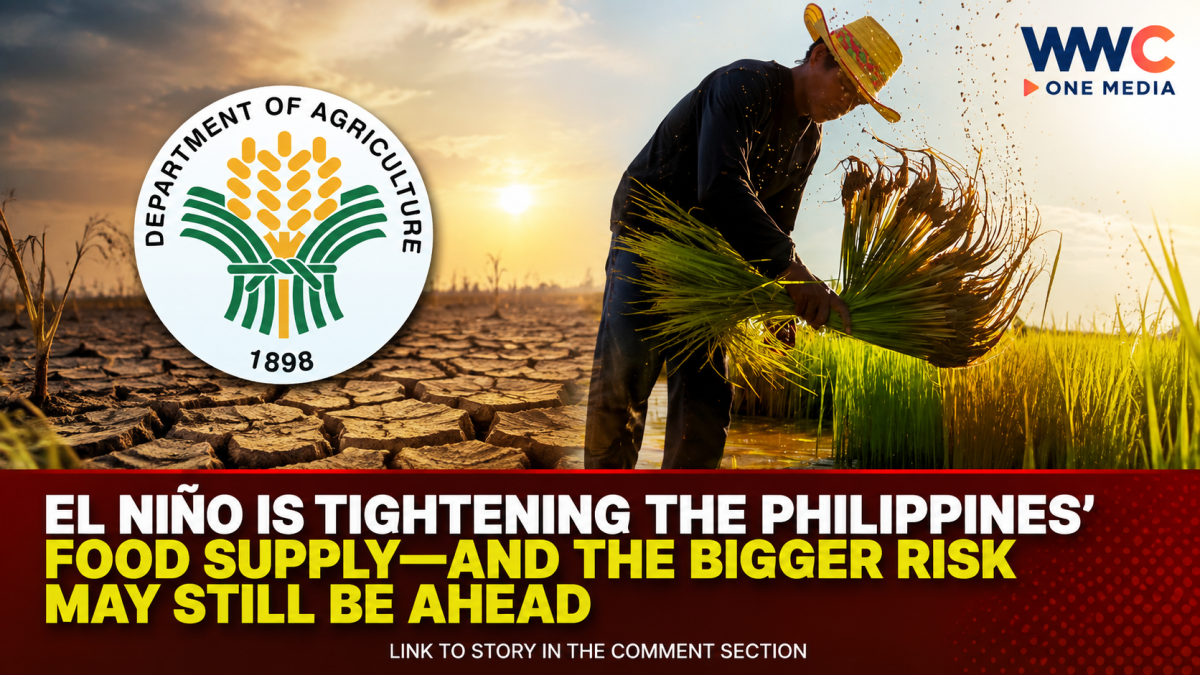
MANILA, Philippines — The Philippines is heading into a potentially tougher food-supply environment as El Niño intensifies, threatening agricultural production, putting upward pressure on food prices and forcing the government to prepare for possible disruptions well into 2027.
The Department of Agriculture (DA) has ordered its agencies to continuously update their El Niño response plans as new weather, water, crop and market data emerge, with the goal of protecting food security while limiting the impact on farmers and consumers.
Agriculture Secretary Francisco Tiu Laurel Jr. said the government is applying lessons from the previous El Niño episode, which ended in 2024, but this time the focus is shifting toward early intervention rather than waiting for production losses to materialize.
The warning comes as the country’s food system faces several pressures at once: declining rainfall in vulnerable agricultural areas, higher production and transport costs, volatile global commodity markets and continued uncertainty over rice supplies.
PAGASA warns El Niño could intensify through 2027
The risk is not simply a seasonal dry spell.
According to the latest available information from the Philippine Atmospheric, Geophysical and Astronomical Services Administration (PAGASA), moderate to strong El Niño conditions are present in the tropical Pacific. Climate models indicate that the phenomenon could persist through the first half of 2027 and may reach very strong levels before the end of 2026.
El Niño generally increases the likelihood of below-normal rainfall across large parts of the Philippines, raising the risk of dry spells and drought.
That does not mean every part of the country will remain dry all the time. PAGASA has emphasized that localized heavy rainfall can still occur, particularly during the Southwest Monsoon and tropical-cyclone events.
But for agriculture, prolonged periods of insufficient rainfall can become particularly damaging when irrigation water is limited.
Rice is at the center of the concern
Rice is one of the biggest pressure points because any significant reduction in domestic palay production can increase the country’s dependence on imports.
There is, however, some breathing room.
Philippine Statistics Authority data show that palay production reached 4.63 million metric tons in the second quarter of 2026, up 5.7% from the same period a year earlier and the highest second-quarter output recorded since comparable records began in 1987.
But the outlook becomes less comfortable when looking ahead.
The PSA’s standing-crop estimate for July to September 2026 points to approximately 3.25 million metric tons of palay, down 13.3% from the actual output during the same period in 2025.
That projected decline highlights why the government is preparing before the full effects of El Niño are felt.
The DA has also decided to keep rice imports open this year rather than suspend them during the harvest season. The agency said maintaining adequate supplies is more important given the expected weather risks toward the end of 2026 and into the early 2027 harvest period.
The government previously projected that a strong El Niño could reduce palay production by hundreds of thousands of metric tons.
Food prices are already under pressure
The threat is not limited to farmers.
The Bangko Sentral ng Pilipinas (BSP) recently projected August headline inflation at 5.5% to 6.5%, with higher prices for rice, vegetables, fruits and fish identified among the factors pushing prices upward.
The projection is above the BSP’s 2% to 4% inflation target.
PSA data also showed that national food inflation stood at 5.3% in July 2026. Cereals and cereal products—including rice and corn—were the largest contributor to food inflation during the month, followed by fish and seafood and vegetables and related products.
This creates a difficult policy problem.
If drought reduces agricultural output, supplies can tighten. If supplies tighten while fuel, fertilizer, transportation and other production costs remain elevated, food prices can face additional pressure.
And if inflation stays elevated for longer, households ultimately feel the impact through higher grocery bills.
The government is preparing several countermeasures
The DA says its strategy includes both immediate assistance and measures designed to protect production before severe losses occur.
Among the measures being pursued are:
- Expanding irrigation capacity, including solar-powered irrigation systems
- Improving water-use efficiency in farms
- Adjusting planting schedules based on weather and water availability
- Promoting drought-tolerant seeds and crops
- Increasing crop diversification
- Using cloud seeding when conditions warrant
- Providing crop insurance assistance
- Supporting farmers through emergency financial assistance
- Monitoring food inventories and market conditions
- Maintaining access to rice imports when necessary
The objective is to keep farmers planting while ensuring that food continues to reach consumers even if production conditions deteriorate.
The warning signs are already appearing in some areas
National production numbers can sometimes hide what is happening at the local level.
For example, PSA data for Quirino province showed second-quarter palay production falling 8.9% year on year, with insufficient irrigation and rainfall cited among the factors affecting yields.
The province’s rainfed palay production dropped even more sharply, while average yield also declined.
Such regional variations matter because El Niño does not affect every farming area equally. Irrigated farms may have greater protection from prolonged rainfall shortages, while rainfed farms can be much more exposed.
Global markets could add another layer of risk
The Philippines’ food-security challenge also extends beyond domestic weather.
The country’s rice market is closely connected to international supply and trade policies. Previous El Niño episodes demonstrated how weather disruptions in major producing countries, combined with export restrictions, can quickly affect global rice prices.
The Department of Agriculture has pointed to the 2023 experience, when global rice prices climbed sharply amid production concerns and India’s restrictions on some rice exports.
That history is one reason officials are reluctant to wait until domestic shortages become visible before acting.
The Philippines is also facing wider international supply-chain risks.
A recent Congressional Policy and Budget Research Department analysis warned that fertilizer disruptions could compound the impact of El Niño because the Philippines depends heavily on imported fertilizer. Its analysis found that a combination of fertilizer supply shocks and declining palay production could eventually transmit into higher rice prices.
That means the country’s food-security challenge is no longer simply a question of whether it will rain.
It is increasingly about whether farmers have enough water, fertilizer, seeds, financing and market access to keep producing—and whether imports can fill the gap when domestic harvests fall short.
What happens next could determine food prices in 2027
For now, the Philippines is not facing a nationwide food shortage.
That distinction is important.
The current concern is risk: the possibility that worsening El Niño conditions could reduce agricultural output, tighten supplies and make food more expensive if preparations fail to offset production losses.
The country also enters this period with a stronger second-quarter palay harvest, giving policymakers some additional room to prepare.
But that buffer could be tested as the dry season approaches.
The coming months will therefore be critical for Philippine agriculture.
If irrigation, imports, crop support and water-management measures work as planned, the country may be able to absorb much of the shock.
If El Niño becomes unusually strong while domestic production falls and international food markets tighten at the same time, however, the pressure could move rapidly from farms to markets—and ultimately to household budgets.
The real test may not be whether the Philippines can survive El Niño. It may be whether the country can keep food affordable while doing it.

Leave a Reply