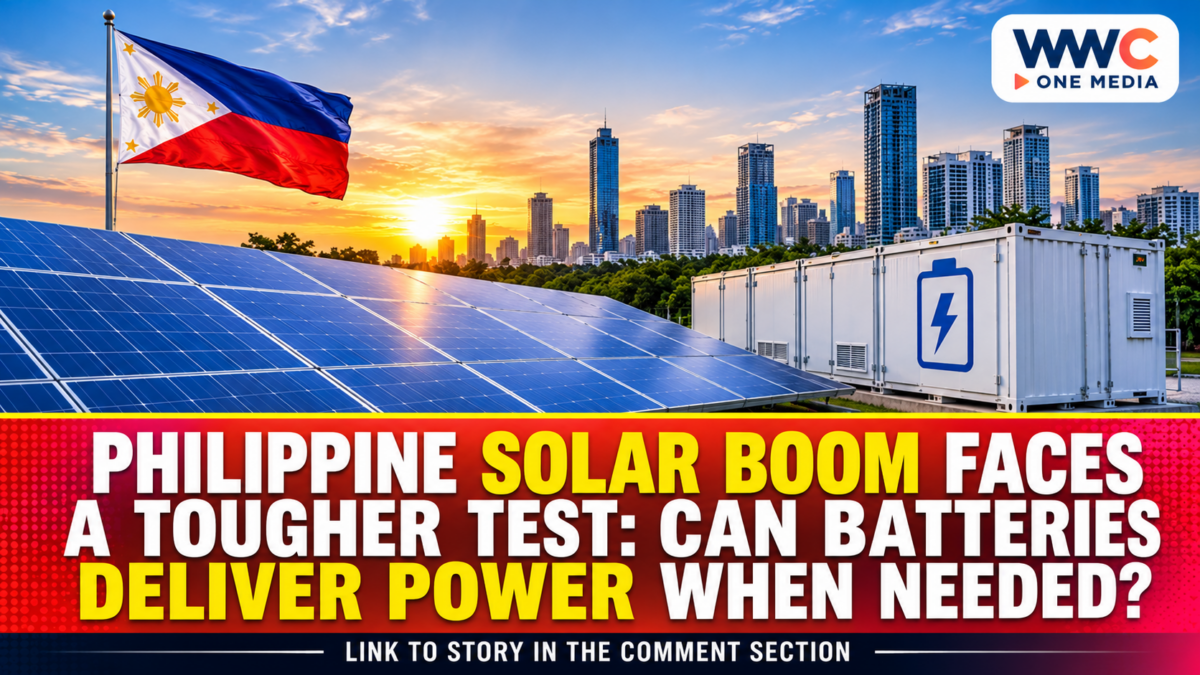
The Philippines has expanded its solar and battery energy storage capacity, but government figures show a continuing gap between the power plants installed and the electricity they can reliably deliver. The Department of Energy’s August 2026 inventory records 4,249 megawatts (MW) of installed solar capacity and 3,367 MW of dependable solar capacity nationwide.
That distinction is central to the country’s energy challenge. Adding renewable generation can diversify the electricity mix, while batteries can help shift power to periods when it is needed. But neither project announcements nor installed megawatts alone establish that households and businesses will have sufficient electricity throughout the day.
The bigger test is whether generation, storage, transmission and reserve capacity develop together. The public record shows that the Philippines is moving in that direction, but also that the reliability question cannot be answered by counting solar installations alone.
Solar battery storage: What the national figures reveal
The DOE’s List of Existing Power Plants as of 31 August 2026 provides a useful comparison between installed and dependable capacity.
Solar installations totalled 4,249 MW, while their dependable capacity was listed at 3,367 MW. The same inventory recorded 886 MW of installed battery energy storage system (BESS) capacity and 733 MW of dependable battery storage capacity.
| Technology | Installed capacity | Dependable capacity |
|---|---|---|
| Solar | 4,249 MW | 3,367 MW |
| Battery energy storage | 886 MW | 733 MW |
These categories measure different things. Installed capacity describes the rated capacity of facilities in the inventory. Dependable capacity is the amount classified as dependable under the government’s reporting framework. Neither figure, by itself, tells consumers how much electricity will be available at a particular hour.
Solar output changes with sunlight and weather. Batteries, meanwhile, can store electricity and release it later, but their contribution depends on their energy capacity, charging level, operating arrangements and discharge duration.
This is why the distinction between megawatts and megawatt-hours matters. MW measures the rate at which a facility can supply or absorb power. MWh measures the amount of energy stored or delivered over time.
For consumers, the practical question is not simply how many megawatts have been announced. It is whether the system can deliver electricity when demand rises and other generators are unavailable.
A major solar-and-storage project is already contributing
One example of the combination of renewable generation and storage is MTerra Solar.
In a March 30, 2026 media release, the DOE welcomed the energization of the project’s first 250 MW of solar capacity and 450 megawatt-hours (MWh) of battery storage.
The announcement is significant because it describes an actual energization milestone rather than only a proposed development. It also demonstrates why solar and storage are increasingly being considered together: generation can occur during daylight hours, while stored electricity can potentially be dispatched later, subject to the system’s operating limits.
The project’s reported 250 MW solar capacity and 450 MWh storage figure should not be confused as equivalent measurements. The first describes power capacity; the second describes stored energy. The amount of time the battery can sustain a particular output depends on how it is operated and the power level being delivered.
The distinction is important when comparing projects. A battery with a high MW rating does not necessarily have the same discharge duration as another battery with the same rating but a larger MWh capacity.
The DOE announcement establishes the first energization milestone. It does not, by itself, establish that the project can eliminate supply shortages across the national grid. <Cite refs={[“turn197664search2”]}/>
The grid must be ready for more renewable electricity
More generation and storage require a transmission network capable of moving electricity where it is needed.
NGCP’s Transmission Development Plan 2026–2050 identifies battery storage as part of the country’s wider grid-development strategy. Its planning document recommends 430 MW of BESS capacity across Luzon, the Visayas and Mindanao.
The same document records 756.4 MW of existing BESS capacity as of December 2025. It also lists 1,883.90 MW of committed proposed projects and 3,291.76 MW of indicative proposed capacity.
Those categories should not be treated as one operating total. Existing facilities, committed proposals and indicative developments represent different stages of project progress. A proposed project does not become available grid capacity simply because it appears in a planning document.
The plan also identifies different storage needs across the three major grids. Its recommended BESS capacity is 270 MW for Luzon, 70 MW for the Visayas and 90 MW for Mindanao.
This planning approach highlights a broader point: storage must be positioned where it can support the network. A battery in one location cannot automatically solve a transmission constraint or local shortage elsewhere. <Cite refs={[“turn645872view0″,”turn645872view1”]}/>
WWC has previously examined the expansion of Philippine energy projects entering the grid-study process. That development pipeline is relevant because proposed generation and storage projects still need technical assessments and grid connections before they can contribute to electricity supply.
Regulators are treating storage as a grid-support resource
Battery systems are not limited to storing excess solar generation. They can also provide services that help grid operators maintain a stable electricity system.
In October 2026, the Energy Regulatory Commission granted provisional authority for an ancillary services procurement agreement between NGCP and East Asia Utilities Corporation involving a 44.72 MW BESS in Mactan, Lapu-Lapu City, Cebu.
The ERC announcement said the agreement provides NGCP with up to 13 MW of regulating reserve and 13 MW of contingency reserve for five years.
These services are different from simply selling stored electricity to consumers. Regulating reserve helps the grid respond to changes in supply and demand, while contingency reserve provides additional support when an unexpected event affects the system.
The ERC also reported that the Visayas grid had recorded 123 yellow and red alerts from January to early September 2026. The DOE estimated that around 200 MW of battery storage in the region could reduce the occurrence of those alerts by about half.
That estimate is a projection, not proof that the alerts have already been reduced by that amount. The distinction matters when evaluating the real-world performance of new facilities. <Cite refs={[“turn197664search1”]}/>
Why batteries cannot replace every source of dependable power
Battery storage can improve flexibility, but it is not an unlimited source of electricity.
A battery must first be charged. Its ability to support the grid depends on how much energy it can store, how quickly it can discharge and whether sufficient electricity is available to recharge it.
A storage facility may help manage short-term shortages or shift electricity from one period to another. It cannot automatically replace the sustained output of a power station during a prolonged supply shortfall.
This is why a balanced electricity strategy requires more than a choice between renewable and conventional generation. It must consider the reliability of individual generators, reserve requirements, transmission capacity, storage duration and the timing of electricity demand.
The same issue is relevant to smaller developments. WWC’s report on a proposed solar-powered battery project in Negros Oriental explains why a project’s proposed capacity and memorandum of understanding should not be mistaken for an operating power facility.
The economics also matter. Batteries require capital, maintenance and eventual replacement. Their value to the grid depends on how they are contracted, when they charge and discharge, and how the costs are recovered.
What happens next
The next measure of progress should be the amount of new capacity that reaches commercial operation and can provide useful services to the grid.
For solar projects, that means tracking actual generation and the ability to deliver electricity through the transmission network. For BESS projects, it means examining both MW and MWh, commissioning status, discharge duration and the services covered by regulatory approvals.
The ERC’s revised draft rules for energy storage systems, posted in September 2026, also show that the regulatory framework is still developing. The commission invited stakeholder comments and scheduled consultations as part of its rulemaking process. <Cite refs={[“turn197664search0”]}/>
For consumers, the ultimate test remains straightforward: fewer supply interruptions, sufficient electricity during peak demand and power costs that remain manageable.
The Philippines does not have to choose between expanding renewable energy and maintaining dependable electricity. The challenge is to ensure that generation, batteries, transmission infrastructure and conventional sources work as a coordinated system.
More solar panels and larger batteries can help. Whether they make electricity more dependable will depend on how effectively the entire power network is planned, connected and operated.
Frequently asked questions
Does solar power provide electricity at night?
Solar panels do not generate electricity from sunlight after sunset. Electricity stored in batteries during the day can be discharged later, depending on the battery’s capacity and operating conditions.
What is a battery energy storage system?
A battery energy storage system stores electricity and releases it when needed. It can support renewable energy integration, grid reserves and the management of changes in electricity supply and demand.
What is the difference between MW and MWh?
MW measures the rate of power production or delivery. MWh measures the quantity of energy stored or delivered over time. Both figures are needed to understand a battery’s capabilities.
Can batteries prevent all power interruptions?
No. Batteries can provide grid support and short-term electricity, but their contribution depends on their size, charge, discharge duration, location and operating arrangements. They cannot automatically replace all generation or transmission infrastructure.
How much battery storage does the Philippines have?
The DOE’s August 31, 2026 inventory listed 886 MW of installed battery energy storage capacity and 733 MW of dependable capacity nationwide.