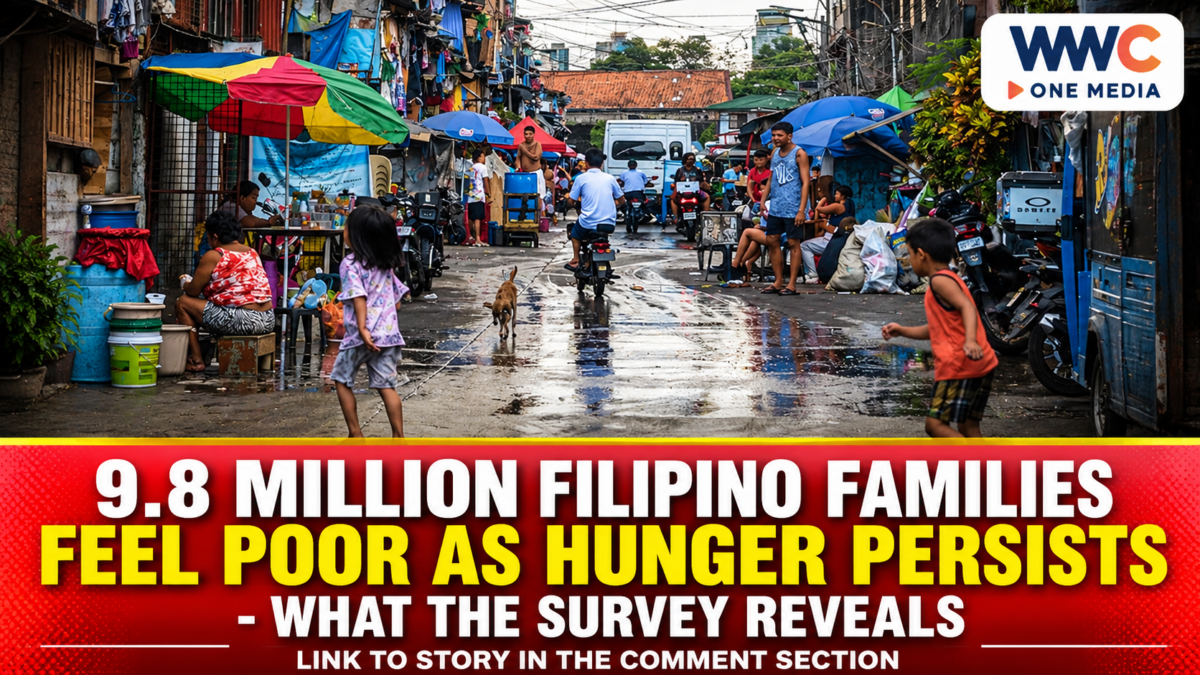
MANILA, Philippines — Millions of Filipino households continue to face financial insecurity, with an estimated 9.8 million families considering themselves poor and another 5.8 million reporting that they experienced involuntary hunger at least once in the third quarter of 2026.
The latest Tugon ng Masa survey by OCTA Research found that 37% of respondents rated their families as poor between Sept. 28 and Oct. 4. The figure was slightly lower than the 39% recorded in the previous quarter, equivalent to approximately 10.3 million families.
But the difference does not establish that poverty perceptions have meaningfully improved.
OCTA considers the two results statistically unchanged because the two-percentage-point movement falls within the survey’s national margin of error of ±3 percentage points.
The hunger figures tell a similar story. An estimated 22% of families, or around 5.8 million, experienced involuntary hunger during the three months preceding the survey, compared with 21%, or approximately 5.6 million families, in the second quarter.
The findings point to a persistent affordability problem for households across the Philippines, even as the national figures show little statistical movement.
Millions Still Consider Their Families Poor
The latest results show that self-rated poverty remains elevated.
Of the respondents, 21% said their families were not poor, compared with 18% in the previous quarter. Another 42% remained uncertain about whether their households should be considered poor or not poor.
The regional breakdown reveals significant differences.
Mindanao recorded the highest self-rated poverty rate at 56%, although this was lower than the 58% reported in the previous quarter.
The Visayas followed at 49%, up from 46%. Balance Luzon registered 26%, down from 33%, while Metro Manila recorded 20%, compared with 18% previously.
These differences matter because a national average can conceal the financial pressures experienced in particular parts of the country.
Mindanao’s continuing high poverty perception suggests that economic vulnerability remains especially pronounced in the region. Meanwhile, the increase recorded in the Visayas indicates that household concerns are not confined to one geographic area.
For a closer look at how Filipino households have been rating their financial circumstances throughout the year, WWC ONE MEDIA previously examined the earlier OCTA poverty and hunger figures from July 2026.
Hunger Affects an Estimated 5.8 Million Families
The survey’s hunger findings provide another indication of the difficulties households face in meeting basic needs.
OCTA estimated that 22% of families experienced involuntary hunger at least once during the three months before the survey. This represents approximately 5.8 million families nationwide.
Around 78% said they had not experienced hunger during the same period.
Importantly, the survey found that approximately 83% of families reporting hunger said the experience occurred only once or a few times. This distinction matters: the figure does not mean that all 5.8 million families regularly went without food.
The geographic pattern also differs from the self-rated poverty results.
Metro Manila and the Visayas recorded the highest reported hunger incidence, both at 29%. Balance Luzon followed at 21%, while Mindanao registered 16%.
The contrast is significant. Mindanao had the highest self-rated poverty and food poverty figures, but the highest reported hunger incidence was recorded in Metro Manila and the Visayas.
The findings show why poverty, food insecurity and involuntary hunger should not be treated as interchangeable measures.
WWC ONE MEDIA has also examined the wider food-security issue in its report on hunger trends and regional differences in the Philippines.
Food Poverty Remains a Separate Concern
Beyond general self-rated poverty and hunger, OCTA also measured self-rated food poverty.
The latest results placed food poverty at 27%, representing approximately 7.1 million families. This was slightly lower than the 28%, or around 7.4 million families, recorded in the previous quarter.
OCTA considers this change statistically insignificant.
Mindanao again recorded the highest regional figure, with 54% of respondents rating their families as food-poor.
Food poverty is an important distinction because a household may struggle to obtain sufficient and nutritious food even when its members do not report experiencing involuntary hunger during the survey period.
In practical terms, a family might reduce food quality, variety or quantity to stretch its budget without necessarily reporting that it went without food altogether.
The survey therefore captures several dimensions of household hardship rather than relying on a single measure.
Why OCTA’s Numbers Are Different From Official Poverty Statistics
One important point must be understood when interpreting the results: OCTA’s self-rated poverty figures are not the same as the Philippine government’s official poverty estimates.
The Philippine Statistics Authority uses household income and established poverty thresholds to determine whether families have sufficient resources to meet basic food and non-food needs.
Its 2025 Full Year Official Poverty Statistics, published in November 2026, recorded poverty incidence among families at 6.4%, equivalent to approximately 1.90 million families. The corresponding poverty incidence among individuals was 9.7%, or about 11.08 million Filipinos.
The PSA estimated that a family of five needed an average of ₱14,634 per month in 2025 to meet basic food and non-food requirements.
OCTA’s survey, by contrast, asks respondents how they perceive their own economic circumstances. Its estimated 9.8 million families should therefore not be presented as an updated official count of families below the government’s poverty line.
The two measurements answer different questions.
Official poverty statistics assess income against a defined threshold. Self-rated poverty captures how households judge their own financial position.
Both can provide useful information, but they cannot be substituted for one another.
Rising Prices Remain a Major Household Concern
The results also come amid continuing concerns about the cost of living.
OCTA’s separate third-quarter survey on urgent national concerns found that 42% of adult Filipinos wanted the government to act on rising prices of basic goods and services, up from 37% in July.
Higher wages ranked second at 35%, while graft and corruption was cited by 29%.
The findings suggest that the affordability of everyday necessities remains central to public concerns.
For households with limited financial flexibility, increases in food, transport, electricity and other essential expenses can quickly reduce the money available for other needs.
WWC ONE MEDIA has previously examined the relationship between household budgets and the wider pressure on Filipino consumers from rising prices.
Government assistance can provide temporary support, but longer-term improvements also depend on stable employment, income growth, food availability and the affordability of essential services.
What Happens Next?
OCTA’s third-quarter findings do not show a statistically significant national improvement in self-rated poverty, hunger or food poverty compared with the previous quarter.
The figures instead highlight persistent household vulnerability and significant differences between regions.
The survey was based on face-to-face interviews with 1,200 Filipino adults aged 18 and above. It was conducted from Sept. 28 to Oct. 4, 2026, with a national margin of error of ±3 percentage points at a 95% confidence level.
The results are estimates from a public-opinion survey, not a census of every Filipino household.
For policymakers, the regional differences point to the importance of examining where economic hardship is most pronounced and whether assistance reaches households facing the greatest difficulties.
The national figures may appear relatively stable, but millions of families continue to describe their circumstances as poor or report going without food at least once.
The bigger question is whether the next round of economic and social-protection measures will translate into a meaningful improvement in what families can afford — or whether millions will remain trapped between rising household expenses and limited purchasing power.