
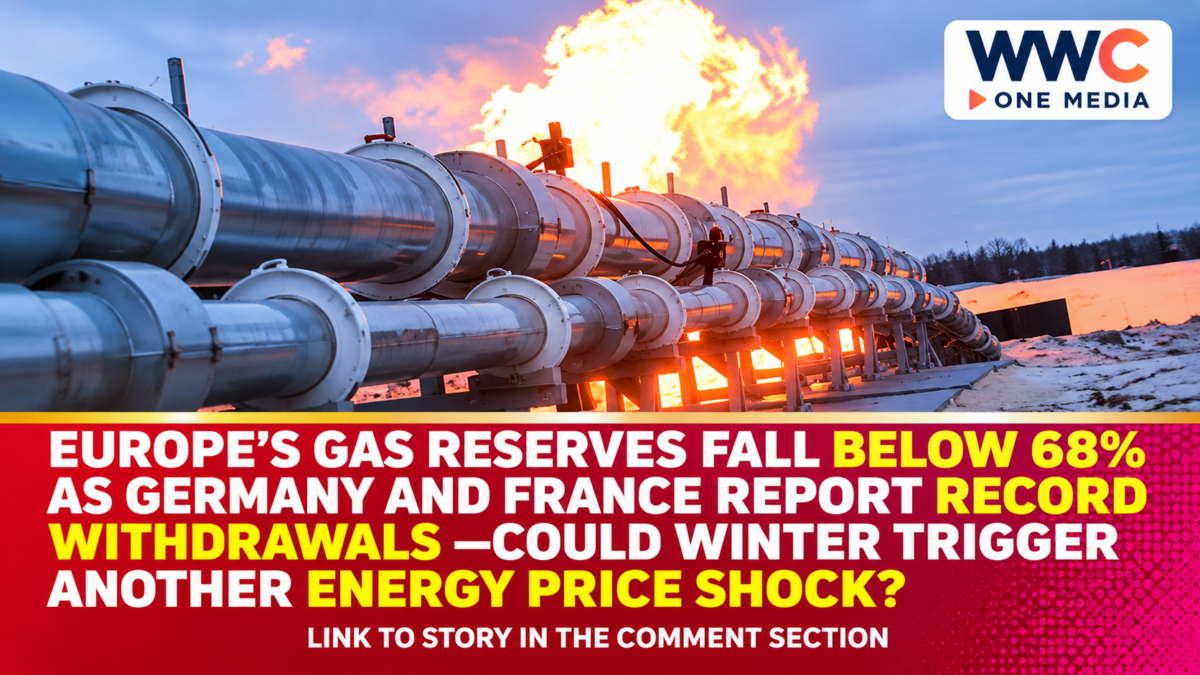
BRUSSELS — Europe’s natural gas reserves are coming under renewed pressure as colder temperatures accelerate withdrawals from underground storage facilities, raising concerns about energy affordability, industrial competitiveness and competition for international liquefied natural gas (LNG) supplies.
European Union gas storage stood at 67.84% of capacity in the November 25, 2026, data update, while Germany’s reserves declined to 55.25% and France’s inventories fell to 71.12%.
Russian energy company Gazprom announced on November 25 that Germany and France had recorded their highest gas withdrawals for the calendar date of November 23. European withdrawals also nearly doubled compared with the previous day.
The development comes as Europe navigates the 2026–2027 winter heating season with historically low starting inventories and continued uncertainty surrounding international energy markets.
Although European authorities maintain that the region is prepared for winter, rapidly declining reserves could leave energy markets increasingly sensitive to prolonged cold weather and unexpected supply disruptions.
Europe Gas Storage: Germany Faces Mounting Pressure
Germany’s underground gas storage facilities held 136.67 terawatt-hours (TWh) of natural gas in the November 25 European storage data update.
The country’s 55.25% storage level highlights the challenges facing Europe’s largest gas storage market as winter demand intensifies.
France held 88.10 TWh of natural gas, equivalent to 71.12% of its storage capacity.
Across the European Union, total stored natural gas amounted to 768.16 TWh.
Storage levels varied considerably between member states:
- Germany: 55.25%
- France: 71.12%
- Netherlands: 57.96%
- Italy: 84.39%
- Poland: 94.41%
- Austria: 62.06%
- Slovakia: 46.70%
- European Union average: 67.84%
The differences demonstrate why Europe’s overall storage percentage cannot fully describe the energy security position of individual countries.
National storage capacities, consumption requirements, pipeline connections and access to LNG imports all influence the ability of individual markets to respond to winter demand.
The latest figures extend the downward trend examined in WWC ONE MEDIA’s earlier coverage of Europe’s declining gas storage and the growing importance of LNG imports.
However, declining storage does not automatically mean that Europe is running out of natural gas.
Germany’s Energy Regulator Says Gas Imports Remain Stable
Despite concerns surrounding Germany’s storage levels, the country’s Federal Network Agency reported on November 25 that natural gas imports remained stable.
Between November 17 and November 23, Germany received 19.2 TWh of gas through pipelines and another 2.2 TWh through its domestic LNG terminals.
Average utilisation of German LNG terminals during the period stood at 45.1%.
The regulator acknowledged that storage inventories were substantially below comparable periods in previous years and indicated that it was taking the development seriously.
Nevertheless, it explained that withdrawals remained consistent with prevailing market and weather conditions.
Germany’s energy security depends on the combined performance of storage facilities, pipeline imports, LNG terminals, supporting infrastructure and consumer demand.
Storage inventories represent an important reserve, but they are not the country’s only available source of natural gas.
The immediate challenge is maintaining sufficient flexibility to respond if colder weather increases consumption while international supply conditions become less favourable.
Cold Weather Creates a Double Challenge for European Energy Markets
Winter temperatures can increase natural gas requirements for residential heating, commercial buildings and industrial operations.
Periods of cold weather accompanied by weaker wind generation may also increase reliance on gas-fired electricity production.
During its November 20 meeting, the European Union’s Gas Coordination Group confirmed that storage had already played an important role in supporting electricity generation during the season’s first cold spell with low wind output.
This illustrates how several energy-market pressures can emerge simultaneously.
Higher heating demand can accelerate withdrawals, while increased requirements for gas-fired power generation may add further pressure to available supplies.
Under such circumstances, the availability of additional imports becomes particularly important.
The interaction between weather, electricity generation and international energy supply was previously explored in WWC ONE MEDIA’s analysis of European gas price volatility and geopolitical uncertainty.
A sustained period of unusually cold weather could increase procurement costs, although the magnitude of any price movement would depend on available supplies, demand and broader market conditions.
Germany’s Uniper Invests €120 Million in Gas Storage Infrastructure
The growing importance of flexible energy infrastructure is reflected in German energy company Uniper’s investment programme for its Bierwang gas storage facility in Bavaria.
Uniper is investing approximately €120 million under its Bierwang2030 programme to modernise infrastructure, expand storage capabilities and strengthen operational security.
The facility has a working gas volume exceeding 820 million cubic metres, making it one of Germany’s major porous-rock gas storage facilities.
The investment programme includes infrastructure electrification, capacity improvements, security enhancements and research into underground hydrogen storage.
An electrically driven compressor is also being developed to support gas injection and withdrawal operations.
The investment illustrates the commercial importance of maintaining infrastructure that can respond effectively to changes in energy demand.
Storage capacity alone does not determine how successfully a facility can support the wider energy system. Its ability to deliver gas when required is also important.
However, the €120 million investment is a longer-term infrastructure programme, not an immediate addition of natural gas supplies for the current winter.
Europe’s Winter Gas Security Depends Increasingly on LNG
Europe entered October 2026 with underground gas storage at approximately 72% of capacity following a difficult refilling season.
The European Network of Transmission System Operators for Gas identified LNG import flexibility as an important component of the region’s winter preparedness.
European LNG regasification infrastructure has a potential capacity of approximately 145 billion cubic metres over the winter season.
That capacity could help compensate for lower starting inventories, provided sufficient international cargoes are available and infrastructure can deliver the imported gas to consumers.
Import infrastructure, however, should not be confused with actual fuel availability.
A terminal may have sufficient capacity to receive additional shipments without guaranteeing that suppliers can provide those cargoes at affordable prices.
The broader implications of international supply competition are examined in WWC ONE MEDIA’s report on global LNG supply disruptions and delayed market relief.
Stronger European LNG demand could intensify competition with Asian importers for internationally traded cargoes, depending on supply availability and existing contractual arrangements.
For energy-dependent industries across the Asia-Pacific, European winter consumption therefore remains an important international market consideration.
EU Prepares for Another Major Russian LNG Policy Shift
The European Union’s energy market is also preparing for the full phase-out of Russian LNG imports by January 1, 2027, under the REPowerEU regulatory framework.
During its November 20 meeting, the Gas Coordination Group reviewed preparations for this transition.
The group concluded that Europe was prepared and did not anticipate immediate adverse consequences for supply security from the measure.
However, maintaining strong LNG imports and avoiding excessive depletion of storage inventories remain important considerations extending beyond the current winter.
The international significance of these developments is particularly relevant to Asian economies expanding gas-fired electricity generation.
WWC ONE MEDIA has previously examined how Vietnam is strengthening its LNG supply strategy amid potential electricity-generation pressures.
European and Asian buyers may face overlapping procurement requirements when weather conditions increase energy demand across different regions.
The resulting market impact will depend on global production, shipping availability, purchasing agreements and consumption patterns.
What Happens Next?
Europe’s energy outlook will depend on how rapidly storage inventories decline throughout the winter, whether pipeline supplies remain dependable and whether additional LNG shipments can be secured when required.
A prolonged cold spell could accelerate withdrawals and increase procurement costs.
Conversely, milder temperatures, stronger renewable electricity generation and dependable international imports could reduce pressure on reserves.
European authorities have not identified an immediate winter supply security risk, but maintaining sufficient inventories throughout the season remains important.
Germany’s storage level of 55.25% provides a clear indication of the reduced reserve cushion available to its energy market.
The central question is not whether Europe has already run out of gas. It has not.
The more consequential question is whether its remaining reserves, import infrastructure and international supply relationships can withstand simultaneous weather and market pressures without another significant energy price shock.
Frequently Asked Questions
How much natural gas does Europe currently have in storage?
The November 25, 2026, European storage update recorded EU reserves at 67.84% of capacity, equivalent to 768.16 TWh of natural gas.
What is Germany’s current gas storage level?
Germany’s storage facilities were 55.25% full in the November 25 update, holding approximately 136.67 TWh of natural gas.
Did Germany and France break gas withdrawal records?
Gazprom announced that both countries recorded their highest withdrawals for the calendar date of November 23. This does not mean they recorded the highest daily withdrawals across all dates in history.
Is Europe facing an immediate natural gas shortage?
The European Union’s Gas Coordination Group reported on November 20 that no immediate winter supply security risks had been identified. Lower storage levels nevertheless reduce the available reserve cushion.
Could Europe’s winter gas demand affect Asian LNG prices?
Stronger European demand could increase competition for internationally traded LNG cargoes. Actual price movements will depend on global supply, weather, shipping conditions and contractual arrangements.










