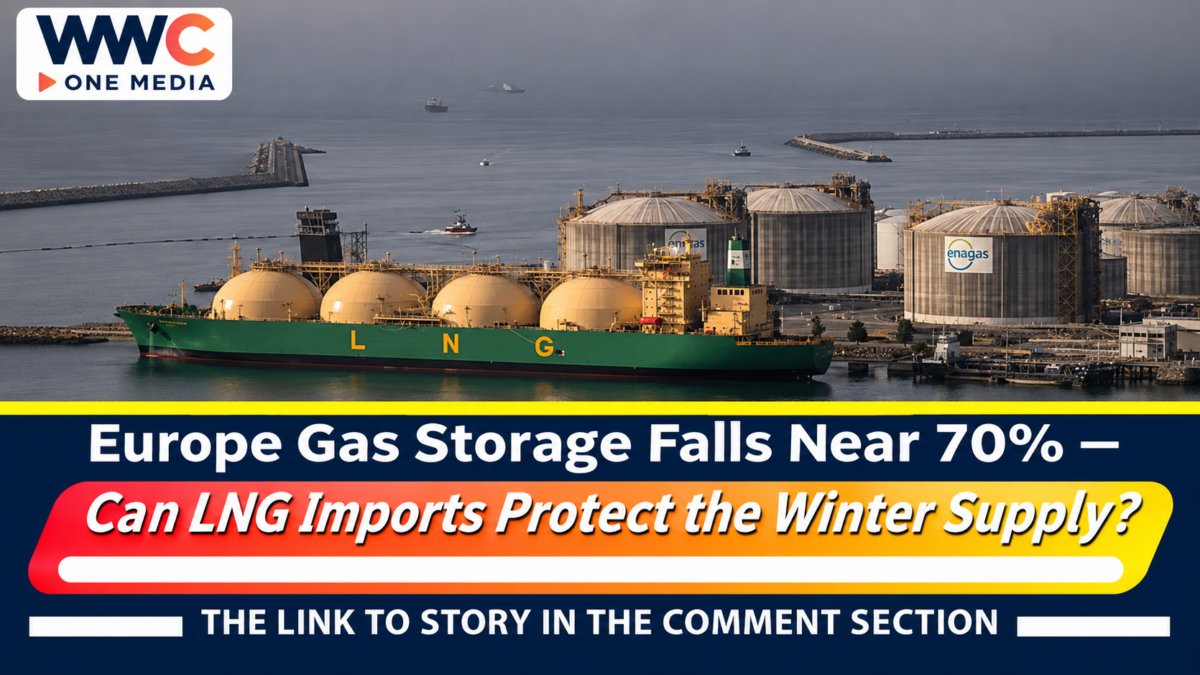
BRUSSELS — European Union underground natural gas storage stood at 70.4% of capacity on Nov. 15, 2026, according to a government energy dashboard using European storage-operator data. The latest Europe gas storage reading puts a smaller reserve cushion at the centre of the winter supply challenge as disruption to Middle Eastern liquefied natural gas shipments continues to affect international markets.
Europe has not exhausted its gas. Official assessments indicate that infrastructure can handle substantial imports, although weather and competition with Asian buyers could test supply.
Europe gas storage: What the latest numbers show
The Swiss Federal Office of Energy’s public dashboard displayed approximately 797 terawatt-hours of gas stored across the EU on Nov. 15, equivalent to 70.4% of working capacity. Germany stood at 57.3%, France at 76.4% and Italy at 87.2%.
These figures are storage percentages, not estimates of how many days Europe has left before running out of fuel. Underground reserves supplement pipeline imports, LNG deliveries and domestic production; the balance changes daily as customers use gas and suppliers inject or withdraw it.
An October assessment from Europe’s gas transmission system operators recorded 72% EU storage fullness on Oct. 1 and described stocks as historically low entering the 2026–27 heating season. The Nov. 15 reading illustrates the limited buffer available as the cold-weather period advances.
Analysis: EU averages conceal national differences. Germany’s lower fill rate does not mean immediate shortages, while Italy’s stronger reserves cannot overcome every transport constraint.
Middle East disruption has altered the LNG balance
The International Energy Agency’s Nov. 3 review documented an unprecedented disruption to LNG markets associated with interruptions through the Strait of Hormuz. It estimated that loadings from Qatar and the United Arab Emirates were more than 60 billion cubic metres lower year on year during March–October 2026.
The agency projected that global LNG supply could decline by around 3% in 2026 under its assumption that the Strait of Hormuz would remain largely disrupted through year-end. This is a conditional forecast, not a measured full-year outcome.
Even buyers outside the Gulf can feel the effects. When significant Middle Eastern cargoes are unavailable, European importers and Asian customers may compete for flexible LNG supply originating elsewhere.
WWC’s earlier report on Poland’s decision to terminate a Qatar LNG agreement illustrates a contractual consequence of disrupted deliveries. That commercial case is separate from the daily movement of European benchmark gas futures.
Why cold weather matters more when reserves are lower
Gas consumption typically rises when homes and businesses require more heating. A cold spell can increase withdrawals, while a milder period may reduce the need to draw down stored volumes.
The IEA modelled a scenario in which EU inventories could fall below 10% of working capacity by the end of March 2027 if colder-than-average conditions coincide with continued LNG disruptions. That result is a stress scenario, not the agency’s prediction that Europe will necessarily reach that level.
The European gas transmission operators reached a complementary conclusion. Their October winter outlook found that infrastructure was sufficiently flexible to meet demand across assessed situations, while cautioning that limited LNG availability could leave inventories well below 30% by winter’s end.
Analysis: The important variable is not temperature alone. The amount of LNG delivered, pipeline supply, industrial consumption and the timing of winter cold all affect how much gas remains for late-season demand and the next storage-refilling period.
No original meteorological bulletin was obtained that would substantiate a specific Nov. 17 forecast of a new cold snap across Europe. Such a forecast should not be presented as independently checked here.
Europe has more import flexibility, but not unlimited fuel
The European Commission said on Oct. 8 that the gas system was sufficiently flexible to meet winter demand despite lower reserves. It pointed to the ability to increase LNG imports and emphasised conserving inventories for possible late-winter cold periods.
Transmission operators estimated European LNG regasification capacity at approximately 1,600 terawatt-hours per winter season, or about 145 billion cubic metres. Regasification capacity describes how much imported LNG terminals can process, not a promise that enough cargoes will be available or affordable.
The IEA also reported that the share of destination-flexible LNG contracts rose from 29% in 2016 to more than 50% in 2025. Such contracts allow cargo diversion.
WWC’s coverage of Bangladesh seeking additional US LNG supplies examines a separate buyer’s response to the same global supply disruption.
Analysis: More terminals and flexible contracts make the system more resilient, but they cannot eliminate price competition. The effect on a particular country’s gas bill depends on purchasing arrangements, transportation, availability and the wider energy mix.
What the European squeeze could mean for the Philippines
The Philippines does not purchase European gas-storage capacity. However, LNG is internationally traded, and additional European demand for replacement cargoes can influence the prices offered to importers elsewhere.
A European wholesale benchmark does not determine Philippine electricity rates, which also reflect procurement agreements, exchange rates and domestic regulation.
WWC’s reporting on Filipinos turning to solar amid volatile imported fuel prices explores another response to energy-market uncertainty. It does not establish that solar installations or household savings can be predicted from one day’s European gas market movement.
Analysis: For businesses planning fuel purchases or electricity expenditures, the practical takeaway is to distinguish near-term spot prices from long-term contracts and domestic tariff decisions. A headline about European futures is not a forecast of the next Philippine electricity bill.
What happens next
Storage-operator reports, actual tanker deliveries, pipeline flows and updated official weather forecasts will provide the most useful evidence of how Europe’s winter position develops. Future publications from energy regulators and network operators can show whether contingency assumptions remain appropriate.
The verified position as of Nov. 17 is that EU storage is considerably below historical comfort levels, while international LNG supply remains disrupted. Europe’s import infrastructure offers flexibility, but its ultimate effectiveness depends on available cargoes and winter demand.
No exchange-issued Nov. 17 settlement or intraday quotation was independently verified for this article. Consequently, it does not claim an exact daily price increase or attribute one exclusively to Middle Eastern events or a forecast change.
FAQ
How full is Europe’s natural gas storage?
The latest official dashboard reading reviewed for this report showed 70.4% EU storage fullness on Nov. 15, 2026, representing approximately 797 TWh.
Is Europe about to run out of natural gas?
The available official assessments do not establish an imminent EU-wide exhaustion of supply. They warn that low storage and limited LNG availability reduce the margin of safety.
Why does the Strait of Hormuz affect European gas?
Disruptions to Gulf LNG exports reduce globally available cargoes and can increase competition between European and Asian importers.
Does the IEA predict storage will fall below 10%?
The below-10% outcome is a conditional stress scenario involving colder weather and continued LNG disruption, not a certain forecast.
Will European gas prices raise Philippine electricity bills?
Not automatically. International LNG costs may affect procurement, but Philippine bills also depend on domestic contracts, exchange rates and regulated charges.