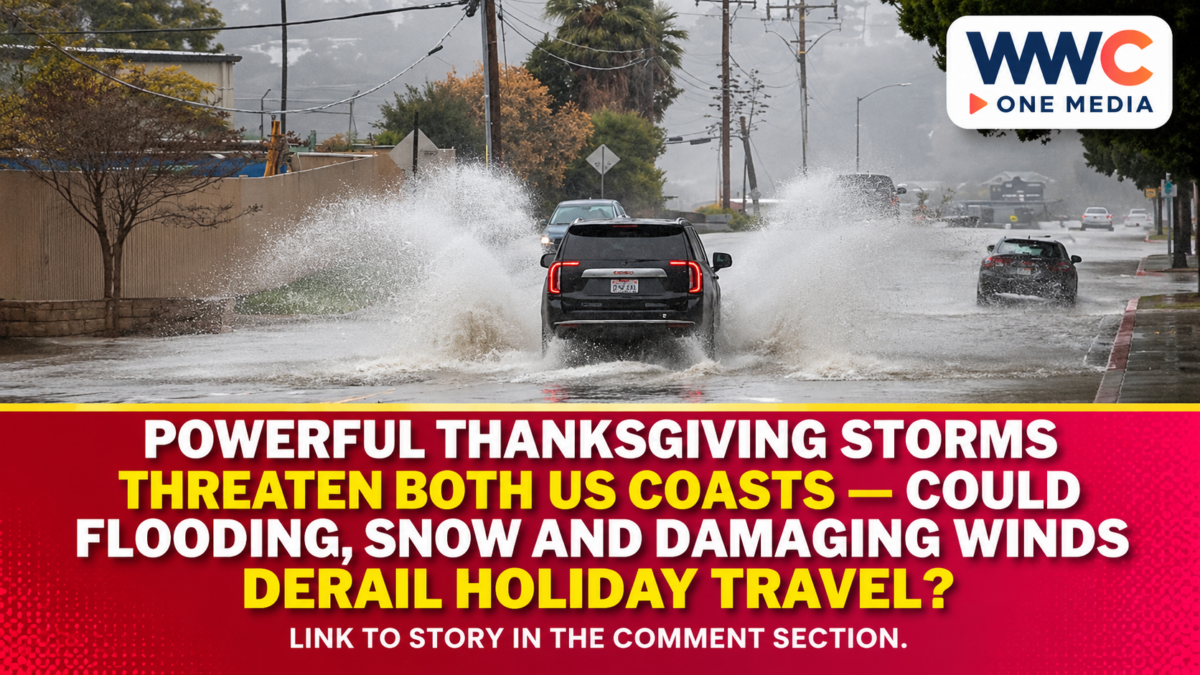
WASHINGTON, UNITED STATES — Powerful Thanksgiving storms are threatening holiday celebrations across the United States, with destructive wind gusts, heavy rainfall, coastal flooding and accumulating snow expected to complicate travel during the long holiday weekend.
New Jersey has declared a statewide emergency covering all 21 counties ahead of a strengthening coastal storm, with wind gusts potentially exceeding 70 miles per hour in exposed coastal areas.
Meanwhile, separate Pacific weather systems are threatening western states with rainfall, mountain snow and coastal flooding, creating simultaneous weather challenges on opposite sides of the country.
The Thanksgiving storms of 2026 could disrupt more than family gatherings. Transportation networks, electricity infrastructure, waterfront businesses and emergency services may also face significant pressure.
Thanksgiving storms 2026: East Coast faces dangerous conditions
A developing low-pressure system off the southeastern United States is forecast to strengthen as it advances northwards along the Atlantic coastline.
The storm is expected to generate substantial rainfall, powerful winds, beach erosion and dangerous coastal inundation.
Particular attention is focused on Virginia’s Tidewater region, the Chesapeake Bay, Delaware Bay and southern New Jersey, where elevated seawater levels could threaten vulnerable communities.
Exceptionally high astronomical tides are expected to intensify the coastal flooding threat on Thanksgiving morning, Thursday, Nov. 26.
The danger is not limited to locations experiencing the heaviest rainfall. Coastal communities may experience flooding when persistent winds push seawater inland during high tide.
The simultaneous occurrence of these hazards increases the importance of local emergency preparations.
New Jersey declares statewide emergency
Governor Mikie Sherrill declared a state of emergency effective at 6 p.m. on Wednesday, Nov. 25, covering every county in New Jersey.
Executive Order No. 31 authorises the implementation of the state’s emergency operations plan and provides authorities with additional powers to respond to deteriorating conditions.
These include closing or redirecting traffic, opening emergency shelters, ordering evacuations where necessary and mobilising the New Jersey National Guard if required.
New Jersey’s storm preparations are based on the following forecast conditions:
- Wind gusts of 50–70 mph (approximately 80–113 km/h) across much of the state, potentially exceeding 70 mph near the coastline.
- Rainfall of one to three inches statewide, with coastal locations potentially receiving four inches.
- Offshore seas reaching 15–20 feet.
- Multiple periods of moderate to major coastal flooding.
The most hazardous conditions are expected during Thanksgiving Day, although storm-related threats could continue through Friday, Nov. 27.
The emergency declaration does not establish that every community will experience severe damage. It enables authorities to prepare resources and respond as conditions evolve.
New York City prepares for holiday weather disruptions
New York City is also preparing for potentially hazardous Thanksgiving weather.
The city’s Nov. 24 emergency advisory projected wind gusts of 45–55 mph alongside one to two inches of rainfall, with higher local totals possible.
Flooding concerns are particularly significant around Jamaica Bay and the western Long Island Sound.
City authorities activated their flash flood emergency plan on Nov. 23 and began coordinating preparations across departments responsible for sanitation, transportation, parks and building safety.
The city’s initial advisory identified noon to 10 p.m. on Thanksgiving Day as a particularly difficult period for road travel.
Strong winds could bring down branches and electricity lines, while coastal flooding could make some roads impassable.
Outdoor celebrations and public gatherings may also require changes as organisers evaluate weather conditions and public safety requirements.
Travellers should confirm the latest event arrangements, transport schedules and weather alerts before departing.
Pacific Coast battles a separate flooding threat
While eastern communities prepare for the Atlantic storm, the western United States faces a different weather system.
Pacific disturbances are expected to bring additional rainfall and mountain snow to the Pacific Northwest, while coastal communities remain vulnerable to elevated tides.
The overlapping threats have already drawn attention to Pacific Coast king tides and the possibility of historically significant coastal flooding.
King tides are exceptionally high astronomical tides. Their effects can become more severe when they coincide with storm-driven increases in coastal water levels.
For communities situated near beaches, bays and tidal waterways, the resulting inundation can threaten road access and waterfront infrastructure.
The specific vulnerability of California’s shoreline was examined in WWC ONE MEDIA’s earlier coverage of San Francisco’s coastal flood warning during Thanksgiving week.
Even after one period of hazardous weather passes, additional Pacific systems could renew the threat during the return-travel period.
Midwest could experience a snowy Thanksgiving
The storm’s effects extend beyond coastal communities.
Parts of the mid-Mississippi Valley, including the St. Louis metropolitan area, face the possibility of substantial wet snowfall as colder air interacts with the developing weather system.
A combination of rain and accumulating snow could continue through Thanksgiving morning, creating hazardous driving conditions.
For motorists, deteriorating road conditions present a different challenge from coastal flooding. Reduced visibility and slippery surfaces can complicate journeys even when roads remain officially open.
Travel decisions should reflect actual conditions along an intended route rather than the weather at its final destination alone.
The importance of avoiding submerged roads is also highlighted in Japan’s preventive road-closure measures designed to protect motorists during floods.
Drivers should never bypass flood barricades or attempt to cross inundated roads.
When will Thanksgiving weather conditions improve?
The holiday weekend could bring substantially different conditions across the United States.
New England may continue experiencing heavy rainfall into Friday, while portions of the Great Lakes and Ohio Valley face additional showers and mixed precipitation.
The eastern storm is expected to move away during the weekend. However, wind and coastal flooding concerns could persist into Saturday before conditions begin improving on Sunday.
Western states may face a more prolonged period of unsettled weather.
Another Pacific system could bring precipitation to California and the Pacific Northwest on Sunday, with further disturbances possible early next week.
These forecasts remain subject to revision, particularly regarding the timing and intensity of the next Pacific systems.
For airlines, logistics companies and businesses, the possibility of overlapping weather disruptions creates additional planning challenges.
However, the eventual economic impact cannot be established until actual transportation disruptions, infrastructure damage and business interruptions have been documented.
What happens next?
The immediate priority is public safety as Thanksgiving celebrations get underway.
Residents in flood-prone coastal areas should prepare before high tide, secure outdoor belongings and follow evacuation instructions when issued.
Holiday travellers should monitor airline notifications, official road conditions and local weather warnings throughout the weekend.
People should avoid walking or driving through floodwater and stay away from fallen electricity lines.
The central concern is not simply the strength of an individual storm. It is the convergence of multiple weather hazards during a period of substantial holiday movement.
With additional Pacific rainfall possible during the weekend, Thanksgiving travel challenges may extend beyond the holiday itself.
Frequently asked questions
Where will the Thanksgiving storms of 2026 cause the greatest problems?
The Atlantic coastal storm threatens areas from the Carolinas through the Mid-Atlantic and southern New England. Separate Pacific systems threaten the western United States, while parts of the Midwest could experience accumulating snow.
Why did New Jersey declare a state of emergency?
New Jersey declared a statewide emergency ahead of anticipated destructive winds, heavy rainfall, significant tidal flooding and possible power outages.
How strong could Thanksgiving storm winds become?
New Jersey’s forecast includes gusts of 50–70 mph across much of the state, with potentially stronger gusts near the coastline.
Will Thanksgiving storms disrupt flights?
Weather-related flight delays are possible, particularly along the East Coast. Travellers should verify their individual flight status with their airline.
When will the Thanksgiving storms end?
Eastern conditions are expected to begin improving on Sunday, Nov. 29, although additional Pacific storms could prolong unsettled weather in the western United States into the following week.