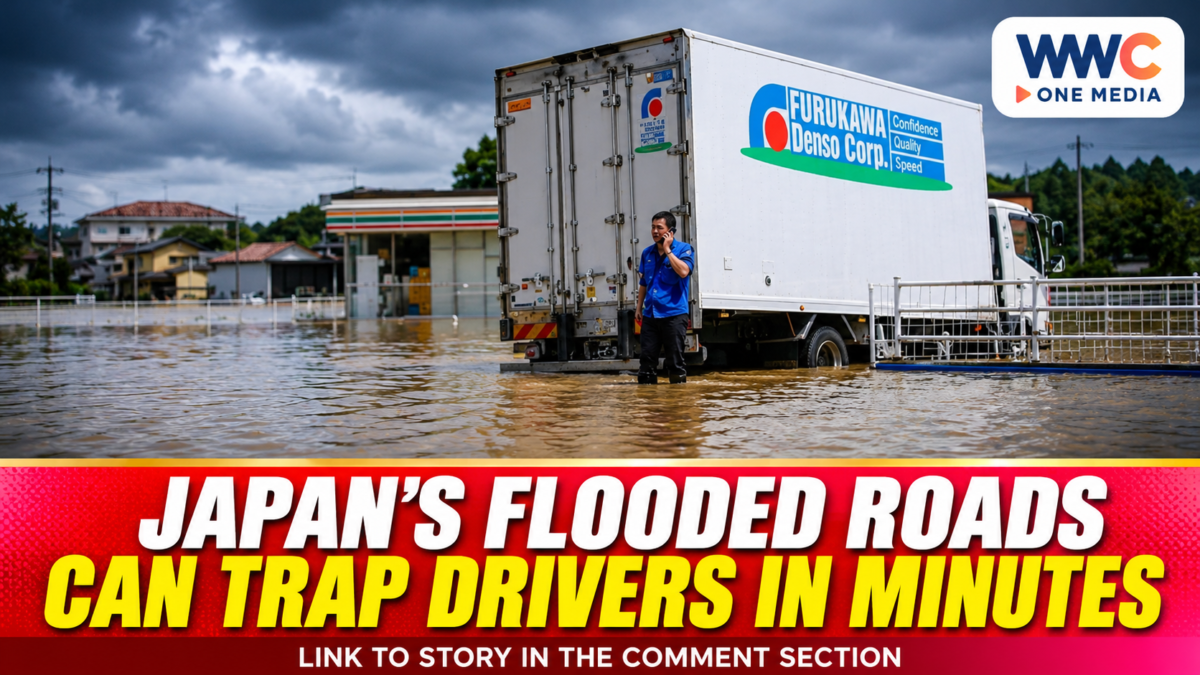
Heavy rain can turn an ordinary road into a dangerous trap, particularly at underpasses where water collects quickly and drivers may not be able to judge its depth. Japan’s transport authorities have responded to a series of flooding incidents by expanding preventive road closures, inspecting drainage systems and strengthening barriers designed to stop vehicles from entering submerged routes.
The measures follow flooding incidents in Chiba and Fukushima in 2026, where inundated underpasses caused serious consequences. They also highlight a problem that motorists often underestimate: a vehicle does not need to be completely submerged before its engine, electrical systems or doors become difficult to operate.
Why flooded underpasses are especially dangerous
Japan has approximately 3,800 underpasses, based on the Ministry of Land, Infrastructure, Transport and Tourism’s March 2025 figures.
These roads pass beneath other roads or railway lines and sit lower than the surrounding ground. During intense rainfall, water can collect in these depressions, sometimes causing levels to rise rapidly.
The danger is not limited to deep water. Rainfall can conceal the road surface, drainage channels and other hazards, making it difficult for motorists to determine whether a route is safe.
An apparently shallow stretch may also become more dangerous when water is moving. Drivers who enter without knowing the depth or current conditions risk losing control or becoming stranded.
The ministry has identified underpasses as locations requiring particular attention during heavy rain and has published information on flood-prone locations to help road users and authorities prepare. 国土交通省+1
Japan is expanding preventive road closures
Japan’s response increasingly focuses on preventing vehicles from entering dangerous locations before flooding becomes severe.
On Sept. 16, 2026, the transport ministry announced an expansion of preventive advance traffic restrictions at underpasses on national highways under its direct management.
The programme added 15 locations to the seven already covered, bringing the total to 22. The restrictions are designed to be implemented using disaster-prevention weather information and hourly rainfall criteria.
This approach changes the timing of road safety measures. Instead of waiting for water to cover a road and then responding to stranded vehicles, authorities can close a vulnerable section before conditions reach that stage.
The ministry said the expansion followed the August Chiba torrential rain and continuing heavy rainfall across Japan. 国土交通省
The government has also been strengthening physical measures to prevent vehicles from entering flooded underpasses. These include barriers and other traffic-control arrangements, alongside improved inspection and maintenance of drainage equipment.
Drainage failures prompted nationwide inspections
A major concern following the August flooding in Chiba was whether emergency power and drainage equipment would operate when needed.
On Aug. 13, an underpass on National Route 16 in Muratacho, Chuo Ward, Chiba City, flooded. The transport ministry said the failure of emergency power equipment was considered a possible cause and ordered inspections of drainage and emergency power systems at vulnerable locations.
The inspection covered 102 underpasses and other flood-prone locations on national highways under direct government management.
By Aug. 21, the ministry reported that inspections had been completed and abnormalities had been identified at three locations. Repairs had been completed at two, while temporary measures were arranged for the remaining location until repairs could be finished.
The ministry also ordered further investigation into drainage pump systems with structures similar to the equipment at the Muratacho site. 国土交通省
This matters because a road’s flood protection depends on more than its elevation and drainage design. Backup power, pumps, sensors, warning signs and barriers must also function when severe weather places pressure on the system.
What happens when a car enters floodwater?
Japan’s transport ministry has warned that water reaching a vehicle’s floor can cause problems with its engine and electrical equipment.
Depending on the vehicle’s design, water entering the cabin can damage electrical systems and cause the engine or motor to stop. Power windows and automatic doors may also stop working.
The danger becomes even more serious when water reaches the doors. The ministry warns that once water reaches the lower edge of a door, external pressure can make it difficult to open from inside. If the water rises beyond half the door’s height, opening it from inside may become nearly impossible.
A vehicle can also lose its ability to move if water reaches critical components. Moving water creates another risk because it can push a vehicle away from the road.
The ministry advises drivers not to enter flooded roads and recommends professional inspection of vehicles that have been inundated, even if they still appear operational after the water recedes. 国土交通省+1
The warning also matters for Filipino motorists
The issue is relevant in the Philippines, where heavy rainfall, overflowing drainage systems and flooded roads regularly disrupt travel.
WWC has previously reported on floodwaters forcing road closures in San Fernando, Pampanga, as well as flood-related restrictions affecting sections of NLEX.
These incidents show how flooding can affect not only residential communities but also major transport routes used by commuters, delivery vehicles and emergency responders.
Japan’s experience offers a useful lesson for road management: warning motorists is necessary, but preventing access to dangerous sections can be just as important.
For drivers, the safest decision is not to treat another vehicle’s passage as proof that a flooded road is passable. Water depth, road conditions and the strength of the current can vary, even along the same stretch.
The country’s Fire and Disaster Management Agency also advises people to evacuate early, follow official information and avoid relying on cars when flooding makes travel dangerous. 防災危機管理eカレッジ+1
What happens next
Japan’s transport ministry has outlined a broader approach involving preventive closures, drainage inspections, physical barriers and updated guidance for underpass safety.
Its October 2026 road-flooding measures include a national guideline intended to strengthen efforts to prevent vehicles from entering flooded underpasses. The ministry has also been expanding preventive restrictions and improving equipment checks.
The effectiveness of these measures will depend on implementation by road administrators, reliable maintenance and timely communication with motorists.
For drivers, however, the immediate rule is straightforward: do not attempt to cross a flooded road when its depth or condition cannot be confirmed. A detour may cost time, but entering floodwater can leave a vehicle stranded and its occupants in danger.
Frequently asked questions
Can a car drive through a flooded road safely?
Not necessarily. Water can damage electrical systems, stop an engine or motor, and create enough external pressure to make doors difficult to open.
How deep does floodwater need to be to affect a vehicle?
Japan’s transport ministry warns that problems can occur when water rises above the vehicle’s floor. The exact effects depend on the vehicle’s design and the conditions.
Why are underpasses particularly vulnerable to flooding?
They are lower than surrounding roads and terrain, allowing rainwater to collect. Water levels can rise quickly during intense rainfall.
What is Japan doing to prevent flooded-road accidents?
Measures include preventive traffic restrictions, drainage and emergency-power inspections, physical barriers and updated safety guidelines.
Should a vehicle be inspected after driving through floodwater?
Yes. Japan’s transport ministry advises professional inspection after a vehicle has been inundated because electrical equipment may have been damaged even if the vehicle can still operate.