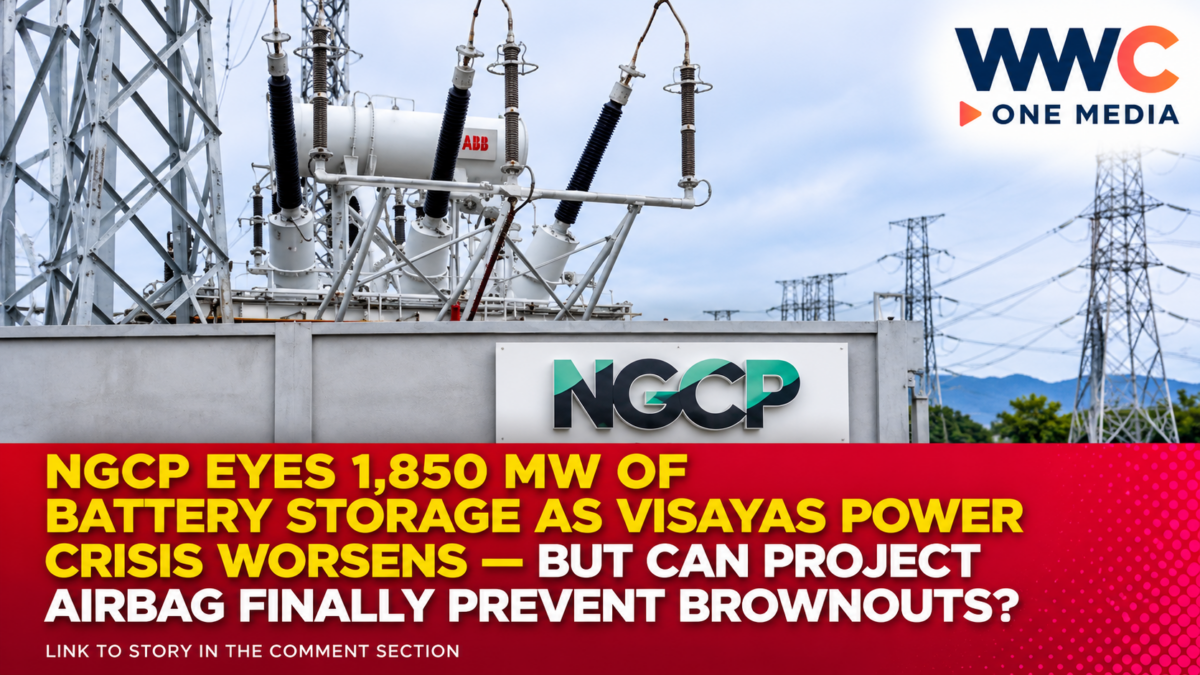
MANILA, Philippines — October 30, 2026. The National Grid Corporation of the Philippines (NGCP) is moving forward with an ambitious battery storage initiative that could reshape how the country responds to electricity shortages, as recurring power plant outages and dangerously thin reserves continue to threaten the Visayas power grid.
Dubbed Project Airbag, the initiative involves 850 megawatts (MW) of battery energy storage capacity across six ongoing project sites, with another 1,000 MW being assessed for 12 additional locations nationwide.
NGCP vice chairman Henry Sy Jr. outlined the strategy during a briefing on October 29, presenting battery storage as a faster-response solution that could provide temporary support whenever electricity supply becomes dangerously tight.
The announcement arrives as the government prepares for the possibility of a strong El Niño in 2027, which could affect hydropower production and increase electricity demand.
But behind the ambitious initiative is a critical question affecting millions of Filipino households.
Can large-scale battery storage finally reduce the Philippines’ recurring brownouts, or will the country’s shortage of dependable power generation continue to undermine grid reliability?
NGCP’s Project Airbag: 850 MW underway, another 1,000 MW being assessed
Project Airbag is designed to improve the national transmission grid’s flexibility and ability to respond quickly to unexpected electricity supply problems.
According to NGCP, the first group of projects involves 850 MW of battery storage capacity across six sites.
These are located in:
- Laoag, Ilocos Norte
- Gamu, Isabela
- Santiago, Isabela
- Calatrava, Negros Occidental
- Dumanjug, Cebu
- Ubay, Bohol
The company is also assessing another 1,000 MW of possible capacity across 12 additional locations.
These include Balingueo in Pangasinan, Cabanatuan in Nueva Ecija, Pagbilao in Quezon, Tuy in Batangas, Nabas in Panay, Victoria in Northern Samar, Cadiz in Negros Occidental, Polanco in Zamboanga del Norte, Placer in Surigao del Norte, San Francisco in Agusan del Sur, Bunawan in Davao City and General Santos City.
The locations indicate a geographically distributed strategy rather than dependence on one enormous battery facility.
NGCP aims to place storage resources closer to different parts of the transmission network where they could help respond to disturbances and shifting demand.
However, the announced 1,850 MW should not be interpreted as capacity that is already connected, commissioned and delivering electricity.
The 850-MW group consists of ongoing projects, while the additional 1,000 MW remains under assessment.
The October 29 announcement did not disclose complete project costs, commissioning dates or the energy-storage duration of each facility.
These details will determine how much practical support the batteries can provide.
How battery storage could prevent some power interruptions
A battery energy storage system, or BESS, stores electricity when energy is available and delivers it when needed.
Unlike a coal, gas or hydroelectric power plant, a battery does not generate new electricity.
Instead, it changes the timing of electricity delivery.
For example, a battery can charge when surplus electricity is available and discharge during periods of higher demand.
It can also respond rapidly when a generator unexpectedly shuts down.
This immediate response can help maintain system stability while other power plants or reserve resources adjust their output.
Battery systems can also provide certain ancillary services used to maintain the reliability of the transmission network.
But their usefulness depends on several factors.
These include how much energy is stored, the battery’s remaining charge, how long it can discharge at a particular power level and the available capacity of the surrounding grid.
A 100-MW battery does not necessarily supply 100 MW for an entire day.
Its duration depends on its energy capacity, measured in megawatt-hours (MWh).
For instance, an illustrative 100-MW battery with 200 MWh of usable stored energy could theoretically discharge at its maximum rated output for about two hours before accounting for operating constraints and losses.
That distinction matters because battery storage can bridge short-term power shortages but cannot replace missing electricity generation indefinitely.
Visayas power crisis exposes the urgent need for backup resources
The urgency of NGCP’s strategy is especially apparent in the Visayas.
The region has repeatedly experienced yellow and red grid alerts during 2026 as several major generating units remained unavailable.
On October 18, NGCP declared a yellow alert from 5 p.m. to 8 p.m.
At the time, the grid had approximately 2,512 MW of available generating capacity against projected peak demand of 2,354 MW.
Although available generation exceeded expected demand, the remaining reserve margin was insufficient to satisfy the grid’s contingency requirement.
NGCP identified major coal generating units that were unavailable, including Panay Energy Development Corporation Unit 3 and KEPCO SPC Power Corporation Unit 1.
Scheduled maintenance affecting the Mindanao–Visayas interconnection also contributed to the tight reserve situation.
The announcement demonstrates that a grid can experience a yellow alert even when its available generating capacity is higher than its forecast peak demand.
The difference lies in whether sufficient reserves remain available to respond to unexpected failures.
Visayas may face more years of electricity shortages
The region’s challenges are not limited to individual power plant outages.
NGCP officials have warned that electricity demand in the Visayas has grown more quickly than dependable generating capacity over an extended period.
WWC ONE MEDIA previously examined these structural problems in Visayas May Face Two More Years of Power Shortages and Rotational Brownouts.
That report discussed NGCP’s concern that the region needs additional generating capacity to maintain adequate reserves as demand continues rising.
For businesses, recurring supply interruptions can affect manufacturing schedules, refrigeration, logistics and daily operations.
For households, they can disrupt work, education and essential services.
Battery storage could help reduce the consequences of sudden supply losses, but the longer-term solution requires sufficient generation, reliable transmission infrastructure and proper maintenance.
DOE pushes 253 MW of batteries for the Visayas
Project Airbag is moving forward alongside a separate government effort to strengthen the Visayas grid.
The Department of Energy (DOE) has identified approximately 253 MW of battery storage capacity that could provide ancillary services across six sites in Leyte, Panay, Negros, Cebu and Bohol.
Energy Secretary Sharon Garin previously urged NGCP to accelerate the connection and deployment of battery facilities to address persistent shortages.
In September, the DOE said the additional battery capacity could help reduce the frequency of grid alerts.
NGCP spokesperson Cynthia Alabanza also emphasized that battery deployment could provide short-term relief.
However, she acknowledged that unavailable generating units must return to service and additional power plants remain necessary.
The distinction is important.
The 253-MW initiative concerns identified ancillary-service capacity for the Visayas.
The larger Project Airbag announcement concerns a broader nationwide storage development strategy.
The two should not automatically be combined into a single new capacity total because the publicly reported project descriptions do not establish that all capacities are separate, approved and commercially operational.
ERC approves Mactan battery reserve agreement
Regulators have also moved to accelerate battery storage participation in the Visayas electricity market.
On October 9, the Energy Regulatory Commission (ERC) approved provisional authority for an ancillary-service agreement between NGCP and East Asia Utilities Corporation.
The agreement covers a 44.72-MW battery energy storage system in Mactan, Lapu-Lapu City, Cebu.
Although the facility has a 44.72-MW rated capacity, the approved contract provides for up to 13 MW each of regulating and contingency reserves.
This is another important distinction: the full facility rating should not be mistaken for the amount contracted under each reserve category.
The ERC provisionally approved a rate of ₱5.28 per kilowatt-hour, significantly below the approximately ₱21-per-kWh average reserve-market price reported for the Visayas.
ERC Chairman Francis Saturnino Juan said the regulator prioritized additional reserve capacity because of the region’s continuing reliability problems.
The approval remains subject to final regulatory evaluation, with hearings scheduled for November 3 and 10.
The project also requires applicable technical accreditation and regulatory compliance before the contracted services can be fully implemented.
For consumers, the development could help diversify reserve procurement and potentially reduce dependence on more expensive sources.
However, it does not guarantee an immediate or uniform reduction in monthly electricity bills.
ERC reserve-market intervention puts electricity costs under scrutiny
The push for additional battery storage comes amid concern about the cost of procuring electricity reserves.
In October, the ERC suspended selected operations of the Visayas reserve market after unusually high prices placed additional pressure on electricity consumers.
The regulator cited substantial reserve-related costs and initiated measures to review market rules and procurement arrangements.
WWC ONE MEDIA explored the issue in ERC Freezes Power Reserve Market as Visayas Electricity Costs Explode — But Will Filipino Consumers Finally Get Relief?.
That report examined how tight power supply, insufficient reserves and market-price volatility have combined to increase energy costs in the region.
Battery systems may help by supplying faster-response services and increasing the number of resources available for reserve procurement.
However, their economic benefits depend on the terms of contracts, how frequently they are dispatched and the cost of charging the batteries.
The batteries themselves also involve construction, financing, maintenance and replacement expenses.
The availability of storage therefore does not automatically make electricity cheaper.
Cebu, Bohol and Negros remain vulnerable to power shortages
The consequences of inadequate reserves have been especially visible in parts of Central and Western Visayas.
Earlier in September, Cebu and Bohol sought stronger government intervention as recurring supply problems threatened households and businesses.
WWC ONE MEDIA documented the regional response in Cebu, Bohol Seek Power Emergency as Visayas Grid Faces Repeated Red and Yellow Alerts.
The report examined the need for battery storage, additional generating capacity and government coordination to address the worsening electricity situation.
In Negros Occidental, repeated power interruptions have also raised public safety concerns.
As explored in Brownouts Keep Hitting Negros Occidental — But BFP Warns the Biggest Fire Risk May Come When Power Returns, repeated disruptions can create hazards when electrical equipment is switched back on.
These problems demonstrate why power reliability has become an economic and public safety concern rather than simply a technical matter for utilities.
For NGCP, the challenge is to improve grid stability while generation companies restore unavailable plants and develop new capacity.
El Niño could create another test in 2027
The government is also preparing for possible electricity supply risks associated with El Niño in 2027.
Prolonged dry conditions can affect rainfall, reservoir levels and the availability of hydroelectric power.
Hotter weather can also increase electricity demand as households and businesses use more cooling equipment.
If hydroelectric production declines while demand rises, the pressure on the power system could intensify.
Battery storage may help address short-term fluctuations, but it cannot fully compensate for an extended shortage of generation.
The batteries must still receive electricity from available sources before they can discharge it.
A system experiencing persistent shortages may have fewer opportunities to recharge storage resources.
The effectiveness of Project Airbag during a prolonged El Niño will therefore depend on the overall power supply mix, transmission capacity and operating conditions.
NGCP’s storage initiative should be viewed as an additional layer of resilience, not a guarantee that climate-related electricity problems will disappear.
Renewable energy integration becomes another major opportunity
One long-term advantage of energy storage is its potential to help integrate renewable electricity.
Solar power, for example, generates electricity during daylight hours but does not produce the same output after sunset.
Battery storage can absorb available solar generation and discharge stored energy later.
This can help reduce abrupt changes in electricity supply and support the use of renewable energy.
NGCP also wants the grid to accommodate more distributed energy resources, including rooftop solar systems, embedded generation and net-metered facilities.
However, the expansion of rooftop solar introduces new technical challenges.
Grid operators need accurate information about where generation is connected and how its output affects electricity flows.
WWC ONE MEDIA previously reported on this issue in NGCP Wants Rooftop Solar Tracked as Unrecorded Systems Raise Grid Stability Concerns.
The report explained why visibility over distributed solar installations is important for grid planning and system reliability.
Battery storage and improved renewable energy monitoring could eventually work together to create a more flexible electricity network.
But both require investment, technical coordination and regulatory oversight.
Who will pay for NGCP’s battery storage projects?
The October 29 Project Airbag announcement did not provide a complete investment budget or financing structure for the nationwide storage initiative.
This leaves several important questions unanswered.
Will the facilities be owned directly by NGCP, developed through contractors or provided by independent storage operators?
How will project costs be recovered?
What regulatory approvals will be required before construction and operation?
And how will storage services be priced when they are used to support the grid?
These matters could affect whether the initiative ultimately improves electricity affordability.
NGCP operates the country’s high-voltage transmission network under a regulated framework.
Any applicable charges passed through to electricity consumers must be considered within the relevant regulatory rules and approvals.
The project should therefore be evaluated using both engineering and economic criteria.
Its success will depend not only on the megawatts announced but also on cost, operational reliability, battery duration and the measurable reduction in grid disturbances.
Why Project Airbag cannot replace new power plants
NGCP has emphasized that battery storage is a bridge rather than a substitute for dependable generation.
That warning addresses a fundamental limitation.
A battery can release stored energy rapidly, but it cannot continuously supply electricity once its stored energy is exhausted.
If a power shortage lasts longer than the battery’s available discharge duration, the grid still needs generation, imports from other regions or demand-reduction measures.
This is particularly relevant in the Visayas, where multiple generating plants have experienced simultaneous outages.
The region’s shortages cannot be solved simply by installing batteries without ensuring sufficient energy is available to recharge them.
Long-term solutions will require new generating capacity, restoration of unavailable plants, stronger transmission connections, demand management and storage technologies working together.
The energy transition will therefore involve a combination of infrastructure improvements rather than reliance on any single technology.
Can Project Airbag finally end the Visayas brownout crisis?
NGCP’s latest battery storage announcement represents a significant attempt to strengthen the flexibility of the Philippine electricity grid.
With 850 MW of projects underway and another 1,000 MW being considered, Project Airbag could expand the country’s ability to respond to sudden disturbances and short-duration shortages.
The additional 253-MW ancillary-service initiative and the provisional approval of a Mactan battery facility demonstrate that government agencies are also moving to strengthen reserve capacity.
But the country’s electricity problems are deeper than a shortage of batteries.
The Visayas continues to face tight generating capacity, plant outages, transmission constraints and expensive reserve procurement.
El Niño could add further pressure in 2027.
For consumers, the most meaningful outcome will be fewer brownouts, more stable power supply and electricity costs that remain manageable.
Those benefits will depend on when projects become operational, how reliably they perform and whether the underlying shortage of generation is addressed.
Project Airbag could help prevent some power disruptions from becoming bigger emergencies. But until the Philippines builds enough dependable electricity supply, battery storage may only buy the grid more time — and that time could be running out.