
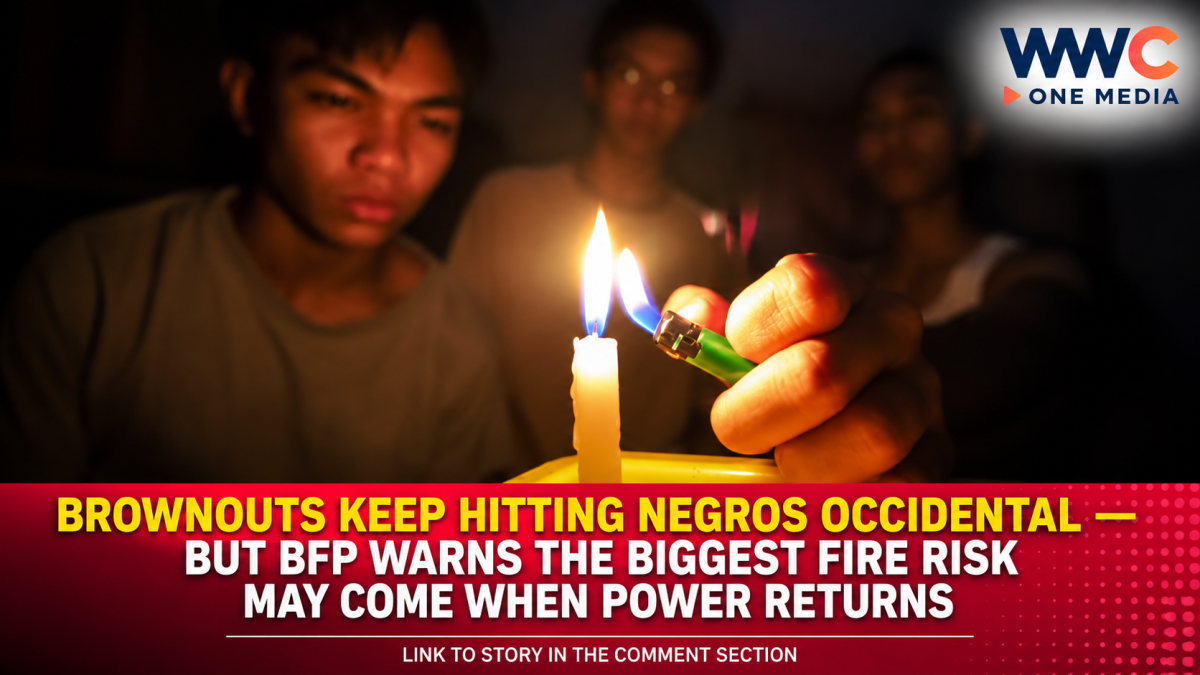
BACOLOD CITY, Negros Occidental — With recurring power interruptions continuing to affect communities across Negros Occidental, the Bureau of Fire Protection (BFP) is reminding residents to take extra precautions when electricity suddenly goes out — and especially when power is restored.
The warning comes as the Visayas grid continues to face tight electricity supply, forcing distribution utilities to implement rotational brownouts in several areas.
Recent reports indicate that the outages are not simply isolated distribution problems. The National Grid Corporation of the Philippines (NGCP) has repeatedly placed the Visayas grid under red and yellow alerts because available generating capacity has fallen short of demand and required reserves.
Why power restoration can be dangerous
One of the most important concerns during repeated brownouts is what happens when electricity suddenly returns.
Residents are advised to unplug or switch off appliances during an outage, particularly high-load equipment, and to check electrical connections before restoring power to appliances.
The concern is not merely theoretical. In August, a residential fire in Silay City, Negros Occidental was investigated by the BFP after authorities identified the sudden restoration of electricity as one possible factor being examined in connection with the blaze.
The incident highlights why households should avoid leaving appliances plugged in and switched on while waiting for electricity to return.
Negros facing a wider power-supply problem
The BFP’s warning comes amid a broader electricity shortage affecting the Visayas.
Negros Electric and Power Corp. (NEPC) said several generating units have been unavailable, contributing to the supply deficit. According to company officials, three coal units had been offline since May 13, removing about 488 megawatts from the Visayas grid, while another 268 MW of capacity was operating below its rated output.
The resulting shortage has forced the implementation of rotational brownouts, particularly during periods of high electricity demand.
NEPC officials previously said the situation had begun improving as some generating plants returned to service, although rotational outages could continue through the end of the year depending on supply conditions.
Outages have already stretched for hours
The power problem has become a growing economic and public-safety concern.
Bacolod Rep. Alfredo Abelardo Benitez said rotational brownouts in parts of the Visayas had increased from roughly an hour to five to nine hours, affecting businesses, schools, medical facilities and investor confidence. He subsequently sought a congressional investigation into the worsening power situation.
In early September, Bombo Radyo also reported that the worsening supply shortage had forced longer rotational interruptions, with the shortage in the Visayas grid reaching hundreds of megawatts during some periods.
NGCP: Hundreds of megawatts unavailable
The NGCP reported that several major generating units were unavailable, while other plants were operating below full capacity.
On September 7, the Visayas grid had 818.9 MW of unavailable capacity, with major coal plants in Cebu and Iloilo among the facilities affected. Limited power imports from Mindanao also contributed to the tight supply situation.
Two days later, the situation remained severe. NGCP reported available Visayas capacity of only 2,124 MW against projected peak demand of 2,555 MW, prompting another red-alert declaration.
DOE moves to stabilize the grid
The Department of Energy has said it is working to stabilize the Visayas power system following the simultaneous loss of several generating units.
Among the measures being pursued is the deployment of 253 MW of battery energy storage capacity to help strengthen grid stability. The DOE has also emphasized the need for power plants and other grid participants to restore reliable supply as quickly as possible.
What households should do during brownouts
With rotational outages expected to continue in affected areas, residents are urged to observe basic electrical and fire-safety measures:
- Unplug sensitive appliances during prolonged outages.
- Turn off appliances before electricity is restored.
- Avoid overloading extension cords and electrical outlets.
- Check wires, plugs and outlets for overheating or damage.
- Use flashlights instead of candles whenever possible.
- Never leave cooking appliances unattended.
- After power returns, gradually reconnect appliances instead of switching everything on simultaneously.
- Immediately report smoke, sparks, burning odors or electrical fires to authorities.
The public should also follow official outage schedules and advisories from their local electricity provider because load-dropping requirements can change depending on real-time grid conditions.
The bigger concern
For Negros Occidental, the continuing brownouts have become more than an inconvenience. Businesses are absorbing additional costs from generators, while households face disruptions to work, education and daily activities.
Gov. Eugenio Jose Lacson previously warned that prolonged outages were already hurting businesses, although he stopped short of calling the situation an energy crisis at that point.
The immediate priority, however, remains keeping communities safe.
As long as the Visayas grid remains vulnerable to supply shortages, residents should treat every power interruption — and particularly the sudden return of electricity — as a potential electrical-safety hazard.
The brownout may end when the lights come back on. But for households with appliances left connected, that may be precisely when the danger begins.



Leave a Reply