
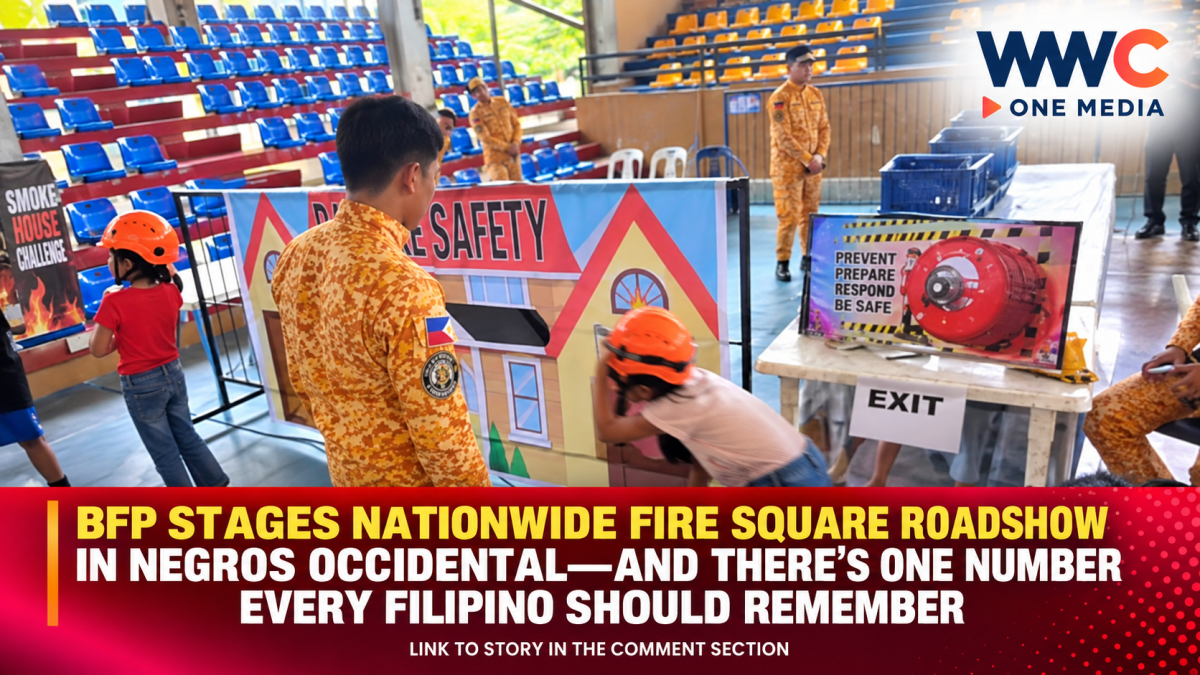
BACOLOD CITY, Philippines — Fire safety education took center stage in Negros Occidental as the Bureau of Fire Protection (BFP) joined the nationwide Fire Square Roadshow on September 11, bringing hands-on emergency preparedness activities closer to communities while reinforcing awareness of the country’s Unified 911 Emergency Hotline.
The activity formed part of a nationwide campaign highlighting the importance of knowing how to respond when fires, accidents and other emergencies strike.
In the Negros Island Region, the BFP-NIR organized simultaneous activities at three strategic locations, targeting elementary and high school students and providing them with practical lessons on fire prevention, emergency response and personal safety.
According to BFP-NIR, the roadshow featured 11 interactive stations, giving participants opportunities to experience emergency-response techniques rather than simply listening to lectures.
Among the activities were rappelling, simulation exercises, CPR demonstrations, first-aid training, a smoke house, a maze and survival exercises. Participants could also take part in an interactive Snake and Ladder activity designed to teach fire and life-safety lessons in a more engaging way.
The program was designed particularly for young people, with the BFP emphasizing that fire preparedness and emergency-response skills should be learned before an actual crisis occurs.
More than a fire-safety demonstration
The roadshow was also used to promote the proper use of the Unified 911 Emergency Hotline, the country’s single emergency number for urgent police, fire, medical and disaster-related assistance.
The nationwide Unified 911 system was officially launched on September 11, 2025, replacing a fragmented system of local emergency numbers with a single integrated emergency hotline.
Under the system, emergency calls can be routed to appropriate responders, including the Philippine National Police, BFP, local governments and other emergency-response agencies.
The service is designed to operate 24 hours a day and seven days a week, while accommodating calls in Filipino and various Philippine languages. The government initially set a target response time of five minutes.
That makes public awareness particularly important: knowing when and how to call 911 can be just as important as knowing how to evacuate a burning building or administer basic first aid.
Unified 911 expands across the country
The emergency system has continued to expand since its 2025 launch.
In June 2026, four new Unified 911 Satellite Command Centers in Ilocos Norte, Isabela, Iloilo and Leyte became fully operational, strengthening the government’s regional emergency-response network.
In Western Visayas, authorities have also been working to address geographical and language barriers that can affect emergency response. The Region VI Satellite Command Center in Leganes, Iloilo, was activated as part of that effort, with local operators capable of handling emergency communications in languages used in the region.
The push comes as officials seek to make emergency response faster and more accessible outside Metro Manila.
Interior Secretary Jonvic Remulla said the expanded 911 system is also raising expectations for faster police and fire response, putting greater pressure on agencies to improve their operational capabilities.
The numbers show why 911 matters
The government said in July that Unified 911 had handled more than 12.78 million calls since its launch in 2025 through its national, regional and satellite command centers.
The Department of the Interior and Local Government also reported an overall 97.23% efficiency rate for the system as of June 2026, citing improved coordination among LGUs, the PNP, BFP, emergency medical services and hospitals.
In Eastern Visayas alone, the regional 911 command center had recorded more than 62,500 calls since its June 2026 launch, with medical emergencies accounting for the largest share of calls, according to the Philippine Information Agency.
These figures underline why activities such as the Fire Square Roadshow go beyond simply teaching children about fire extinguishers.
They are part of a broader effort to build a population that understands prevention, preparedness, first aid, evacuation and emergency reporting.
Why the Fire Square Roadshow matters
The BFP has used Fire Square activities in different parts of the country to teach practical survival skills.
During a March 2026 roadshow in Dumaguete City, for example, around 700 pupils and teachers participated in demonstrations covering first aid, CPR, wound bandaging and fire-extinguisher use.
A separate BFP roadshow in Bicol likewise taught students basic bandaging, CPR, electrical safety, disaster preparedness, rappelling and other emergency skills.
The BFP’s own Fire Square program emphasizes self-help and fire-safety awareness, using interactive activities to make emergency lessons easier to understand and remember.
For Negros Occidental, the message is straightforward: preparedness starts before the emergency.
When flames spread, when someone collapses, when an accident occurs or when a disaster strikes, there may be only a few minutes—or even seconds—to act.
And when professional responders are needed, the number to remember is simple: 911.



Leave a Reply