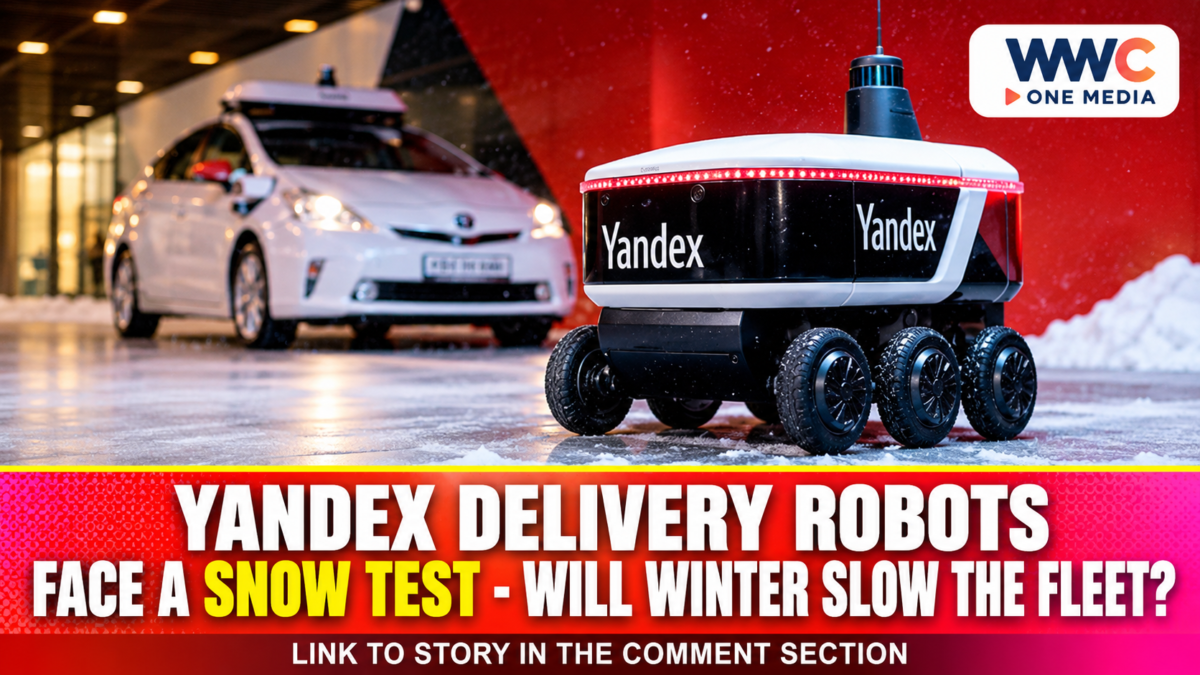
MOSCOW, Russia — Russia’s expanding robot-delivery business is facing a familiar problem that even artificial intelligence cannot completely solve: heavy snow.
Yandex has warned that intense snowfall could increase delivery times for its autonomous rovers and force the company to temporarily limit operations for part of its fleet during periods of particularly heavy precipitation.
The warning comes as the technology company expands its delivery robots across Russian cities, turning what began as a small experiment into a growing logistics operation.
The issue is more than a seasonal inconvenience. When autonomous robots operate on public pavements, snow-covered routes, slippery surfaces and unexpected obstacles can affect how reliably they complete deliveries.
For Yandex, the challenge is to keep its growing fleet useful during winter without compromising service quality or operational safety.
Heavy Snow Could Slow Yandex Rover Deliveries
Yandex said heavy snowfall may increase the time customers wait for orders delivered by its rovers.
During particularly intense precipitation, the company may temporarily restrict the operation of part of its fleet to maintain service quality and predictability.
That does not mean the entire robot-delivery network is being suspended. The warning concerns possible restrictions affecting a portion of the fleet when weather conditions become especially difficult.
The company also said its robots can contact remote operators when they encounter obstacles they cannot overcome independently. It thanked members of the public who help stranded robots.
The distinction matters because autonomous delivery does not mean a machine can handle every situation without human assistance.
A robot may navigate its planned route independently, but unusual conditions can still require intervention, operational adjustments or a temporary pause.
Yandex Is Preparing Its Robots for Winter
Yandex has already introduced specific hardware changes intended to improve the performance of its delivery robots during colder months.
In a November 2026 technical account, the company explained that its fourth-generation R4 rovers receive winter tyres with a more aggressive tread pattern.
The tyres improve traction and increase ground clearance, helping the robots move through slushy snow.
The R4 generation also has six driven wheels, independent suspension and sealed motors. These features are designed to help the machine handle uneven urban surfaces and maintain movement across difficult terrain.
Yandex says the newest generation can also attempt to free itself from snowdrifts by repeating manoeuvres that earlier models required remote operators to perform.
These upgrades show that winter operation has become part of the engineering requirements for commercial delivery robots.
However, improved traction and autonomous recovery do not eliminate every limitation. Deep snow, blocked pavements and severe weather can still make a route unsuitable for reliable delivery.
More Than 1,500 Robots Are Now Part of the Network
The scale of Yandex’s operation helps explain why weather-related interruptions matter.
In its third-quarter 2026 financial results, the company reported that its delivery robot fleet had exceeded 1,500 units.
The robots were serving orders from more than 170 Yandex Lavka dark stores, with delivery also available through partners connected to Yandex Eats and Yandex Delivery.
The network was operating in 13 cities. During the third quarter, Yandex reported more than 750,000 deliveries by its robots, almost three times the second-quarter total.
The company said its robots had completed more than two million deliveries overall. In September, they delivered an average of 10,000 orders per day, 2.4 times the June daily average.
These figures indicate that autonomous delivery is no longer limited to a small technology trial. It has become a service with meaningful operational volume.
For a network of this size, even temporary weather-related restrictions can affect delivery capacity, customer waiting times and the allocation of orders between robots and human couriers.
Why Snow Remains a Difficult Test for Autonomous Technology
Delivery robots must interpret their surroundings while moving through spaces shared with pedestrians, bicycles and other road users.
Their navigation systems rely on sensors, maps and software that help them identify obstacles and select routes.
Yandex has also introduced an artificial-intelligence-based motion planner across its rover fleet. The company says the system helps robots predict how people and vehicles may move, allowing them to choose routes more naturally and spend less time waiting in complicated pedestrian traffic.
In tests announced in May 2026, Yandex said the neural-network planner helped improve average delivery speed by 10%.
The company also said the AI planner operates alongside an algorithmic planner, with the system selecting an appropriate trajectory from the two proposed options.
But snow creates a different kind of challenge. A route that is technically mapped and navigable may become difficult when snow accumulates, surfaces become slippery or obstacles are hidden.
This is why real-world conditions remain important for autonomous systems. Software improvements can help machines make better decisions, but they cannot guarantee that every physical environment will remain passable.
The same issue is relevant to the broader autonomous-transport industry. WWC previously examined how LG Innotek is collecting real-world driving data to improve self-driving technology, including information from changing weather and difficult road conditions.
The Business Question: Can Robot Delivery Stay Reliable at Scale?
Yandex’s expansion places pressure on the company to make its delivery service dependable across different cities and operating conditions.
The commercial appeal of delivery robots is straightforward: they can transport eligible orders without requiring a human courier to make every part of the journey.
Yandex has also developed its fourth-generation R4 platform with mass production in mind. Its company account says the redesigned structure is intended to make robots easier to assemble and maintain while reducing delivery costs as the fleet expands.
The robots can carry up to 25 kilograms in a 61-litre compartment divided into two separate sections, allowing two orders to travel in a single trip.
Yandex says an R4 can travel up to 70 kilometres on one charge and operate for an average of around 10 hours.
These specifications support the company’s ambition to increase delivery capacity. But the business case still depends on how reliably the machines can operate, how often they require maintenance and how much human support is needed when conditions deteriorate.
The company’s financial reporting describes autonomous technologies as an investment area, with spending directed toward developing technology and expanding its delivery robots, robotaxis and autonomous trucks.
That makes operational reliability especially important. A larger fleet creates more delivery capacity, but it also increases the importance of controlling maintenance, charging, staffing and service interruptions.
The wider logistics sector is also experimenting with technology to improve last-mile operations. WWC has covered Ninja Van’s use of AI to turn delivery operations into retail intelligence, illustrating how logistics companies are looking beyond the movement of parcels alone.
Autonomous Delivery Still Needs Human Oversight
Yandex’s warning also highlights a practical point about automation: human involvement does not disappear simply because a vehicle or robot can navigate independently.
Remote operators remain part of the company’s response when a rover encounters an obstacle it cannot manage.
That approach reflects a broader feature of autonomous transportation. Companies must design systems that can recognise when they cannot safely or reliably continue and provide a way for people to intervene.
The regulatory environment matters as well. Russia approved an experimental legal regime for delivery rovers in September 2026, establishing a common framework covering their operation, interaction with other road users, speed limits, safety and insurance.
The framework provides a basis for expanding the service, but operating rules do not remove the need for practical safeguards in difficult conditions.
Similar questions are emerging in other markets. WWC has reported on Grab’s autonomous vehicle safety challenge in Singapore, where the operation of driverless vehicles raised questions about system behaviour and human intervention.
For Yandex, the immediate issue is less dramatic but equally practical: knowing when a robot should continue, when it needs assistance and when weather makes a delivery route unsuitable.
What Happens Next?
Yandex has not announced a complete shutdown of its rover network. Its warning is that heavy snowfall could slow deliveries and lead to temporary restrictions affecting part of the fleet during particularly severe conditions.
The company is continuing to develop winter-ready hardware and navigation systems while expanding its delivery service.
The next test will be whether those improvements can keep deliveries predictable as the fleet grows and winter conditions become more difficult.
Yandex has shown that autonomous robots can complete millions of deliveries. But the latest snowfall warning points to a more demanding measure of success: whether they can keep doing so reliably when the city itself becomes harder to navigate.
Frequently Asked Questions
Why could Yandex delivery robots be delayed by snow?
Heavy snowfall can make routes more difficult to navigate and may prevent robots from overcoming certain obstacles. Yandex says delivery times may increase during heavy snow.
Will Yandex stop all robot deliveries during heavy snowfall?
No. The company said it may temporarily limit operations for part of its fleet during periods of particularly heavy precipitation. It did not announce a complete shutdown.
How does Yandex prepare its rovers for winter?
Yandex says its R4 robots use winter tyres with more aggressive tread to improve traction and increase ground clearance. The newest generation can also attempt to free itself from snowdrifts.
How many Yandex delivery robots are operating?
Yandex reported that its fleet exceeded 1,500 robots in its third-quarter 2026 results. The company said the robots were operating in 13 cities.
Can Yandex robots operate without human assistance?
They can navigate delivery routes autonomously, but Yandex says remote operators can assist when a robot encounters an obstacle it cannot overcome independently.
Where does Yandex operate its delivery robots?
Yandex reported operations in 13 Russian cities in its third-quarter 2026 results, including Moscow, Saint Petersburg, Kazan, Nizhny Novgorod and several other cities and suburbs.