ISLAMABAD, Pakistan — November 26, 2026 — Pakistan’s agricultural challenge is not simply how much land it has. It is how effectively millions of farmers can use that land, access machinery, secure financing and negotiate better prices for what they produce.
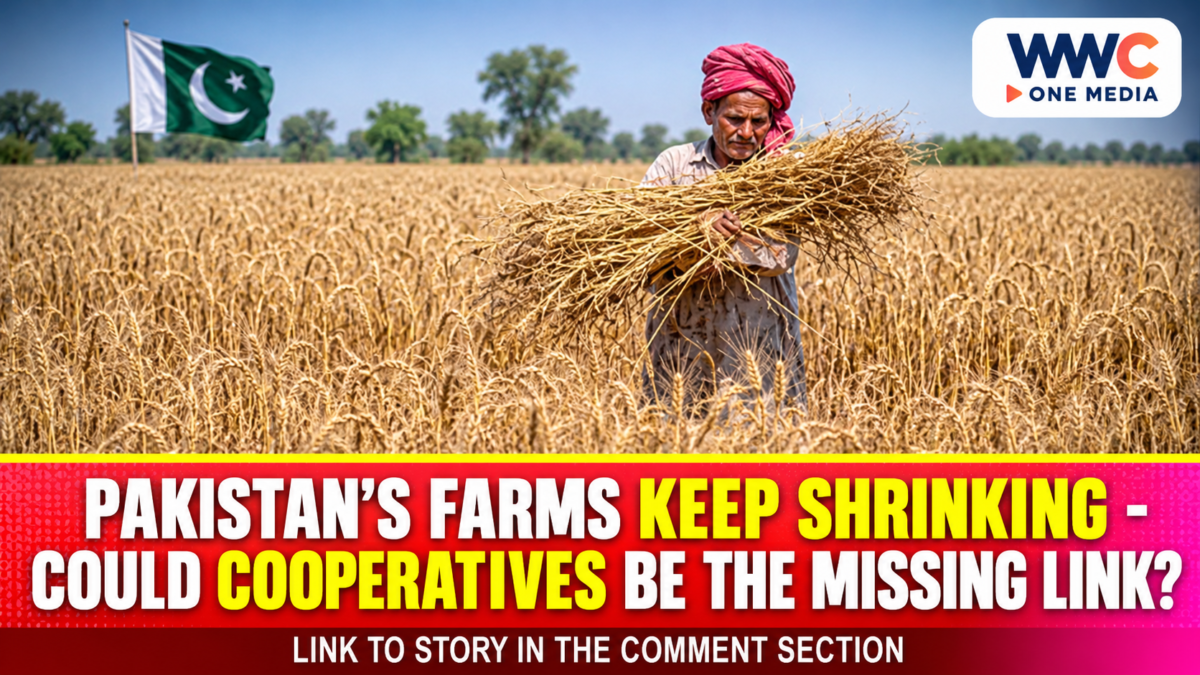
The country’s latest agricultural census exposes the scale of the problem: the average farm size fell from 6.4 acres in 2010 to approximately 5.1 acres in 2024. Meanwhile, the number of farms recorded in the census increased, and millions of holdings were divided into separate plots.
The pattern creates a difficult commercial environment for small farmers. Buying equipment, arranging storage, securing credit and negotiating with processors can become more expensive when individual producers operate on small or scattered parcels.
One possible response is to help farmers work together through properly governed cooperatives or other producer organisations. That does not require families to surrender ownership of their land. It means pooling selected services, purchasing power, production and marketing so that small producers can operate with some of the advantages of scale.
The question is whether Pakistan can build institutions that farmers trust enough to make collective action work.
Pakistan’s farm-size problem is becoming harder to ignore
The Pakistan Bureau of Statistics’ 7th Agricultural Census 2024 shows that the average farm size declined from 6.4 acres in 2010 to 5.1 acres in 2024.
The census recorded 11,701,584 private farms covering 59.30 million acres. Of that area, 52.79 million acres were cultivated.
The distribution is particularly revealing. Farms measuring less than 2.5 acres account for approximately 61% of the private farms recorded in the national size table.
The fragmentation tables show another challenge. Of the 11,103,697 farms covered in the national fragmentation classification, 4,984,468 were recorded as fragmented. The table reports approximately 34.4 million separate fragments, with an average of seven fragments per fragmented farm.
These figures describe different census classifications and should not be treated as interchangeable totals. Together, however, they show how difficult it can be to organise production when land is divided into numerous small holdings and separate plots.
The consequences extend beyond the physical size of a farm. A farmer working a small parcel may find it difficult to justify the full cost of a tractor, harvesting equipment, irrigation infrastructure or cold storage.
A cooperative model could help spread some of those costs across multiple producers.
Why working together could change the economics
A cooperative is an organisation owned and governed by its members. In agriculture, members can jointly purchase inputs, use machinery, store produce, negotiate with buyers or operate processing facilities.
The idea is not to merge every farm into one large property. Landowners can retain ownership while agreeing to share specific services or market their output collectively.
For example, a group of farmers could jointly arrange tractor services rather than each household purchasing expensive equipment. A producer organisation could negotiate bulk purchases of seeds and fertiliser, potentially improving access to suppliers.
Milk producers could pool deliveries to meet the volume requirements of processors. Fruit and vegetable growers could coordinate grading, packaging and transport to reduce the cost of reaching larger markets.
These are potential benefits, not guaranteed outcomes. A cooperative needs transparent accounts, credible leadership, fair pricing rules and reliable payment arrangements. Without those safeguards, collective organisations can become vulnerable to poor management or capture by influential members.
Pakistan’s own financial authorities have identified several of the barriers that make smallholder farming difficult.
The financing gap is another obstacle
The State Bank of Pakistan’s Annual Report 2025–26 describes how smaller landholdings, uncertain farm incomes and weak collateral restrict farmers’ access to formal credit.
The report says agriculture accounts for less than 10% of total private-sector credit, while fewer than one-third of farm owners have access to formal finance.
It also identifies an imbalance in agricultural lending: smallholders account for 93% of existing borrowers of financial institutions, but their average share in annual disbursements is about 40%.
For banks, small loans can be costly to process and monitor. Farmers may also face documentation requirements, limited access to agricultural banking services and repayment schedules that do not match their production cycles.
A cooperative or producer organisation could potentially help farmers coordinate applications, obtain technical assistance and organise purchases. But it cannot automatically replace individual credit assessment or guarantee repayment.
The government and SBP have already introduced measures aimed at improving access.
Zarkhez-e shows how policy is trying to reach small farmers
Pakistan launched Zarkhez-e, also known as Asaan Digital Zarai Qarza, in October 2025 as a digital financing platform for small farmers and tenants.
The programme allows eligible applicants to seek collateral-free agricultural financing through a centralised digital process. Applications undergo identity and agricultural verification before being forwarded to participating financial institutions.
The State Bank’s 2025 risk-coverage scheme provides banks with 10% first-loss coverage on eligible agricultural lending, subject to the scheme’s conditions.
The SBP’s 2025–26 annual report says that, by September 2026, Zarkhez-e had reached more than 85% of districts, with around 60,000 farmers registered and more than 36,500 applications submitted. More than 17,000 loans amounting to Rs7.5 billion had been approved.
The programme is an important example of public policy trying to address the financing barriers faced by smaller producers. But digital lending and cooperative organisation solve different problems.
A loan can help a farmer buy inputs. A well-run producer organisation can help that farmer obtain machinery services, coordinate production, secure buyers and improve bargaining power.
Combining better access to finance with stronger farmer organisations could therefore be more effective than relying on either approach alone.
The next step is not simply creating more cooperatives
Pakistan’s agricultural institutions need more than a new registration drive.
Any cooperative revival would require safeguards that protect members’ ownership rights and prevent management from becoming controlled by a small group.
Members should have clear voting rights, access to accounts and information about how prices, expenses and profits are calculated. Independent audits and transparent procurement would help build confidence.
Disputes also need timely resolution. Farmers who deliver milk, crops or other produce cannot wait years for payment disagreements to be settled. Contracts must establish delivery standards, payment schedules and consequences for buyers or members who fail to meet their obligations.
The State Bank’s financing initiatives show that public institutions are already experimenting with ways to reduce barriers for small producers. The next challenge is connecting finance with practical services and market access.
WWC has examined similar questions about how smallholder farmers can benefit from agricultural research and technology partnerships. Access to innovation matters most when farmers can afford to adopt it and have buyers for the resulting produce.
The same issue applies to livestock. Expanding dairy production through improved cattle supply requires more than animals: producers need feed, veterinary services, collection facilities and dependable markets.
And when local agricultural programmes promise support, implementation matters. Cebu City’s farmer-assistance programme illustrates why budgets and policy announcements must be measured against what farmers actually receive.
What happens next?
Pakistan’s agricultural census provides a clearer picture of the country’s farm structure, while the State Bank’s latest report documents continuing barriers to finance and market access.
The policy challenge is to connect those findings with practical solutions.
Cooperatives could help farmers share machinery, buy inputs collectively, pool produce and negotiate with larger buyers. But success would depend on member control, transparent management, enforceable contracts and access to professional support.
The government does not need to force land consolidation or replace private ownership to make collective services possible. It can create a legal and financial environment in which farmers choose to cooperate because the arrangement offers measurable benefits.
Pakistan’s farms may be getting smaller, but their economic influence does not have to shrink with them.
The real test is whether farmers can build organisations strong enough to negotiate, invest and compete together—without losing control of the land and livelihoods they already own.