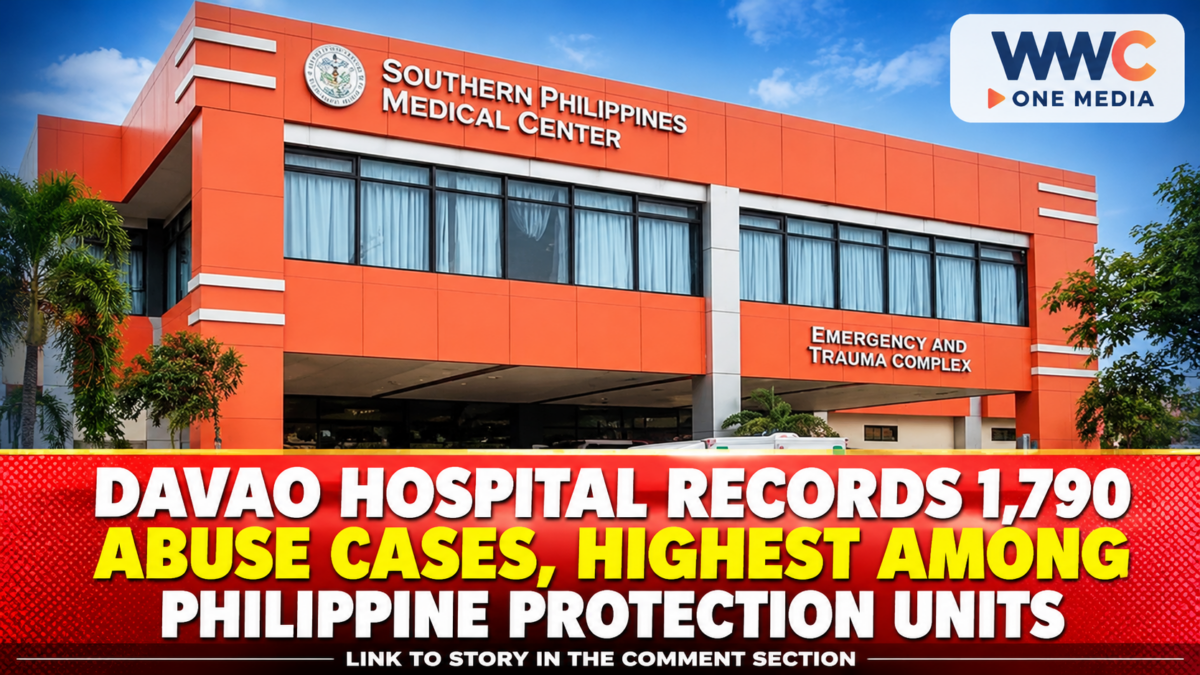
DAVAO CITY, Philippines — November 25, 2026 — Southern Philippines Medical Center (SPMC) has recorded the highest combined number of reported violence-against-women and violence-against-children cases among the facilities listed in the latest national protection-unit tally, placing renewed attention on the scale of abuse reaching hospitals in the Philippines.
The hospital’s Women and Children Protection Unit recorded 1,350 cases involving violence against children and 440 involving violence against women, bringing its combined total to 1,790 cases from January 1 to November 8, 2026.
The figure placed SPMC ahead of two other major hospital protection units: the Philippine General Hospital (PGH) in Manila, which recorded 1,666 cases, and Vicente Sotto Memorial Medical Center in Cebu, which recorded 1,475.
The numbers do not represent every abuse incident in the country. They reflect cases recorded by the participating protection units included in the Child Protection Network’s reporting system. Nevertheless, the figures show how heavily specialized hospital services are being used to respond to violence against women and children.
SPMC leads the reported hospital-unit tally
The national figures show a substantial caseload for SPMC’s protection unit.
Its 1,350 reported cases involving violence against children were lower than PGH’s 1,649. However, SPMC recorded 440 cases involving violence against women, considerably more than PGH’s 17.
That combination brought SPMC’s total to 1,790, compared with PGH’s 1,666.
Vicente Sotto Memorial Medical Center in Cebu recorded 790 cases involving children and 685 involving women, for a combined total of 1,475.
| Hospital protection unit | Violence against children | Violence against women | Combined total |
|---|---|---|---|
| Southern Philippines Medical Center, Davao | 1,350 | 440 | 1,790 |
| Philippine General Hospital, Manila | 1,649 | 17 | 1,666 |
| Vicente Sotto Memorial Medical Center, Cebu | 790 | 685 | 1,475 |
The comparison shows why the distinction between child-protection and women-protection cases matters. A hospital may record a high number in one category without having the highest combined total.
It also shows why the figures should not be used as a direct ranking of which city or region is the most dangerous. The reporting period, number of facilities, access to specialized services and willingness to report can all affect the number of cases recorded.
Why more reports do not automatically mean more abuse
A high number of reported cases can point to a serious protection burden, but it does not automatically establish that abuse is increasing at the same rate.
The Child Protection Network’s published statistics cover January 1 to November 8, 2026. Its reporting notes that figures are compiled from different sources, including its standalone Women and Child Protection Management Information System, spreadsheets submitted to the network and reports provided by individual protection units.
The figures therefore describe cases that reached the participating services during the reporting period. They are not a nationwide survey of all abuse incidents, and they should not be interpreted as a count of every individual survivor in the country.
Some survivors may never report what happened. Others may seek assistance through police stations, social welfare offices, community organizations or facilities that do not appear in the same hospital-unit tally.
This makes accessible reporting channels and effective referral systems essential. A rise in recorded cases can reflect greater willingness to seek assistance, improved detection or expanded access to services, as well as changes in the underlying incidence of abuse.
Davao’s wider child and women protection challenge
The SPMC figures form part of a wider picture of violence and vulnerability in the Davao Region.
The Philippine Statistics Authority’s 2025 National Demographic and Health Survey found that about 17% of women aged 15 to 49 in Davao Region who had ever been married or had an intimate partner reported experiencing physical, sexual or emotional violence committed by their current or most recent partner.
The survey reported that 15.1% experienced emotional violence, 8.8% physical violence and 2.9% sexual violence. These categories can overlap.
The survey and SPMC’s hospital records measure different things. The PSA figure comes from a population survey about experiences of intimate-partner violence, while the hospital tally counts reported cases handled by protection units. They should not be added together or treated as directly comparable.
Still, both sets of data underline the importance of prevention, early identification and access to support for people experiencing violence.
WWC ONE MEDIA has also examined the broader challenge of strengthening child protection in the Philippines, including the country’s international standing and the need to improve prevention in its 2026 child-protection assessment.
Online exploitation adds another layer to child safety
Child protection is no longer limited to what happens inside homes, schools or communities.
The Philippines’ Republic Act No. 11930, or the Anti-Online Sexual Abuse or Exploitation of Children and Anti-Child Sexual Abuse or Exploitation Materials Act, criminalizes a range of acts involving online sexual abuse and exploitation, including grooming, luring, livestreaming abuse and the production or distribution of child sexual abuse or exploitation materials.
The law also recognizes that online and offline abuse can be connected. Digital communication may be used to establish contact with a child, facilitate exploitation or distribute abusive material.
That makes parental awareness, school safeguarding, responsible digital-platform practices and accessible reporting channels important parts of the wider response.
The issue is particularly relevant as the country debates stronger protections for minors online. WWC ONE MEDIA previously examined the proposed restrictions on under-18 social media access and the challenge of balancing online safety with children’s access to digital services in its report on the Philippines’ proposed social media restrictions.
Protection requires more than recording cases
The number of cases handled by SPMC highlights the importance of specialized medical, psychosocial and legal support for survivors.
A protection response does not end when a patient reaches a hospital. Survivors may need medical examination, psychological assistance, social-work intervention, legal guidance and referrals to agencies that can help protect them from further harm.
The law also recognizes the need for recovery and rehabilitation. Republic Act No. 11930 identifies services that may include emergency shelter, counseling, free legal services, medical or psychological assistance, livelihood and skills training, and educational support for victims of child sexual abuse or exploitation and their families, when applicable.
The Department of Social Welfare and Development has also reiterated the importance of reporting abuse and protecting children from exploitation, including sexualized content and online misconduct.
For child-protection concerns, the government’s MAKABATA Helpline 1383 accepts reports and requests for assistance. The hotline can be reached by calling 1383, while mobile contact options include 0919-354-1383 for Smart subscribers and 0915-802-2375 for Globe subscribers.
WWC ONE MEDIA has previously reported on how local governments, social workers and journalists can work together to strengthen child protection, including Iloilo City’s initiative to improve reporting and media coverage involving minors.
The real test is whether survivors can get help earlier
SPMC’s 1,790 recorded cases make it the leading facility in the latest combined hospital-unit tally. But the figure should not become a reason to label Davao City as the country’s most abusive or dangerous location.
The more important question is whether survivors can reach help before violence escalates, whether children are protected from people who exploit their trust, and whether medical and social services have the resources to respond.
The challenge extends beyond one hospital. It requires families, schools, local governments, law enforcement agencies, health institutions and digital platforms to recognize warning signs and respond appropriately.
The national figures provide a snapshot of cases that reached specialized services. The incidents that remain unreported are not visible in the tally.
For Davao and the wider Philippines, the priority must be making protection accessible, ensuring survivors are treated with dignity and preventing abuse before another case reaches a hospital.