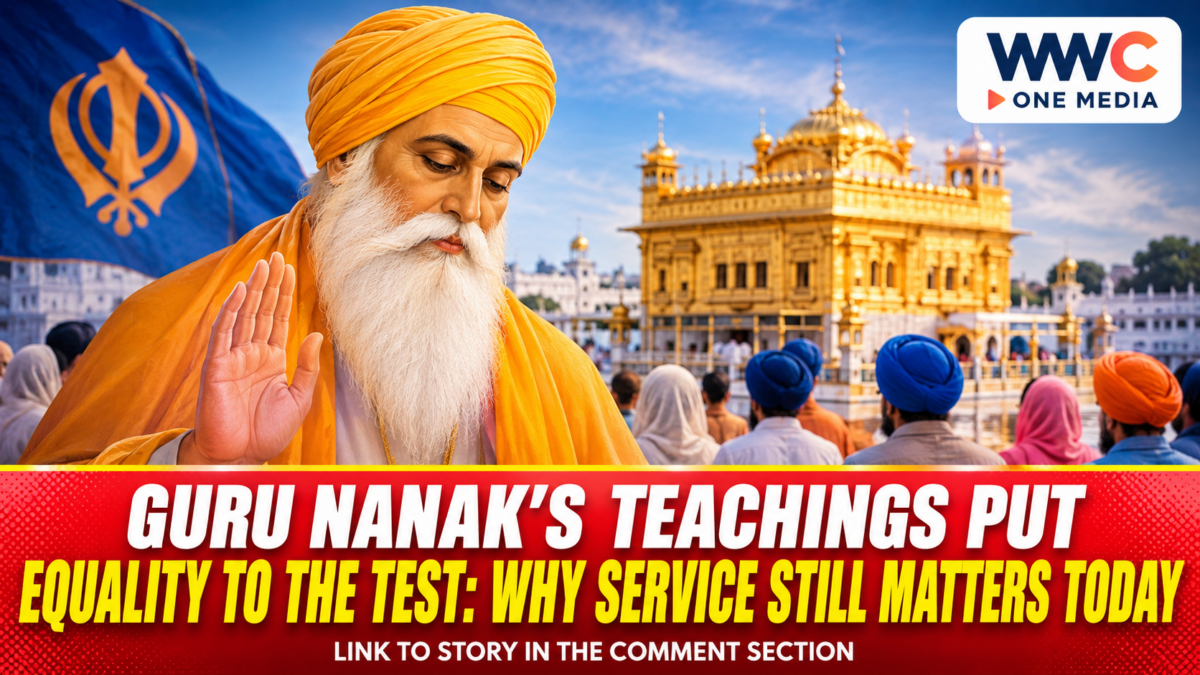
Guru Nanak Dev Ji’s birth anniversary was observed on November 24, 2026, a date listed for his birthday in Punjab’s official holiday calendar and coinciding with Karthika Pournami in Telangana’s state calendar. The annual observance offers an opportunity to examine a central part of his legacy: the belief that equality must be reflected in how people live, work and treat others—not simply in what they say they believe.
For communities marking Prakash Purab, the remembrance carries a message that reaches beyond a religious gathering. The Sikh tradition associated with Guru Nanak places importance on honest labour, sharing with others and serving people in need. These principles provide a practical way to consider whether the ideals of social harmony are being carried into everyday life.
Guru Nanak teachings connect faith with everyday conduct
Guru Nanak Dev Ji was born in 1469, according to the Shiromani Gurdwara Parbandhak Committee’s historical account published in its Gurdwara Gazette. The same account describes his teaching of one God and his rejection of the idea that one person or group should be regarded as inherently superior to another.
The account sets out three principles commonly expressed as Kirat Karo, Naam Japo and Vand Chakko: earn honestly, remember or meditate on the Divine, and share with others. It also emphasises truthful living and the dignity of labour. <Cite refs={[“turn582377view1″,”turn582377view2”]}/>
These principles matter because they connect spiritual belief with decisions made outside places of worship. Honest work concerns how people earn a living. Sharing concerns how they respond to another person’s needs. Equality concerns whether they extend respect without using social position, wealth, caste or gender as a measure of human worth.
That makes the teachings relevant not only during an annual observance but also in workplaces, schools, neighbourhoods and public institutions.
Equality is more than a message for special occasions
The SGPC-published account says Guru Nanak emphasised equality across caste, colour, creed, gender and race. It also records his position that no one should claim superiority over another because all creation comes from one God. <Cite refs={[“turn582377view1”]}/>
The principle is straightforward, but applying it can be difficult. Social divisions can persist through unequal treatment, exclusion from opportunities, discrimination and assumptions about who deserves respect.
A public celebration can bring people together for a shared occasion, but the deeper test is what happens after it ends. Do people receive fair treatment regardless of their background? Are workers respected for their contribution? Can members of different faiths participate in community life without being treated as outsiders?
These are questions for society as a whole. They should not be reduced to a judgment about any single religious group or community.
The same wider discussion of religious respect has appeared in WWC ONE MEDIA’s coverage of a Philippine college dispute over Muslim students’ religious attire. The circumstances are different, but the underlying public concern is similar: institutions and communities must take religious dignity seriously while dealing fairly with people whose beliefs differ.
Langar makes the principle of sharing visible
One of the most recognisable Sikh practices associated with service is langar, the community kitchen where food is prepared and offered to people. The SGPC-published account describes service to people who are hungry or in need as an important social duty and identifies the free kitchen as part of Guru Nanak’s legacy. <Cite refs={[“turn582377view2”]}/>
The practice gives a concrete form to the principle of sharing. Food is not merely discussed as an expression of compassion; it is prepared and distributed. Participation can involve cooking, serving, organising or contributing supplies.
Its wider social significance lies in the idea that a person’s dignity should not depend on wealth or status. A shared meal can create a setting in which people meet on equal terms, even if their circumstances outside that space are very different.
This does not mean one act of charity can resolve poverty or discrimination. Community kitchens are not substitutes for public services, fair wages or policies that address the causes of hardship. But they can demonstrate how service becomes meaningful through consistent action.
The importance of organised community assistance also appears in WWC ONE MEDIA’s report on Filipinos volunteering to prepare emergency food packs. Disaster relief and langar are different traditions and activities, but both illustrate how practical help depends on people contributing time and effort.
Religious harmony requires respect across differences
Guru Nanak’s teachings, as presented in the SGPC account, recognise the oneness of God and describe encounters with people from different religious traditions. The account also discusses the universal character of his message and the importance of harmonious living. <Cite refs={[“turn582377view1”]}/>
Harmony, however, should not be confused with the absence of disagreement. A diverse society will contain different beliefs, customs and convictions. Respect is demonstrated when people can hold those differences without discrimination, coercion or hostility.
That distinction is important in cities where many communities share public spaces. Religious freedom includes the ability to practise one’s faith, while social harmony also depends on respecting the rights of neighbours who follow another faith—or none.
For public institutions, the responsibility is practical: apply rules fairly, protect people from discrimination and avoid treating one religious identity as more deserving of public respect than another.
WWC ONE MEDIA has also examined how public events can bring religious and cultural communities together in its report on Cebu’s Halad sa Pagtuo celebration. Such events differ in tradition and purpose, but they raise a shared question about how communities make public celebrations welcoming, accessible and respectful.
The public calendar marks the date; people carry the message
The Government of Punjab’s 2026 calendar lists November 24 as the birthday of Sri Guru Nanak Dev Ji. Telangana’s official 2026 calendar lists November 24 as Karthika Pournami. The dates place the observance within the public calendar, but a holiday entry alone cannot measure how deeply the associated values are practised. <Cite refs={[“turn532281search48″,”turn582377view0”]}/>
That distinction is worth remembering. Annual observances preserve memory and give communities time to gather, pray and reflect. Their lasting value, however, depends on whether the principles being remembered influence daily conduct.
Guru Nanak’s emphasis on honest work, sharing and equality offers a standard that can be applied in ordinary settings: how an employer treats workers, how a neighbour responds to someone in need, how an institution accommodates religious differences and how people speak about those outside their own community.
What happens next
Prakash Purab will return as an annual observance, but the work of putting its values into practice does not need to wait for another anniversary. Community organisations can continue service initiatives, institutions can review whether their practices treat people fairly, and individuals can make sharing and respect part of daily life.
The enduring challenge is not simply to remember a message of equality. It is to make that equality visible in the choices people make when no celebration is taking place.
Frequently asked questions
When was Guru Nanak Dev Ji born?
The SGPC-published historical account states that Guru Nanak Dev Ji was born in 1469 at Nankana Sahib, in present-day Pakistan. <Cite refs={[“turn582377view1”]}/>
What is Prakash Purab?
Prakash Purab is an observance marking the birth anniversary of a Sikh Guru. Guru Nanak Dev Ji’s Prakash Purab is also widely known as Guru Nanak Jayanti.
What are the three principles associated with Guru Nanak’s teachings?
They are commonly expressed as Kirat Karo (earn honestly), Naam Japo (remember or meditate on the Divine) and Vand Chakko (share with others). <Cite refs={[“turn582377view1”]}/>
What is langar in Sikhism?
Langar is the community kitchen tradition in which food is prepared and served to people. It expresses service, sharing and the principle that people should be treated with dignity. <Cite refs={[“turn582377view2”]}/>
Why are Guru Nanak’s teachings relevant today?
His emphasis on equality, honest work, service and sharing provides principles that can guide how people treat others in workplaces, communities and public institutions.