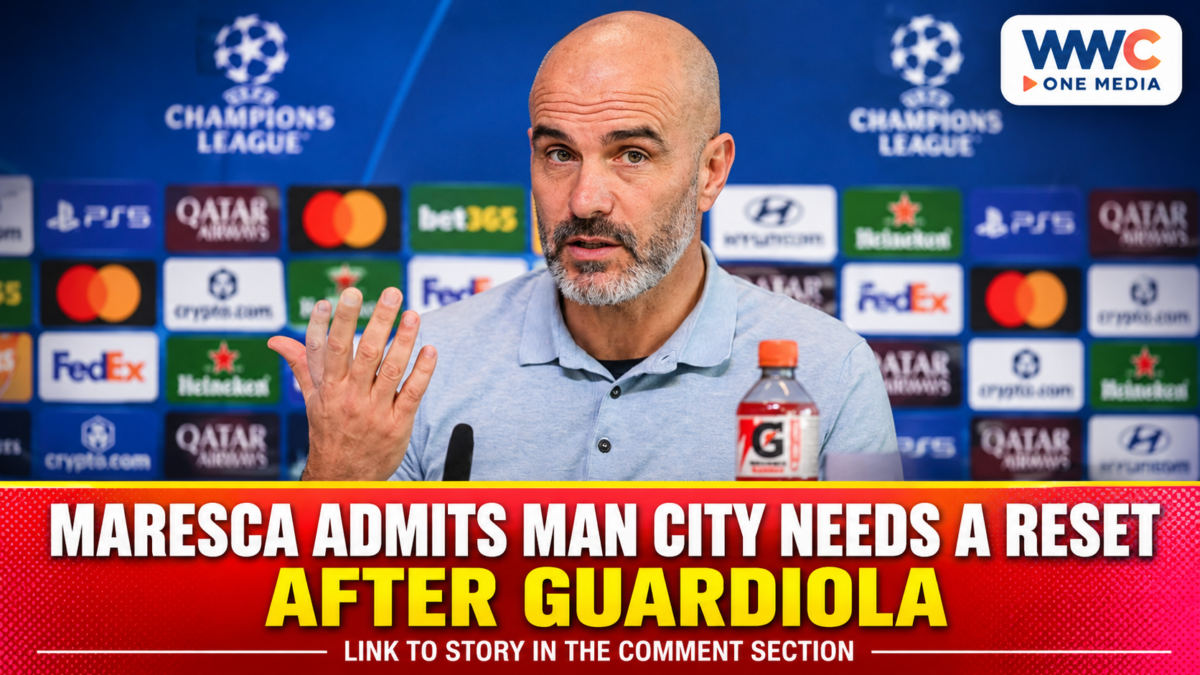
MANCHESTER, England — Manchester City are discovering that replacing a manager who shaped an entire footballing era is about more than changing the name on the touchline.
Enzo Maresca has acknowledged that the club needs a reset following Pep Guardiola’s departure after 10 years in charge. But the Italian’s first major challenge is becoming increasingly clear: restoring consistency to a team that has struggled to turn possession and attacking pressure into reliable results.
City’s 2-2 Champions League draw against Napoli on November 24 offered another example. The home side twice came from behind at the Etihad Stadium, but could not secure the victory Maresca wanted.
Rayan Cherki scored the late equaliser after Ayyoub Bouaddi had also brought City level. Napoli’s goals came through Rasmus Højlund and Noa Lang.
The result left City with 10 points from five Champions League league-phase matches, keeping them inside the top eight at that stage of the competition. Yet the performance also reinforced Maresca’s concerns about defensive balance and the team’s ability to manage difficult moments.
The manager’s message is clear: the transition is still under way, but patience alone will not solve the problems.
Why Maresca Says Manchester City Must Start Again
Maresca’s explanation centres on the scale of the change at Manchester City.
Guardiola spent a decade establishing a distinctive footballing identity at the club. His teams became associated with possession-based football, positional rotations, aggressive pressing and an emphasis on controlling matches through structure.
Maresca, who previously worked as one of Guardiola’s assistants, understands that system better than many incoming managers.
But understanding the previous approach does not mean reproducing it immediately.
Ahead of the Champions League meeting with Napoli, Maresca explained that the club was effectively starting again after 10 years under the same manager, with the same methods and expectations.
He described the transition as a reset or restart and said the team was still working to find the right balance.
The problem, he explained, was not limited to midfield. The coaching staff were also experimenting with defensive personnel and combinations to identify the right solutions for different opponents.
That distinction is important. Maresca is not simply asking players to learn a new formation. He is trying to establish how the entire team should operate under a different leadership structure.
Seven Straight League Wins Were Followed by a Difficult Spell
Maresca’s opening months at Manchester City initially suggested that the transition would be smoother.
The club began the 2026/27 Premier League campaign with seven consecutive victories, giving the new manager an impressive start and creating expectations that City could quickly maintain their position among the title contenders.
The momentum has since weakened.
Before the Napoli match, City had gone four consecutive Premier League games without a victory, following defeats and a 1-1 draw against Fulham on November 21.
That Fulham result was particularly significant because it ended City’s 20-match winning streak against the London club across all competitions.
Rodrigo Muniz put Fulham ahead before Elliot Anderson equalised for City. The home side had opportunities to take all three points but could not find a winner.
The dropped points also exposed a recurring problem: City have been forced to chase matches after conceding first.
Maresca acknowledged after the Fulham draw that the team needed to find a way to keep clean sheets rather than repeatedly placing itself under pressure.
WWC’s report on Manchester City’s frustrating 1-1 draw with Fulham examined how the result ended the club’s long winning sequence against the London side and intensified questions about its defensive organisation.
Napoli Draw Shows Both City’s Fighting Spirit and Its Defensive Weakness
The Champions League match against Napoli provided a fresh test of Maresca’s rebuilding process.
After a goalless first half, Napoli took the lead through Højlund, who scored on his return to Manchester.
City responded when substitute Jeremy Doku set up Bouaddi for the midfielder’s first senior goal.
Napoli moved ahead again through Lang, whose volley restored the visitors’ advantage. Cherki then rescued a point with a low finish from a tight angle.
The final score was 2-2.
City’s ability to recover twice demonstrated that the team has not lost its willingness to fight. However, conceding twice from a limited number of Napoli opportunities left Maresca frustrated.
After the match, he said the result was not what the team wanted, but argued that taking a point was preferable to losing.
He also pointed to Napoli’s clinical finishing, noting that the visitors converted two of their three shots on target.
For Maresca, the issue was not simply the amount of possession City enjoyed. It was the relationship between the chances the team created and the goals it conceded.
The manager said the two Napoli goals could have been avoided and acknowledged that City needed to improve its defensive balance.
The match therefore offered a mixed assessment: City showed resilience, but their defensive problems remained visible.
Maresca’s Connection to Guardiola Is Both an Advantage and a Challenge
Maresca is not arriving at Manchester City as an outsider unfamiliar with the club’s footballing philosophy.
He previously managed the club’s Elite Development Squad, returning in June 2022 as part of Guardiola’s coaching staff.
That experience gave him direct exposure to the training methods, tactical principles and expectations that shaped the first team.
His subsequent managerial career also gave him experience beyond the City structure.
At Leicester City, he guided the club back into the Premier League by winning the Championship title. He later took charge of Chelsea, winning the UEFA Conference League and the FIFA Club World Cup before leaving Stamford Bridge in January 2026.
Manchester City appointed him on June 29, 2026, confirming a three-year contract running until summer 2029.
His return represents continuity in some areas, but it also gives him the responsibility of building a team that can succeed without relying on Guardiola’s daily influence.
That is a difficult balance. A manager who understands the previous system must still establish his own authority, methods and selection preferences.
The Premier League’s official manager profile also documents Maresca’s progression from City’s development structure to Leicester, Chelsea and eventually the senior Manchester City job.
WWC previously covered Maresca’s opening seven-match Premier League winning run, which showed how quickly the new manager initially established momentum.
The contrast between that start and the current run illustrates how quickly expectations can change at a club competing for major honours.
The Midfield Question: Finding the Right Combination
One of Maresca’s immediate tactical challenges is determining which midfield combination gives City the best balance.
The manager has acknowledged that he is still learning which players are best suited to particular opponents and match situations.
This is not unusual during a managerial transition, particularly when the squad contains players with different strengths and responsibilities.
A midfield must provide more than technical quality. It must also protect the defence, control transitions, support the forwards and maintain the team’s shape when possession is lost.
If too many players move forward, the team can become vulnerable to counterattacks. If the midfield remains too conservative, the attack may struggle to create enough pressure.
The Napoli match illustrated the difficulty. City controlled significant periods of the contest but still conceded twice, forcing the team to recover from behind on both occasions.
Maresca’s challenge is to find a combination that allows City to attack with their usual ambition without exposing the defensive line.
That is why his reference to finding the right balance is more than a general comment about adjusting to a new manager. It points to a tactical issue that can directly influence the team’s results.
Arsenal Is the Next Major Test for Maresca
Manchester City’s next Premier League assignment is a major away fixture against Arsenal on November 29.
The match carries additional significance because Arsenal are among the teams City are chasing in the title race.
City cannot afford to approach the game as another opportunity to experiment without considering the consequences of dropping more points.
The team must improve its defensive concentration, manage transitions more carefully and avoid giving Arsenal early opportunities to take control.
The Champions League draw with Napoli may provide some encouragement because City recovered twice and remained competitive until the final whistle. But Arsenal will offer a different tactical challenge and are capable of punishing defensive mistakes.
For Maresca, the fixture is an opportunity to demonstrate that the reset is beginning to produce tangible improvements.
A positive result would not complete the transition, but it could restore confidence and provide momentum after a difficult run.
What Guardiola’s Departure Means for Manchester City’s Future
Guardiola’s departure was always going to create a major adjustment period.
During his 10-year tenure, Manchester City developed a recognisable style and built expectations around sustained domestic success and regular involvement in the latter stages of European competition.
The challenge for the club is to preserve the standards established during that period while allowing a new manager to develop a different approach.
Maresca’s appointment suggests that City wanted a coach familiar with the organisation and its footballing principles. His previous experience within Guardiola’s staff offers continuity, but it does not guarantee that the transition will be immediate.
There are also wider questions surrounding the club’s future, including squad development, recruitment and the expectations attached to competing at the highest level.
Those issues are separate from Maresca’s immediate tactical responsibilities, but they form part of the environment in which he must work.
WWC has also examined the separate Manchester City financial case and its ongoing appeal process. That matter concerns the club’s governance and financial-rule proceedings, not the team’s current results, and should not be confused with the sporting challenges facing the new manager.
The Real Test Is Turning the Reset Into Results
Maresca has explained why Manchester City cannot simply continue as though Guardiola had never left.
The club is adjusting to a new manager, different methods and evolving player combinations after a decade under one of the most influential coaches in modern football.
But the 2-2 draw with Napoli showed that the transition still has work to do.
City remain competitive, have shown the ability to recover from difficult positions and are still in contention for Champions League progress. However, the repeated defensive problems and the recent Premier League results have increased the pressure on Maresca to find solutions.
His task is not to become another Guardiola. It is to establish a Manchester City team that can win consistently under his own leadership.
The Arsenal match will provide another important indication of whether that process is beginning to take shape.
For now, Maresca has identified the problem. The next step is proving that his reset can deliver results.