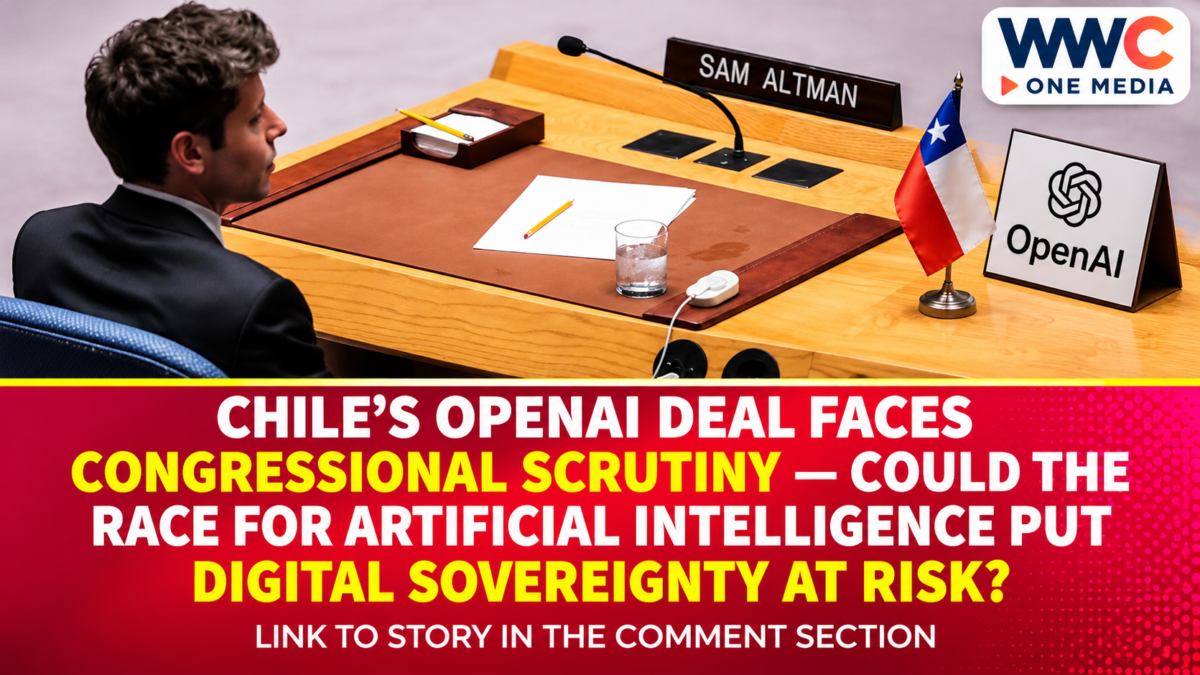
SANTIAGO, Chile — The Chile OpenAI agreement has become the subject of congressional scrutiny as lawmakers seek greater clarity concerning the government’s plans to integrate artificial intelligence into public administration, train civil servants and support local technology startups.
Chile’s Minister of Science, Technology, Knowledge and Innovation, Ximena Lincolao, signed a memorandum of understanding with OpenAI on November 16, 2026, in California, United States.
The initiative, known as OpenAI for Chile, aims to improve government services and strengthen the country’s technological capabilities.
However, formal parliamentary requests issued following the agreement have raised questions concerning supplier selection, government spending, personal information protection and technological independence.
The controversy presents an increasingly important challenge for governments worldwide: how to benefit from advanced artificial intelligence without surrendering effective control over public institutions, sensitive information and national technology strategies.
Chile OpenAI Agreement: What Has Actually Been Signed?
The memorandum establishes a preliminary framework for cooperation between Chile’s science ministry and OpenAI.
Its objectives cover three principal areas: modernising government administration, developing public-sector AI skills and supporting Chilean entrepreneurs.
The arrangement creates opportunities for government institutions to explore new technological applications without immediately committing to nationwide deployment.
OpenAI publicly launched the initiative on November 17 as part of its international OpenAI for Countries programme, with support from the US Department of Commerce’s American SI Exports Program.
However, the memorandum is not a completed procurement contract.
It does not establish a guaranteed investment amount, compulsory purchase of AI services or exclusive commercial relationship.
Most provisions are non-binding, although the sections addressing confidentiality and public communications create binding obligations.
This distinction is important because preliminary cooperation can influence future technology decisions without immediately establishing substantial financial commitments.
Why Chilean Lawmakers Are Demanding Answers
Congressional oversight began shortly after the agreement was signed.
On November 17, Deputy Gael Yeomans Araya submitted a formal request seeking information about the agreement’s commitments, the process used to select OpenAI and safeguards surrounding personal information.
Her request also addresses whether government databases could become accessible to the company, where information would be processed and whether it could be used in AI model training.
Deputies Irací Hassler Jacob and Sofía González Cortés submitted another request seeking details of the science ministry’s agreements and meetings with artificial intelligence companies.
Deputy José Montalva Feuerhake separately requested the complete memorandum, accompanying documents and the technical and legal assessments supporting its execution.
The parliamentary documents establish that lawmakers are examining the government’s decisions.
They do not establish that OpenAI has obtained unauthorised access to public databases or that the ministry has violated Chilean law.
Nevertheless, the questions demonstrate why technology procurement requires transparent governance, particularly when applications may eventually interact with public-sector information.
Digital Sovereignty Becomes the Central Issue
Digital sovereignty describes a country’s ability to exercise meaningful control over its digital infrastructure, information and technology-related decisions.
For government institutions, sovereignty extends beyond the physical location of computer servers.
It also involves determining who can access information, which legal requirements apply, how technology providers are supervised and whether public institutions can change suppliers without excessive disruption.
The Chilean memorandum identifies privacy, cybersecurity and human oversight as considerations for future AI applications.
However, it does not commit OpenAI to establishing computing infrastructure within Chile.
That leaves important operational questions to be addressed through subsequent agreements and technical assessments.
Comparable concerns have emerged in WWC ONE MEDIA’s coverage of the proposed US–Malaysia sovereign AI cloud and government control over national data.
For Chile, the central policy question is not whether foreign technology should be used.
It is whether public institutions can retain sufficient authority over how that technology operates, what information it processes and how its performance is independently evaluated.
Chile Delays Its New Data Protection Framework Until October 2027
The AI partnership comes at an important moment in Chile’s regulatory development.
On November 23, 2026, Chile published Law No. 21.855, modifying its previously enacted personal data protection legislation, Law No. 21.719.
The amendment establishes October 15, 2027, as the new effective date for the principal data protection reforms.
It also expands the governing council of the future Personal Data Protection Agency from three members to five.
This creates a transitional period during which AI-related initiatives could continue developing before the new regulatory framework becomes fully operational.
However, the postponement does not mean that Chile currently has no data protection laws or that government institutions are automatically free to disclose personal information.
The implications of the transition will depend on existing legal obligations and the safeguards established for individual technology projects.
For citizens, important questions include whether sensitive information will remain adequately protected and whether effective mechanisms will exist to address inappropriate data processing.
Could OpenAI Gain a Long-Term Competitive Advantage?
Although the agreement contains no exclusivity provision, early participation in government technology programmes could create commercial advantages for a technology supplier.
Training public servants on particular software platforms may encourage familiarity with those systems.
If administrative processes subsequently become dependent on specialised applications, changing providers could require additional training, technical modifications and financial expenditure.
This potential challenge is commonly described as vendor lock-in.
Vendor lock-in is not an established outcome of Chile’s agreement. It is a commercial risk that could emerge depending on future implementation decisions.
Governments can address such risks through interoperability requirements, data portability, transparent procurement and clearly defined contract termination arrangements.
International public-sector AI projects already demonstrate the importance of these questions, including Singapore’s introduction of an AI chatbot for government services.
For Chile, retaining flexibility could be particularly valuable as AI technology and market competition continue evolving.
Chile Is Also Developing Alternative AI Partnerships
The OpenAI arrangement does not represent Chile’s only technology cooperation initiative.
On November 11, the science ministry announced a separate memorandum with ElevenLabs intended to support Chilean startups through access to voice and audio technologies.
ElevenLabs expressed its intention to provide up to 44 million platform credits over 12 months to eligible businesses.
Chile has also pursued regional AI development through Latam-GPT, an initiative designed to develop language technology for Latin America and the Caribbean.
On November 24, 2025, Chile announced an agreement to incorporate Peru into that regional project.
These initiatives illustrate the possibility of pursuing multiple international and regional technology partnerships simultaneously.
A diversified technology strategy could help reduce dependence on any individual provider while supporting local innovation.
However, participation in several initiatives does not automatically guarantee technological independence or equal access to commercial opportunities.
The quality of implementation remains essential.
What Happens Next for Chile’s OpenAI Agreement?
The next meaningful developments will include the ministry’s responses to parliamentary inquiries, detailed implementation plans and any subsequent commercial contracts.
Future agreements will need to establish financial responsibilities, participating institutions, technology access and applicable information-security requirements.
Government agencies should also consider independent performance evaluations, particularly where AI-generated information could affect important public services.
The importance of effective monitoring has been examined in OpenAI’s disclosures concerning unexpected AI behaviour and the challenges of supervising advanced models.
Chile’s AI partnership presents legitimate opportunities to improve productivity, strengthen public-sector capabilities and encourage entrepreneurship.
It also raises legitimate questions concerning transparency, competition and digital governance.
The eventual success of the initiative will depend not simply on how quickly Chile adopts artificial intelligence, but on whether it can establish enforceable safeguards and measurable public benefits.
Frequently Asked Questions
What is the Chile OpenAI agreement?
It is a memorandum of understanding signed on November 16, 2026, establishing a framework for cooperation in government AI adoption, civil servant training and startup development.
Is Chile’s agreement with OpenAI legally binding?
Most provisions are non-binding. However, the memorandum establishes binding obligations relating to confidentiality and public communications.
Will OpenAI receive Chilean citizens’ personal data?
The memorandum does not independently establish that such information has been transferred. Detailed data processing and security arrangements remain important matters for future implementation.
When will Chile’s new data protection legislation take effect?
Law No. 21.855 establishes October 15, 2027, as the effective date for the principal reforms under Law No. 21.719.
Does Chile have to purchase OpenAI products?
No. The memorandum does not constitute a procurement award, exclusive commercial arrangement or mandatory purchasing commitment. Separate agreements would be necessary for specific commercial services.