
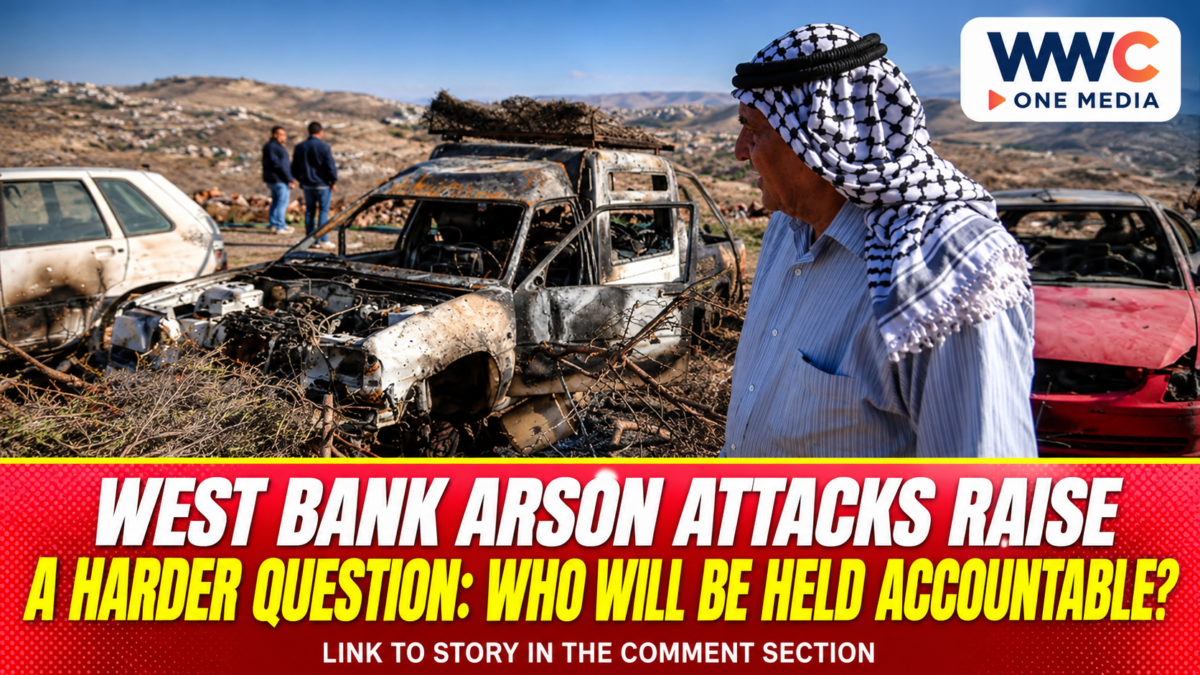
Twelve Palestinian-owned vehicles were set on fire in three villages in the occupied West Bank early on November 22, with residential walls also marked by graffiti, according to a report published that morning by the Palestinian official news agency WAFA. The reported incidents in Kafr Malik, Deir Abu Mash’al and Deir al-Sudan have renewed attention on the protection of Palestinian communities and the difficulty of establishing accountability for attacks on civilian property.
The fires are part of a wider pattern of property damage and intimidation documented by United Nations humanitarian monitors. The immediate challenge is to establish what happened in each village, identify those responsible through a credible investigation and ensure that residents can continue using their homes, vehicles and livelihoods without fear of further attacks.
West Bank arson attacks reported in three villages
The November 22 report identified three locations in the Ramallah and al-Bireh governorate.
In Kafr Malik, east of Ramallah, local sources cited in the report said seven vehicles were burned in the northern part of the village and graffiti was sprayed on residential walls. In Deir Abu Mash’al, northwest of Ramallah, three vehicles were reportedly set alight. Two more vehicles belonging to Palestinian residents were reported burned in Deir al-Sudan, north of Ramallah.
The reported total was 12 vehicles.
The report attributed the incidents to Israeli settlers, but the underlying account of the individual attacks was attributed to local sources. The information reviewed for this article did not include a publicly accessible police case file, forensic report, suspect identification or court record establishing criminal responsibility.
That distinction matters. The reported damage should be taken seriously, but responsibility for a specific crime must be established through evidence and a proper legal process. No individual or organisation should be declared guilty on the basis of an untested allegation.
A wider pattern of attacks has affected Palestinian communities
The fires occurred against a backdrop of sustained property damage, injuries and displacement across the West Bank.
In its November 18 humanitarian situation report, the United Nations Office for the Coordination of Humanitarian Affairs recorded 40 settler attacks resulting in casualties or property damage across 30 communities between November 10 and 16. The same reporting period included 38 Palestinians injured by settlers and 68 people displaced by settler attacks and related access restrictions, including 31 children.
The report also documented damage to homes, commercial property and essential infrastructure. In Al Lubban ash Sharqiya, Nablus governorate, a vehicle repair garage and electricity poles were reportedly set on fire, disrupting power for approximately 15 herding families and three houses. Five Palestinians were injured while trying to extinguish the fire.
These figures describe incidents recorded during a defined reporting period; they are not a judicial determination of responsibility in every case. But they show why the latest reports cannot be considered only as isolated property-loss events.
WWC previously examined efforts by former Israeli military officials to support Palestinian olive farmers. That separate initiative reflected concerns about the safety of farming communities and access to agricultural land.
Damage to property can also threaten livelihoods
A burned vehicle is not necessarily just a damaged private asset. In rural communities, vehicles may be essential for reaching farms, transporting produce, taking children to school or accessing medical care.
When attacks affect agricultural equipment, storage facilities, water systems or electricity connections, the consequences can extend beyond the immediate repair bill. Households may lose income, farmers may miss harvesting periods and small businesses may struggle to resume normal operations.
The Humanitarian Country Team for the Occupied Palestinian Territory reported on November 20 that more than 400 settler attacks linked to the 2026 olive harvest had caused casualties or property damage since September. The statement also reported damage to more than 4,000 trees and saplings and the vandalism or theft of over 25,000 kilograms of produce.
The same statement estimated that between 80,000 and 100,000 Palestinian families in the West Bank rely on olives and olive oil, a sector contributing approximately 15 percent of agricultural gross domestic product.
Those figures underline the economic dimension of civilian protection. Damage to a vehicle or farm asset can affect a household immediately; damage to trees and agricultural infrastructure can reduce productive capacity over a much longer period.
Accountability requires more than public condemnation
An effective response to arson allegations requires investigators to establish the location and timing of each incident, document damage, collect physical evidence, review available recordings and identify potential witnesses. Suspects must be treated in accordance with due process, while victims should have access to protection and appropriate remedies.
The public records reviewed for this article did not provide a detailed police investigation file for the November 22 incidents. They also did not establish whether suspects had been identified, arrested or charged. Those details should not be inferred from reports that security personnel were deployed or that an investigation was announced elsewhere.
The UN Humanitarian Country Team has called for perpetrators of attacks on Palestinian communities and livelihoods to be stopped and held to account. Its November 20 statement also urged Israeli authorities to ensure safe and reliable access to agricultural land.
The wider diplomatic concern is reflected in the Philippines’ own public position. WWC’s report on the Philippine delegation’s walkout during the Israeli prime minister’s UN address examined Manila’s stated concern about the humanitarian situation and settler violence, alongside its support for a two-state solution.
Political statements do not replace criminal investigations. But they show that civilian protection and the future of the occupied territories remain part of international diplomatic discussions.
Civilian protection must extend beyond the immediate scene
The consequences of violence in the West Bank are not limited to the location where an incident occurs. Repeated attacks, restrictions on movement and damage to property can make it harder for families to remain in their communities.
A separate episode in Hebron illustrates how displacement and property damage can affect daily life. WWC’s coverage of Palestinian families returning to damaged homes after an Israeli military operation dealt with a different cause of displacement, not the November 22 arson reports. The comparison is relevant only in showing how households face practical recovery challenges when homes, businesses and essential services are disrupted.
For communities experiencing repeated insecurity, repairs alone may not be enough. Residents also need reliable access to roads, farmland, electricity and water, as well as confidence that complaints will be investigated.
What happens next
The most important next step is a verifiable account of the November 22 incidents: which properties were damaged, what evidence investigators collected, whether suspects were identified and whether any cases proceed to prosecution.
The public record reviewed here does not establish those outcomes. Further statements from Israeli police or military authorities, Palestinian authorities and independent monitors could clarify the investigation and the extent of the damage.
The broader humanitarian figures also require continued monitoring. The UN’s reporting shows that attacks and access restrictions have consequences for safety, housing, agriculture and essential services across the West Bank.
For the residents of Kafr Malik, Deir Abu Mash’al and Deir al-Sudan, the immediate issue is the damage left behind. For authorities, the test is whether the incidents are investigated impartially and whether practical measures prevent further attacks.
Frequently asked questions
What happened in the West Bank on November 22, 2026?
A Palestinian official news agency report, citing local sources, said 12 Palestinian-owned vehicles were set on fire in Kafr Malik, Deir Abu Mash’al and Deir al-Sudan. Graffiti was also reported on residential walls.
Which villages were affected by the reported arson attacks?
The three villages identified in the November 22 report were Kafr Malik, Deir Abu Mash’al and Deir al-Sudan, all in the Ramallah and al-Bireh governorate.
Were there injuries in the November 22 vehicle fires?
The primary report reviewed for this article did not document injuries connected specifically to those three incidents. It focused on vehicle damage and graffiti.
Have suspects been arrested?
The records reviewed for this article did not establish whether suspects had been identified, arrested or charged in connection with the November 22 incidents.
How widespread is settler-related property damage in the West Bank?
OCHA documented 40 settler attacks resulting in casualties or property damage across 30 communities between November 10 and 16, 2026. Its report also recorded injuries and displacement during that period.










