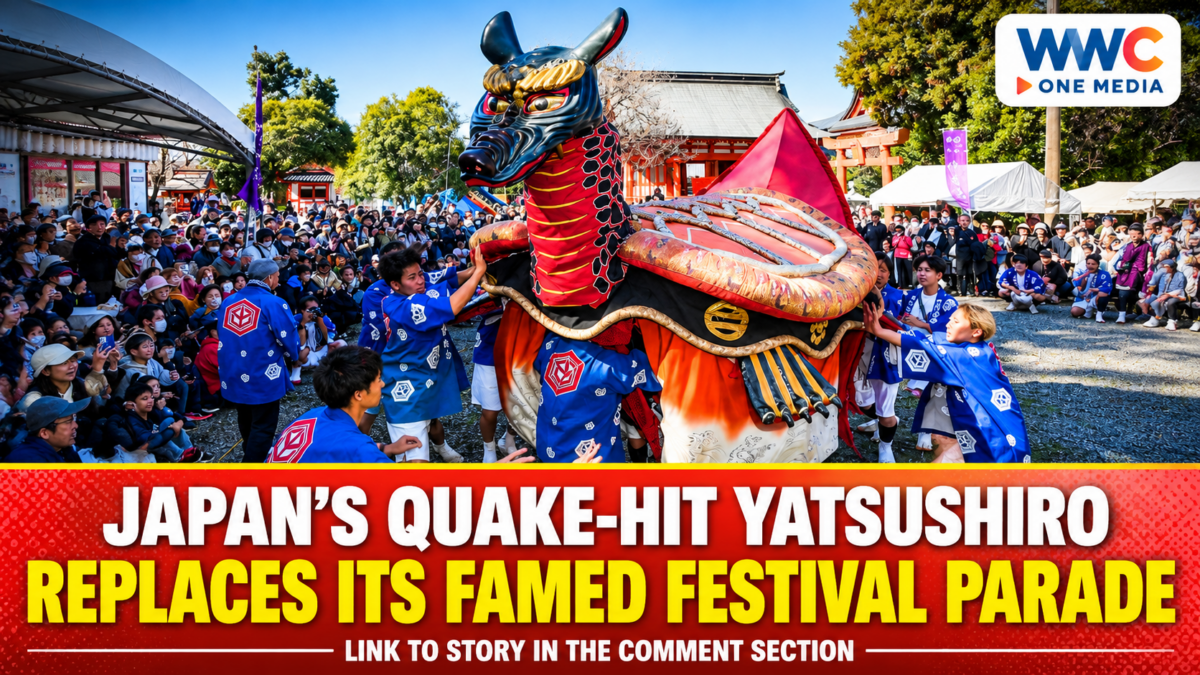
YATSUSHIRO, Kumamoto Prefecture, Japan — A centuries-old Japanese festival took a different form this year after a powerful earthquake disrupted preparations in Kumamoto Prefecture, prompting organisers to cancel its traditional procession and replace it with special events dedicated to community recovery.
At Yatsushiro Shrine on November 23, residents and visitors gathered for a recovery-prayer programme featuring traditional performances, including the distinctive kida creature and shishi lion dances. The celebrations also included a special dragon dance and a sky-lantern activity carrying messages of hope for the earthquake-affected community.
The gathering offered a different way to preserve the spirit of the Yatsushiro Myoken Festival, one of southwestern Japan’s best-known traditional cultural celebrations.
But the change was significant. The traditional shinko gyoretsu procession, which normally forms the centrepiece of the annual festival, was cancelled because of the damage caused by the July 2026 Kumamoto earthquake and concerns about public safety.
Why Japan’s Yatsushiro Myoken Festival Had to Change
The decision followed the magnitude-7.1 earthquake that struck Kumamoto Prefecture at 4:27 p.m. on July 28, 2026.
The earthquake caused widespread disruption across the prefecture. Yatsushiro City recorded seismic intensity 6-upper on Japan’s seven-level intensity scale, while other municipalities in the prefecture experienced intensity 7.
The damage affected homes, infrastructure, public facilities and cultural properties. The scale of the disaster made the safe organisation of large public gatherings a serious consideration for local authorities and festival organisers.
In September, Yatsushiro City announced that the main festival procession and associated events scheduled for November 22 and 23 would be cancelled. The decision was made following discussions involving Yatsushiro Shrine and the Yatsushiro Myoken Festival Preservation and Promotion Association.
The cancellation covered the traditional procession, the festival eve event, the children’s festival and activities planned to mark the 10th anniversary of the festival’s UNESCO intangible cultural heritage registration.
Some religious ceremonies were still expected to take place.
The decision reflected a difficult balance: preserving a major local tradition while taking into account the safety and circumstances of residents affected by the earthquake.
Kida and Shishi Lion Dances Keep the Tradition Alive
Rather than allowing the festival season to pass without a community gathering, organisers prepared a separate two-day recovery-prayer programme.
The November 23 event, held at Yatsushiro Shrine, included traditional shishi lion performances and the appearance of the kida, a mythical creature combining the characteristics of a turtle and a snake.
Known locally as the game or gama in some descriptions, the kida is one of the most recognisable figures associated with the Myoken Festival. It is linked to a local religious tradition in which the deity Myoken is said to have crossed the sea on the creature’s back.
The traditional figure is not simply a decorative festival prop. It is a large performance structure operated by several bearers inside its body, with one performer controlling its neck. Its movements, including sudden turns and playful gestures, make it a distinctive attraction during the festival.
The November 23 programme also featured a special performance of Nagasaki dragon dance by students from Kakumei High School, alongside a recovery-prayer ceremony and a local market.
A sky-lantern activity was scheduled for the evening, with participants invited to write messages expressing their wishes for the region’s recovery. The official event programme provided for up to 50 lanterns, with a scheduled release at 5:15 p.m.
The format was different from the usual procession, but it allowed residents to gather around familiar cultural symbols while expressing support for their community.
A Festival With Nearly Four Centuries of History
The Yatsushiro Myoken Festival is deeply connected to the history and religious traditions of Yatsushiro.
The festival is associated with Yatsushiro Shrine, also known as Myoken Shrine, and honours the deity Myoken, linked to the North Star and the Big Dipper.
Historical accounts maintained by the city describe the present form of the festival procession as developing around the time Lord Tadaoki Hosokawa moved to Yatsushiro Castle in 1632. The festival’s origins are older, with records suggesting related ceremonies existed even earlier.
The present festival tradition is generally dated to approximately 380 years ago.
Its traditional procession brings together a range of distinctive cultural performances and objects, including the kida, lion dances, decorated floats and other ceremonial participants. These elements reflect the religious beliefs, craftsmanship and community participation that have helped sustain the festival across generations.
In 2011, the Japanese government designated the festival’s procession as an Important Intangible Folk Cultural Property.
In 2016, the Yatsushiro Myoken Festival was included in UNESCO’s intangible cultural heritage listing for Japan’s Yama, Hoko and Yatai float festivals.
The designation recognises more than the visual spectacle of a procession. It also reflects the cultural knowledge, community participation and traditional practices involved in maintaining these events.
The Earthquake’s Impact Goes Beyond Festival Preparations
The cancellation of the procession is one visible consequence of a much wider recovery challenge.
Kumamoto Prefecture’s October 30 recovery plan reported that the July earthquake had caused 420 human casualties, including deaths and injuries, and damage to 82,223 residential buildings as of October 26.
The prefectural government also reported widespread disruption to essential services, including water, electricity and gas. At the peak of the evacuation response, 10,467 people were staying in evacuation centres on July 30. As of October 26, 1,073 people remained in evacuation centres across seven municipalities.
Yatsushiro’s own November 20 disaster report continued to document the local impact, including housing damage and losses involving businesses, public facilities and cultural properties.
These figures help explain why the usual festival programme could not simply proceed as planned. Public safety, damaged facilities and the circumstances of affected residents had to take priority.
WWC previously examined the wider consequences in its report on Kumamoto’s earthquake recovery and the scale of its reconstruction challenge.
The human dimension of the disaster is also evident in the story of a Japanese artist who returned to work after the earthquake damaged his home and studio.
Why Cultural Traditions Matter During Recovery
Traditional festivals can serve purposes beyond tourism and entertainment. They bring communities together, provide opportunities for younger generations to learn local practices and help maintain a shared sense of identity.
The Myoken Festival’s importance is particularly visible in its community-based performances. Its floats, costumes, dances and ceremonial objects require specialised knowledge and the participation of people who maintain these traditions.
That makes the interruption of a major procession more than a scheduling issue. It also raises questions about how communities can continue passing down cultural knowledge when disasters disrupt normal activities.
The recovery events in Yatsushiro offered one answer: retain selected performances and ceremonies, even when the full procession cannot safely take place.
A similar challenge can be seen in other parts of Japan, where restoring historic landmarks requires both physical reconstruction and the preservation of cultural identity. WWC’s coverage of Shuri Castle’s rebuilt main hall and Okinawa’s continuing restoration work examines another example of how Japan approaches the protection of its historic heritage.
What Happens to the Myoken Festival Next?
The 2026 cancellation does not mean that the Yatsushiro Myoken Festival has been permanently discontinued.
The special recovery events were organised to maintain the connection between the festival and the local community while the region continued addressing earthquake-related damage.
The traditional procession, however, was not held this year. The city and festival organisers have not established in the records reviewed here a confirmed date for the full procession’s return.
For now, the priority remains recovery, safety and the continuation of the cultural practices that make the festival significant.
The earthquake changed the way Yatsushiro marked its annual celebration, but the recovery programme demonstrated that cultural traditions can take different forms when communities face difficult circumstances.
For a festival that has survived for generations, this year’s gathering was a reminder that preserving heritage does not always require recreating the same spectacle. Sometimes, keeping the tradition alive begins with bringing people together again.