LAS VEGAS, Nevada — Formula 1 has another reason to believe its high-profile Las Vegas eLas Vegas Grand Prix Silences F1 Doubters With 352 Overtakes and a Sold-Out Crowd — But the Bigger Win Is a $3.2 Billion Business Boom
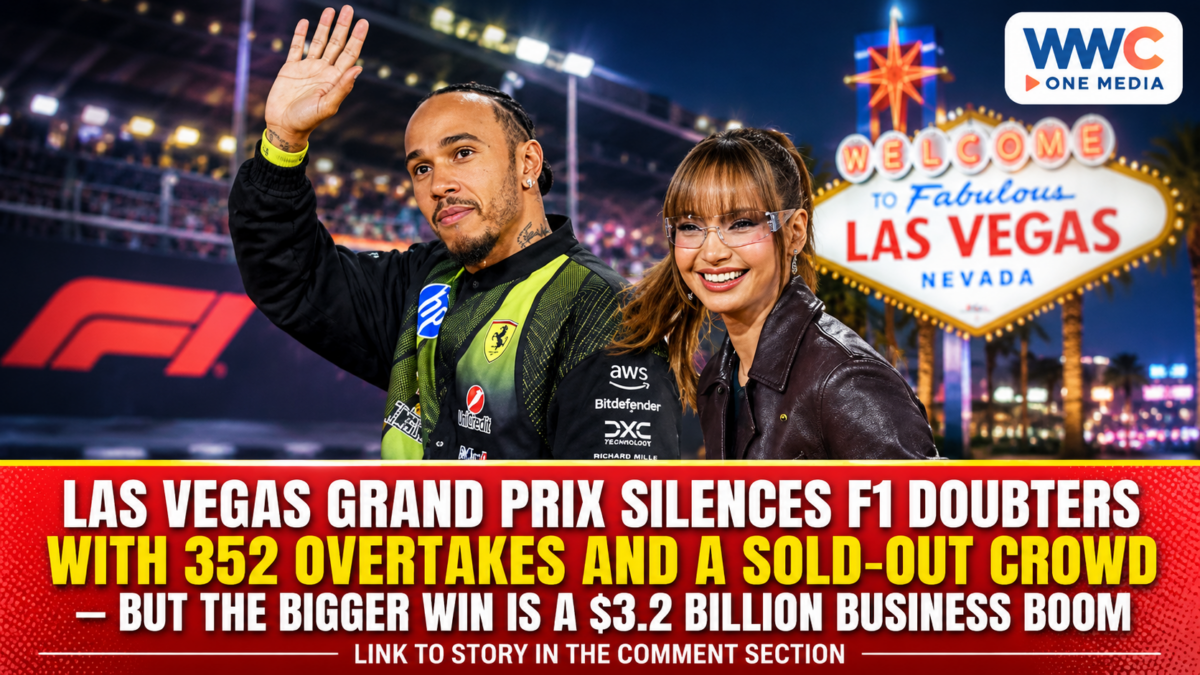
LAS VEGAS, Nevada — Formula 1 has another reason to believe its high-profile Las Vegas experiment is working. The 2026 Las Vegas Grand Prix delivered 352 overtakes, 35 lead changes and a dramatic finish, while the event also became the 21st consecutive sold-out race of the season.
Max Verstappen of Oracle Red Bull Racing won the November 21 contest after holding off McLaren’s Lando Norris by just 0.639 seconds. Oscar Piastri completed the podium, finishing 1.529 seconds behind the winner.
The 50-lap race transformed the Las Vegas Strip Circuit into a succession of battles, with drivers repeatedly using slipstreaming, energy deployment and overtaking modes to challenge for position.
But the significance of the weekend extended beyond the racing.
Formula 1 used the event to reinforce Las Vegas’s growing role as a commercial, entertainment and tourism destination. The championship reported that the Grand Prix has generated a cumulative economic impact of $3.2 billion for Southern Nevada since its debut in 2023.
That combination of sporting spectacle and business activity is becoming central to the Las Vegas race’s identity.
352 Overtakes Turn the Las Vegas Strip Into an F1 Battleground
The 2026 race produced an extraordinary amount of position-changing action.
Across 50 laps, the field recorded 352 overtakes and 35 changes of the race lead. The close competition was helped by the circuit’s long straights, powerful slipstream effect and the way drivers managed their available energy.
Verstappen started from pole position and eventually secured his third Las Vegas Grand Prix victory. The Dutch driver had to defend repeatedly as rivals attempted to use the tow and energy deployment to move ahead.
Norris recovered from a difficult first half of the race to finish second, while Piastri charged from 17th on the starting grid to claim third.
The final margin between Verstappen and Norris was just 0.639 seconds, making the result a close finish despite the repeated changes in position throughout the field.
The top five were separated by less than three seconds, adding to the intensity of a race that kept the order unsettled until the closing stages.
The official classification recorded Verstappen’s winning time as 1:27:39.624. Norris finished in 1:27:40.263, with Piastri crossing the line in 1:27:41.153.
The Racing Was Spectacular — But Drivers Raised Questions About Battery Deployment
The large number of overtakes generated excitement, but the drivers’ post-race comments revealed a more complicated technical story.
Norris said energy management played a major role in determining when drivers could attack or defend. He described the race as one in which battery deployment required constant attention, sometimes influencing whether a driver could maintain position on the straights.
He also pointed out that some passes came from substantial speed differences created by the boost system, rather than conventional wheel-to-wheel manoeuvres.
That distinction matters.
A high overtaking count does not automatically mean every pass was the result of a driver finding a traditional racing opportunity. Some moves were strongly influenced by energy deployment and the advantage created by following another car.
Verstappen also described the race as unusual from a driver’s perspective. He explained that the combination of slipstreaming and energy deployment made it difficult to pull away from the cars behind.
The result was an entertaining contest for spectators, but one that also renewed questions about how Formula 1’s technical rules shape the quality of racing.
The discussion is relevant as the championship continues to develop its next generation of power-unit regulations. The drivers’ comments showed that the challenge is not simply to increase the number of overtakes, but to make racing both competitive and satisfying from inside the cockpit.
The Bigger Story: Las Vegas Has Become a Major F1 Business Platform
Formula 1’s commercial message was just as important as its sporting assessment.
The championship said the 2026 Las Vegas Grand Prix was the 21st sold-out race in a row during the season. It also highlighted seven major partnership announcements made over four days and the second annual F1 Business Summit, which brought together figures from technology, finance, luxury, fashion, hospitality, media, entertainment and sport.
The announcements included partnerships involving Nike, Standard Chartered and WHOOP.
Nike is scheduled to become Formula 1’s Official Apparel and Uniform Supplier from 2027. Standard Chartered is also set to become a global partner from that season, while WHOOP joined as an official partner of Formula 1 and F1 ACADEMY.
These announcements demonstrate how the championship is expanding its commercial reach beyond traditional motorsport sponsorship.
For major brands, Formula 1 offers access to a global audience that connects sport with fashion, entertainment, technology and lifestyle. For Las Vegas, hosting the race creates an opportunity to bring international businesses, visitors and media attention into the city during a strategically important tourism period.
WWC previously examined the commercial implications of Nike’s planned Formula 1 partnership and its move into the championship’s global apparel business.
$3.2 Billion in Economic Impact Since 2023
The financial argument for keeping Formula 1 in Las Vegas has become increasingly important.
Formula 1 reported that the Las Vegas Grand Prix has generated $3.2 billion in cumulative economic impact for Southern Nevada since its first appearance on the calendar in 2023.
The 2025 race alone generated $43 million in state and local tax revenue, attracted 165,000 unique visitors from 49 countries and reached a worldwide audience of more than 67 million.
Those figures refer to the 2025 event and the cumulative period since 2023. They should not be mistaken for a separate 2026 attendance or tax-revenue report.
The distinction is important because the championship has not yet published a complete 2026 breakdown of visitor numbers, ticket revenue or the race’s specific tax contribution.
Nevertheless, the published figures provide a measure of the event’s growing economic significance.
The race takes place during the weekend before Thanksgiving, a period Formula 1 describes as historically one of the slower periods for Las Vegas. The championship says the Grand Prix has helped turn that weekend into one of the city’s busiest.
The impact also extends beyond the circuit. Hotels, restaurants, entertainment venues, transport operators and businesses serving international visitors can all benefit from a major event that attracts people from outside the region.
For a city built around tourism and hospitality, the race offers a high-profile opportunity to promote Las Vegas to audiences around the world.
Las Vegas Has Secured Its Place on the F1 Calendar Through 2037
The championship’s long-term commitment provides another indication that the event is more than a short-lived experiment.
Formula 1 announced a 10-year contract extension in June 2026, confirming that the Las Vegas Grand Prix will remain on the calendar through 2037.
The agreement gives the city and championship a longer planning horizon for infrastructure, commercial partnerships, tourism promotion and future race operations.
The Las Vegas Strip Circuit is 6.201 kilometres long and includes 17 turns. It passes major landmarks and hospitality destinations, including Caesars Palace, the Bellagio and the Venetian.
The current circuit made its Formula 1 debut in 2023. Las Vegas had previously hosted two races under the Caesars Palace Grand Prix name in 1981 and 1982, but the modern event introduced a different model: a street race built around the city’s most recognisable tourist corridor.
That model has also made the event part of a wider debate about the economics of hosting Formula 1.
Some races have strong attendance but face financial or contractual challenges, while others compete for a place on an increasingly crowded calendar. WWC’s coverage of Zandvoort’s departure from the Formula 1 calendar despite its popularity examined how commercial arrangements can determine a race’s future.
Las Vegas has taken a different route by securing a long-term extension while continuing to build its business and entertainment programme around the Grand Prix.
Why the Ticket-Demand Debate Still Matters
The sold-out announcement is significant, particularly because questions about ticket demand had been raised before the event.
However, the distinction between a sold-out race and the performance of every ticket category remains important.
WWC’s earlier examination of Las Vegas Grand Prix ticket listings and the difference between sold-out general admission and remaining premium inventory highlighted why ticket availability should not be treated as a complete measure of commercial performance.
A sold-out event is a strong indicator of demand, but it does not independently disclose ticket revenue, average ticket prices, hospitality sales or the profitability of the race.
Those details matter when assessing the long-term economics of a street circuit that requires extensive preparation and temporary infrastructure.
The 2026 sold-out result is a positive sign for Formula 1 and Las Vegas. A full financial assessment, however, requires more than the announcement of a full house.
Las Vegas Is Selling More Than a Motor Race
The Grand Prix’s commercial strategy reflects a broader change in how Formula 1 presents itself.
The championship is increasingly positioned as a global entertainment property, bringing together racing, fashion, music, technology, celebrity appearances and business networking.
The 2026 Las Vegas weekend included a limited-edition apparel collaboration with K-pop star LISA, a WHOOP partnership announcement, a LEGO driver collection and a planned Apple TV distribution arrangement for F1 ACADEMY in the United States from 2027.
These activities extend the event’s reach beyond fans who follow every race on the calendar.
They also create more opportunities for brands to associate themselves with Formula 1 throughout the year, rather than relying solely on exposure during race broadcasts.
The strategy is not unique to Las Vegas. Other host countries have also used Formula 1 and international motorsport to attract visitors, business partners and global media attention. WWC’s report on Qatar’s preparations for its Formula 1 and MotoGP events illustrates how major racing events can become part of a country’s wider international positioning.
For Las Vegas, the difference is that the race runs directly through the city’s most recognisable commercial district.
What Comes Next for the Las Vegas Grand Prix?
The 2026 edition gave Formula 1 a strong combination of on-track action and commercial momentum.
Verstappen secured another victory, McLaren placed two drivers on the podium, and the race produced 352 overtakes and 35 lead changes. Formula 1 also reported a sold-out event, seven major partnership announcements and continued economic benefits for Southern Nevada.
But the long-term test will be whether the event can sustain its appeal while managing the costs and operational demands of a temporary street circuit.
The championship’s extension through 2037 provides time to develop the event, but the success of future editions will still depend on spectator demand, commercial partnerships, local economic benefits and the quality of the racing.
For now, Las Vegas has delivered the kind of weekend Formula 1 wants to showcase: a close contest on the track, global brands around the event and an international audience watching one of the world’s most recognisable cities become a racing venue.
The bigger question is no longer whether Formula 1 can make a spectacle on the Las Vegas Strip. It is whether the championship can keep that spectacle commercially successful for another decade.xperiment is working. The 2026 Las Vegas Grand Prix delivered 352 overtakes, 35 lead changes and a dramatic finish, while the event also became the 21st consecutive sold-out race of the season.
Max Verstappen of Oracle Red Bull Racing won the November 21 contest after holding off McLaren’s Lando Norris by just 0.639 seconds. Oscar Piastri completed the podium, finishing 1.529 seconds behind the winner.
The 50-lap race transformed the Las Vegas Strip Circuit into a succession of battles, with drivers repeatedly using slipstreaming, energy deployment and overtaking modes to challenge for position.
But the significance of the weekend extended beyond the racing.
Formula 1 used the event to reinforce Las Vegas’s growing role as a commercial, entertainment and tourism destination. The championship reported that the Grand Prix has generated a cumulative economic impact of $3.2 billion for Southern Nevada since its debut in 2023.
That combination of sporting spectacle and business activity is becoming central to the Las Vegas race’s identity.
352 Overtakes Turn the Las Vegas Strip Into an F1 Battleground
The 2026 race produced an extraordinary amount of position-changing action.
Across 50 laps, the field recorded 352 overtakes and 35 changes of the race lead. The close competition was helped by the circuit’s long straights, powerful slipstream effect and the way drivers managed their available energy.
Verstappen started from pole position and eventually secured his third Las Vegas Grand Prix victory. The Dutch driver had to defend repeatedly as rivals attempted to use the tow and energy deployment to move ahead.
Norris recovered from a difficult first half of the race to finish second, while Piastri charged from 17th on the starting grid to claim third.
The final margin between Verstappen and Norris was just 0.639 seconds, making the result a close finish despite the repeated changes in position throughout the field.
The top five were separated by less than three seconds, adding to the intensity of a race that kept the order unsettled until the closing stages.
The official classification recorded Verstappen’s winning time as 1:27:39.624. Norris finished in 1:27:40.263, with Piastri crossing the line in 1:27:41.153.
The Racing Was Spectacular — But Drivers Raised Questions About Battery Deployment
The large number of overtakes generated excitement, but the drivers’ post-race comments revealed a more complicated technical story.
Norris said energy management played a major role in determining when drivers could attack or defend. He described the race as one in which battery deployment required constant attention, sometimes influencing whether a driver could maintain position on the straights.
He also pointed out that some passes came from substantial speed differences created by the boost system, rather than conventional wheel-to-wheel manoeuvres.
That distinction matters.
A high overtaking count does not automatically mean every pass was the result of a driver finding a traditional racing opportunity. Some moves were strongly influenced by energy deployment and the advantage created by following another car.
Verstappen also described the race as unusual from a driver’s perspective. He explained that the combination of slipstreaming and energy deployment made it difficult to pull away from the cars behind.
The result was an entertaining contest for spectators, but one that also renewed questions about how Formula 1’s technical rules shape the quality of racing.
The discussion is relevant as the championship continues to develop its next generation of power-unit regulations. The drivers’ comments showed that the challenge is not simply to increase the number of overtakes, but to make racing both competitive and satisfying from inside the cockpit.
The Bigger Story: Las Vegas Has Become a Major F1 Business Platform
Formula 1’s commercial message was just as important as its sporting assessment.
The championship said the 2026 Las Vegas Grand Prix was the 21st sold-out race in a row during the season. It also highlighted seven major partnership announcements made over four days and the second annual F1 Business Summit, which brought together figures from technology, finance, luxury, fashion, hospitality, media, entertainment and sport.
The announcements included partnerships involving Nike, Standard Chartered and WHOOP.
Nike is scheduled to become Formula 1’s Official Apparel and Uniform Supplier from 2027. Standard Chartered is also set to become a global partner from that season, while WHOOP joined as an official partner of Formula 1 and F1 ACADEMY.
These announcements demonstrate how the championship is expanding its commercial reach beyond traditional motorsport sponsorship.
For major brands, Formula 1 offers access to a global audience that connects sport with fashion, entertainment, technology and lifestyle. For Las Vegas, hosting the race creates an opportunity to bring international businesses, visitors and media attention into the city during a strategically important tourism period.
WWC previously examined the commercial implications of Nike’s planned Formula 1 partnership and its move into the championship’s global apparel business.
$3.2 Billion in Economic Impact Since 2023
The financial argument for keeping Formula 1 in Las Vegas has become increasingly important.
Formula 1 reported that the Las Vegas Grand Prix has generated $3.2 billion in cumulative economic impact for Southern Nevada since its first appearance on the calendar in 2023.
The 2025 race alone generated $43 million in state and local tax revenue, attracted 165,000 unique visitors from 49 countries and reached a worldwide audience of more than 67 million.
Those figures refer to the 2025 event and the cumulative period since 2023. They should not be mistaken for a separate 2026 attendance or tax-revenue report.
The distinction is important because the championship has not yet published a complete 2026 breakdown of visitor numbers, ticket revenue or the race’s specific tax contribution.
Nevertheless, the published figures provide a measure of the event’s growing economic significance.
The race takes place during the weekend before Thanksgiving, a period Formula 1 describes as historically one of the slower periods for Las Vegas. The championship says the Grand Prix has helped turn that weekend into one of the city’s busiest.
The impact also extends beyond the circuit. Hotels, restaurants, entertainment venues, transport operators and businesses serving international visitors can all benefit from a major event that attracts people from outside the region.
For a city built around tourism and hospitality, the race offers a high-profile opportunity to promote Las Vegas to audiences around the world.
Las Vegas Has Secured Its Place on the F1 Calendar Through 2037
The championship’s long-term commitment provides another indication that the event is more than a short-lived experiment.
Formula 1 announced a 10-year contract extension in June 2026, confirming that the Las Vegas Grand Prix will remain on the calendar through 2037.
The agreement gives the city and championship a longer planning horizon for infrastructure, commercial partnerships, tourism promotion and future race operations.
The Las Vegas Strip Circuit is 6.201 kilometres long and includes 17 turns. It passes major landmarks and hospitality destinations, including Caesars Palace, the Bellagio and the Venetian.
The current circuit made its Formula 1 debut in 2023. Las Vegas had previously hosted two races under the Caesars Palace Grand Prix name in 1981 and 1982, but the modern event introduced a different model: a street race built around the city’s most recognisable tourist corridor.
That model has also made the event part of a wider debate about the economics of hosting Formula 1.
Some races have strong attendance but face financial or contractual challenges, while others compete for a place on an increasingly crowded calendar. WWC’s coverage of Zandvoort’s departure from the Formula 1 calendar despite its popularity examined how commercial arrangements can determine a race’s future.
Las Vegas has taken a different route by securing a long-term extension while continuing to build its business and entertainment programme around the Grand Prix.
Why the Ticket-Demand Debate Still Matters
The sold-out announcement is significant, particularly because questions about ticket demand had been raised before the event.
However, the distinction between a sold-out race and the performance of every ticket category remains important.
WWC’s earlier examination of Las Vegas Grand Prix ticket listings and the difference between sold-out general admission and remaining premium inventory highlighted why ticket availability should not be treated as a complete measure of commercial performance.
A sold-out event is a strong indicator of demand, but it does not independently disclose ticket revenue, average ticket prices, hospitality sales or the profitability of the race.
Those details matter when assessing the long-term economics of a street circuit that requires extensive preparation and temporary infrastructure.
The 2026 sold-out result is a positive sign for Formula 1 and Las Vegas. A full financial assessment, however, requires more than the announcement of a full house.
Las Vegas Is Selling More Than a Motor Race
The Grand Prix’s commercial strategy reflects a broader change in how Formula 1 presents itself.
The championship is increasingly positioned as a global entertainment property, bringing together racing, fashion, music, technology, celebrity appearances and business networking.
The 2026 Las Vegas weekend included a limited-edition apparel collaboration with K-pop star LISA, a WHOOP partnership announcement, a LEGO driver collection and a planned Apple TV distribution arrangement for F1 ACADEMY in the United States from 2027.
These activities extend the event’s reach beyond fans who follow every race on the calendar.
They also create more opportunities for brands to associate themselves with Formula 1 throughout the year, rather than relying solely on exposure during race broadcasts.
The strategy is not unique to Las Vegas. Other host countries have also used Formula 1 and international motorsport to attract visitors, business partners and global media attention. WWC’s report on Qatar’s preparations for its Formula 1 and MotoGP events illustrates how major racing events can become part of a country’s wider international positioning.
For Las Vegas, the difference is that the race runs directly through the city’s most recognisable commercial district.
What Comes Next for the Las Vegas Grand Prix?
The 2026 edition gave Formula 1 a strong combination of on-track action and commercial momentum.
Verstappen secured another victory, McLaren placed two drivers on the podium, and the race produced 352 overtakes and 35 lead changes. Formula 1 also reported a sold-out event, seven major partnership announcements and continued economic benefits for Southern Nevada.
But the long-term test will be whether the event can sustain its appeal while managing the costs and operational demands of a temporary street circuit.
The championship’s extension through 2037 provides time to develop the event, but the success of future editions will still depend on spectator demand, commercial partnerships, local economic benefits and the quality of the racing.
For now, Las Vegas has delivered the kind of weekend Formula 1 wants to showcase: a close contest on the track, global brands around the event and an international audience watching one of the world’s most recognisable cities become a racing venue.
The bigger question is no longer whether Formula 1 can make a spectacle on the Las Vegas Strip. It is whether the championship can keep that spectacle commercially successful for another decade.