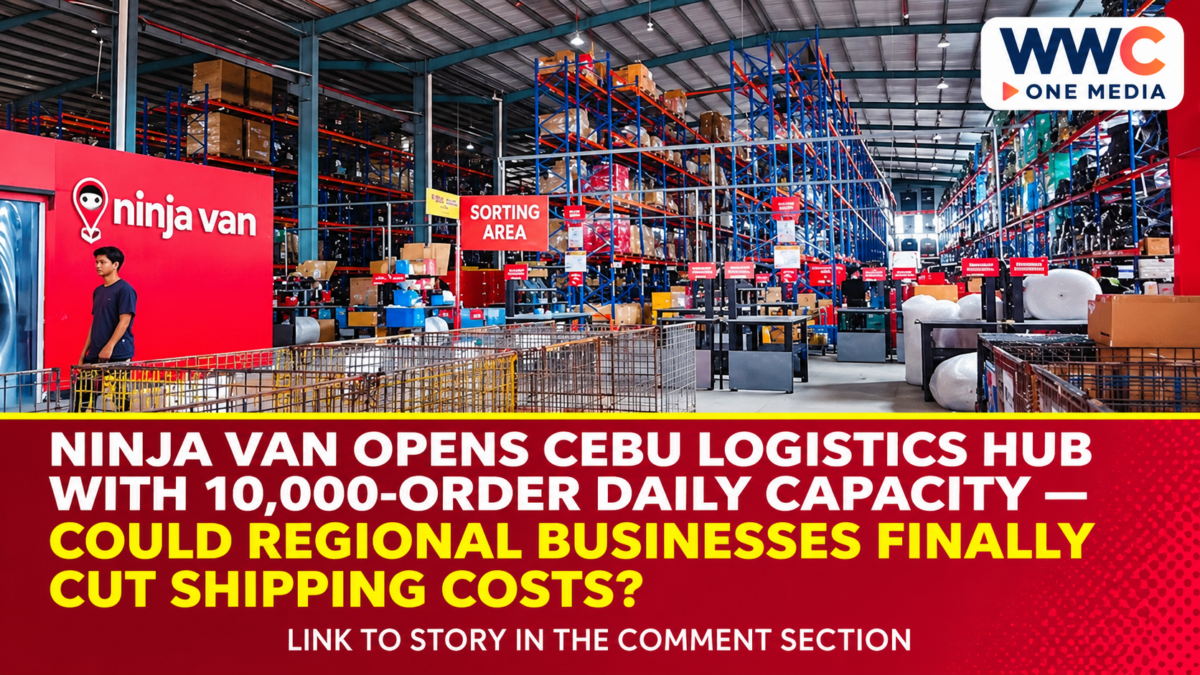
CEBU, PHILIPPINES — Ninja Van Philippines is expanding its logistics operations beyond Metro Manila with a new fulfilment warehouse in Consolacion, Cebu, designed to process up to 10,000 orders daily and bring merchandise inventories closer to customers across the Visayas and Mindanao.
The Ninja Van Cebu hub, which began operating in late October 2026, covers 1,291.32 square metres in Danlag, Consolacion. The company expects its workforce to increase from an initial 50 employees to 100 as operations expand.
The investment comes as the Philippine digital economy continues to grow, reaching an estimated ₱2.74 trillion in gross value added in 2025.
For businesses seeking customers outside their immediate markets, the expansion presents a potential alternative to concentrating merchandise inventories in Luzon.
However, the bigger commercial question is whether a decentralised distribution network can deliver meaningful savings without introducing additional inventory and operating expenses.
Ninja Van Cebu hub challenges centralised distribution
Ninja Van’s Cebu expansion reflects a strategy built around positioning merchandise closer to the markets where businesses expect to generate sales.
The facility supports business-to-consumer and business-to-business transactions, including rapid order fulfilment requirements.
For online merchants, storing products in Cebu could reduce the need to send individual orders from Luzon to customers in southern Philippine regions.
Retail businesses could also use regional inventories to replenish physical stores.
The commercial advantage becomes particularly relevant when customers expect faster deliveries and businesses need to maintain dependable product availability.
Nevertheless, operating a regional warehouse does not automatically guarantee lower shipping costs.
The potential savings must be evaluated against storage charges, inventory volumes and the expense of replenishing regional stocks.
WWC ONE MEDIA previously examined these challenges in its coverage of Cebu businesses pursuing nationwide expansion despite high shipping and distribution costs.
The opportunity for regional businesses lies in finding a distribution model that balances delivery speed with sustainable operating expenditure.
More than a courier facility: How fulfilment changes business operations
A fulfilment warehouse performs a different commercial function from a conventional parcel collection centre.
Rather than simply receiving packages that merchants have already prepared for shipment, fulfilment services can combine merchandise storage, inventory monitoring, order preparation and dispatch.
Ninja Van’s wider fulfilment service incorporates barcode-based processing checkpoints and monitoring arrangements at packing stations.
These systems are designed to improve inventory visibility and provide records that can help resolve order discrepancies.
For growing online businesses, outsourcing these activities could reduce the need to establish independent warehouses and employ dedicated order-processing teams.
This could allow merchants to devote more resources to marketing, product development and customer service.
However, outsourcing also introduces responsibilities involving service agreements, inventory accountability and the handling of damaged or returned merchandise.
Businesses must establish whether the provider’s technology can integrate with their sales platforms and accommodate their particular product requirements.
The company’s expansion beyond conventional parcel delivery was previously examined in WWC ONE MEDIA’s coverage of Ninja Van’s wider transformation into a logistics and business intelligence provider.
The Cebu investment illustrates how physical warehousing and technology-supported order processing can form part of a broader commercial service.
The ₱2.74-trillion digital economy creates new logistics opportunities
The Philippine Statistics Authority’s preliminary Digital Economy Satellite Account, released on April 30, 2026, estimated that the country’s digital economy generated ₱2.74 trillion in gross value added during 2025.
This represented annual growth of 5.4% and accounted for 9.8% of national gross domestic product.
E-commerce contributed 32.2% of the digital economy’s gross value added.
The digital economy also accounted for approximately 10.39 million employed individuals, equivalent to 21.2% of total Philippine employment.
E-commerce represented 75.8% of digital economy employment.
These figures illustrate the economic importance of digitally enabled commercial activities.
However, the statistics should not be interpreted as the total value of parcels shipped nationwide or as Ninja Van’s addressable market.
Gross value added measures economic output after accounting for intermediate consumption. It is different from the gross merchandise value of online transactions.
For logistics providers, the broader commercial opportunity involves supporting businesses that require reliable physical infrastructure alongside digital sales channels.
Could Cebu businesses achieve faster deliveries?
Regional warehousing could provide merchants with greater flexibility when serving customers in different parts of the Philippines.
Consider an online retailer that regularly receives orders from Cebu, Iloilo and neighbouring areas.
Instead of dispatching every purchase from a warehouse in Luzon, the business could position frequently purchased products within a regional facility.
This arrangement could shorten the physical journey between inventory and customers, provided the required products are available.
It could also support quicker delivery options within eligible service areas.
Nevertheless, placing products in multiple warehouses requires more careful inventory planning.
A business could experience excess stock in one region while encountering shortages in another.
Demand forecasting, inventory replenishment and accurate order allocation therefore become essential components of a decentralised distribution strategy.
For merchants, delivery speed should be evaluated alongside total fulfilment costs, product availability and the quality of customer service.
Warehouse expansion highlights the importance of logistics skills
Ninja Van’s anticipated workforce expansion in Cebu covers responsibilities involving warehouse management and order processing.
As regional fulfilment operations grow, employees must be capable of coordinating physical merchandise movements with digital inventory systems.
The commercial value of these systems depends on their ability to support accurate order preparation and dependable dispatch.
Technology alone cannot prevent every operational error.
Appropriate training, inventory verification and clear procedures for handling discrepancies remain important.
The relationship between technology and workforce development was previously examined in WWC ONE MEDIA’s coverage of FAST Logistics’ artificial intelligence initiatives and the changing technical skills required in supply-chain operations.
For Cebu, logistics investments could support employment opportunities extending beyond transportation, particularly in warehouse administration and technology-supported operations.
However, the expected increase to 100 employees at Ninja Van’s Cebu facility remains a projection linked to business expansion rather than an already achieved employment milestone.
Ninja Van prepares additional regional facilities
The Cebu warehouse forms part of a wider Philippine network expansion.
Ninja Van is targeting a South Luzon facility for the fourth quarter of 2026 and a Pampanga warehouse for March 2027.
A separate Davao facility is also planned to strengthen fulfilment services in Mindanao.
Establishing these regional operations could provide businesses with additional options for managing inventories and reaching customers nationwide.
For Ninja Van, the commercial challenge involves generating sufficient demand across individual facilities while maintaining consistent service standards.
A larger warehouse network may provide operational flexibility, but it also introduces additional requirements involving facilities management, staffing and coordination.
What happens next for Ninja Van’s Cebu investment?
The next significant test will be whether the Cebu facility can attract sufficient merchant demand to justify its available processing capacity.
Relevant performance indicators could include actual daily order volumes, fulfilment accuracy, delivery reliability, inventory turnover and customer retention.
The facility’s capacity of up to 10,000 daily orders should not be confused with confirmed daily throughput.
Similarly, potential transportation savings will need to be demonstrated through actual commercial results.
For regional merchants, the opportunity is to reconsider how products are stored and distributed as their customer bases expand.
For Ninja Van, the challenge is proving that regional warehouses can offer dependable services while maintaining financially sustainable operations.
Cebu’s newest fulfilment investment provides an alternative to relying exclusively on distant distribution centres.
Whether that alternative becomes a lasting competitive advantage will depend on the economics of every order moving through the warehouse.
Frequently Asked Questions
Where is the new Ninja Van Cebu hub located?
The facility is located in Danlag, Consolacion, Cebu, Philippines. It began operating in late October 2026.
How many orders can Ninja Van’s Cebu warehouse process?
The warehouse is designed to handle up to 10,000 orders daily. This represents its processing capacity rather than confirmed daily order volumes.
How large is the Ninja Van Cebu hub?
The company’s official announcement identifies the warehouse floor area as 1,291.32 square metres.
Will the new Cebu warehouse reduce shipping costs?
Regional inventory storage could reduce transportation distances and associated costs. Actual savings will depend on individual merchants’ service arrangements, order volumes and inventory requirements.
Where else is Ninja Van expanding in the Philippines?
Ninja Van has announced plans for additional facilities in South Luzon, Davao and Pampanga, with the Pampanga warehouse targeted for March 2027.