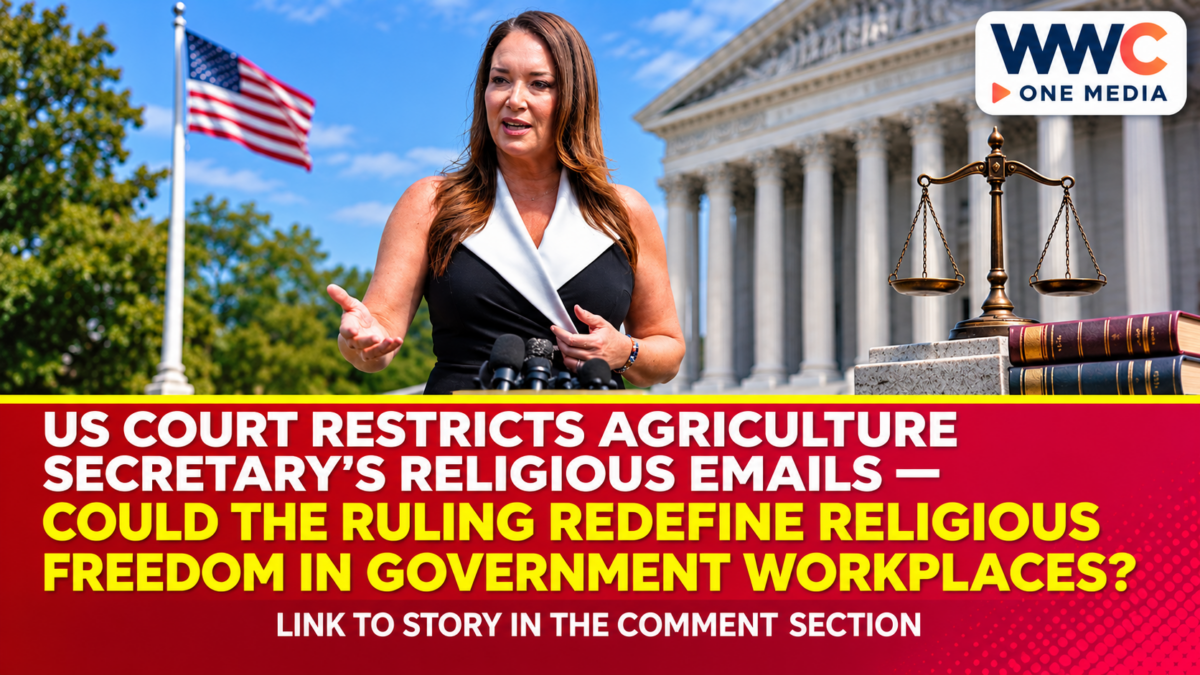
SAN FRANCISCO, UNITED STATES — A US federal court has imposed restrictions on Agriculture Secretary Brooke Rollins’ religious communications to government employees, intensifying a constitutional debate over the boundaries between personal faith, religious freedom and the exercise of public authority.
The USDA religious emails controversy centres on messages distributed through the secretary’s official government account, including Christmas and Easter communications containing explicitly Christian religious language.
On Nov. 19, 2026, US District Judge Trina L. Thompson granted a preliminary injunction concerning the constitutional challenge brought by six Department of Agriculture employees and the National Federation of Federal Employees.
The decision places renewed attention on an important question facing government institutions: how can public officials exercise their religious freedoms without creating pressure on employees who hold different beliefs?
For President Donald Trump’s administration, the case also presents a legal test of its broader policy supporting religious expression within federal workplaces.
USDA religious emails trigger constitutional intervention
The lawsuit was filed on May 13, 2026, in the US District Court for the Northern District of California.
The plaintiffs challenged a series of communications distributed by Rollins to the Department of Agriculture workforce.
The department employs approximately 100,000 civil servants, while the National Federation of Federal Employees represents approximately 110,000 federal workers, including more than 19,000 USDA employees.
The challenged communications included a Christmas message distributed on Dec. 23, 2025, and an Easter email sent on April 5, 2026.
Both messages contained expressions of Christian belief that extended beyond conventional holiday greetings.
The employees argued that the language conveyed an expectation that USDA workers shared the secretary’s religious beliefs.
They also raised concerns about whether employees who followed different religions, or no religion, could feel disadvantaged or excluded within the department.
These concerns formed the basis of their constitutional challenge.
The court subsequently determined that preliminary intervention was warranted while the litigation continues.
Why the secretary’s position of authority matters
One of the central issues in the dispute involves the relationship between a senior government official and employees working under that official’s authority.
Communications from the agriculture secretary can contain important information affecting employees’ professional responsibilities, workplace arrangements and employment conditions.
The plaintiffs maintained that this made it difficult to disregard messages distributed through the secretary’s official account.
Unlike a voluntary religious gathering or private conversation, an agency-wide communication reaches employees through an established professional relationship.
The court examined whether that relationship could create pressure to conform to the religious beliefs expressed by a senior official.
The issue was therefore not simply whether a government employee may discuss religion.
It concerned the circumstances in which religious messages were distributed and the institutional authority of the person communicating them.
The broader constitutional limits on executive authority have also been examined in WWC ONE MEDIA’s coverage of the Trump administration’s restrictions on White House media access and the associated First Amendment questions.
Although the two controversies involve different constitutional protections, both raise questions about how government officials exercise public authority.
What the federal court actually ordered
The ruling requires Rollins to observe established boundaries when communicating religious messages.
These include respecting requests from colleagues to discontinue religious discussions, avoiding persistent conduct that creates a hostile working environment and refraining from using official authority to influence subordinates’ religious choices.
The court drew these restrictions from USDA Secretary’s Memorandum 1078-019, the department’s own guidance concerning religious expression in the workplace.
Importantly, the ruling does not prohibit Rollins from discussing her beliefs with interested colleagues.
Appropriate religious conversations, voluntary invitations to religious events and personal expressions of faith remain permissible within the boundaries identified by the court.
Thompson also expressly distinguished the secretary’s official responsibilities from her activities in a personal capacity.
The ruling should therefore not be interpreted as a general prohibition on Christianity, religious greetings or religious expression by federal employees.
Instead, it addresses the potential for religious coercion arising from the use of government authority.
Trump administration’s religious freedom policy faces scrutiny
The dispute comes against the backdrop of a wider federal initiative to protect religious expression in government workplaces.
On July 28, 2025, the US Office of Personnel Management issued government-wide guidance directing federal agencies to protect employees’ ability to express their religious beliefs.
The guidance addresses activities such as prayer, religious conversations, personal religious items and group gatherings.
It also emphasises that government employees should not face discrimination or retaliation because of their religious beliefs.
The administration’s stated objective is to ensure that religious employees can exercise their constitutional and statutory rights without compromising their careers.
However, protecting an employee’s right to religious expression is not necessarily equivalent to authorising a senior official to distribute religious messages in circumstances that could pressure subordinates.
This distinction lies at the centre of the USDA litigation.
The constitutional challenge involves two related considerations: protecting individual religious practice and preventing government authority from being used to influence another person’s religious choices.
Both principles must be considered when developing workplace policies.
The lawsuit is not over
The November ruling represents an important procedural development, but it does not resolve every aspect of the litigation.
Thompson granted the plaintiffs’ request for a preliminary injunction relating to their constitutional claim.
The court also rejected the government’s request to dismiss that constitutional challenge while granting its motion to dismiss the claims brought under the Administrative Procedure Act.
These outcomes demonstrate why preliminary judicial decisions must be distinguished from final judgments.
An injunction can impose enforceable restrictions while a dispute remains unresolved.
The importance of understanding such procedural distinctions has also featured in WWC ONE MEDIA’s coverage of Donald Trump’s legal dispute involving Federal Reserve Governor Lisa Cook and the limits of presidential authority.
Any subsequent challenge to the USDA injunction would require additional legal proceedings.
The case has not been established as a matter accepted for review by the US Supreme Court.
USDA faces broader questions about institutional governance
The Department of Agriculture’s ability to maintain professional standards is important not only for its workforce but also for the communities and industries that depend on its services.
Effective institutional governance requires clear policies, consistent administration and confidence that employees can perform their responsibilities without inappropriate pressure.
WWC ONE MEDIA previously examined another dimension of the department’s institutional responsibilities through its coverage of USDA cybersecurity vulnerabilities and the resilience of America’s food supply infrastructure.
That issue is separate from the religious communications lawsuit.
Nevertheless, both demonstrate the importance of effective oversight within government institutions.
The current litigation does not establish that agricultural programmes, international food exports or government assistance to farmers have been disrupted.
Its immediate significance concerns constitutional protections and the professional relationship between federal officials and their employees.
For international observers, including governments and institutions across the Asia-Pacific region, the case provides an example of how courts examine competing rights within public administration.
What happens next for Brooke Rollins?
The court has scheduled a joint case management statement for Dec. 10, 2026, followed by a further case management conference on Dec. 17 at 2 p.m. via videoconference.
Additional proceedings could clarify the remaining constitutional questions and determine how the litigation moves forward.
For Rollins, the immediate legal requirement is to observe the boundaries established by the injunction.
For the federal employees who brought the lawsuit, the continuing proceedings concern their ability to work without feeling pressured to adopt particular religious beliefs.
The dispute ultimately raises a question that extends beyond any individual government official: how can public institutions protect freedom of faith while preserving freedom of conscience?
The answer will depend on the continuing legal process and the practical implementation of constitutional workplace protections.
Frequently Asked Questions
Why did a US court restrict Brooke Rollins’ religious emails?
The court found that certain communications distributed through her official government account raised constitutional concerns involving religious coercion and the use of authority over federal employees.
Who filed the lawsuit against the USDA?
The National Federation of Federal Employees and six USDA employees filed the lawsuit on May 13, 2026.
Does the ruling prohibit Brooke Rollins from practising Christianity?
No. The injunction addresses religious communications involving her official position and workplace authority. It does not prohibit personal religious practice.
Has the US Supreme Court ruled on the USDA religious emails case?
No Supreme Court ruling on this particular dispute has been established. The November 19 decision was issued by the US District Court for the Northern District of California.
When is the next USDA religious emails court hearing?
A further case management conference is scheduled for Dec. 17, 2026, at 2 p.m. via videoconference, with a joint statement due on Dec. 10.