
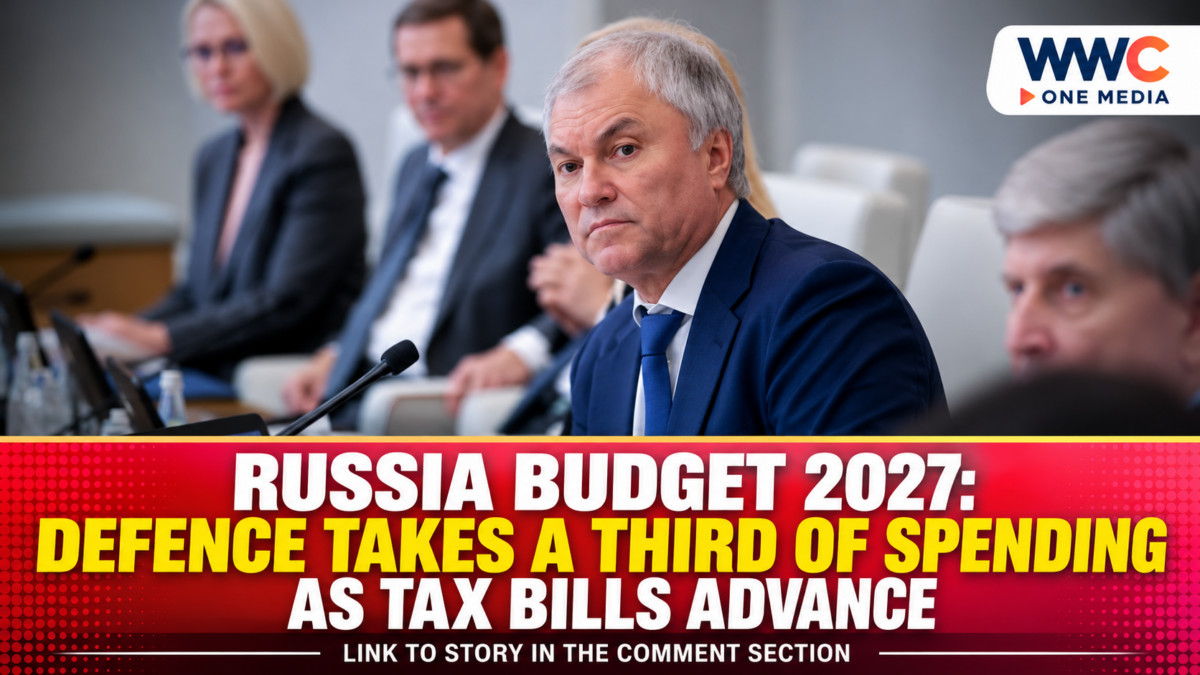
Russia’s State Duma approved the country’s 2027–2029 federal budget in its third reading on November 24, 2026, clearing a major parliamentary stage for a spending plan that places national defence among the government’s largest priorities. The 2027 budget provides 48.74 trillion rubles in total expenditure, including 17.15 trillion rubles under national defence.
The vote puts the proposed spending framework closer to becoming law, while separate tax legislation is also moving through the parliamentary process. The numbers point to a difficult fiscal balancing act: Moscow plans to increase revenue from non-energy sources, maintain major state commitments and finance a substantial defence allocation while projecting another multi-trillion-ruble deficit.
Russia budget puts defence at the centre of 2027 spending
The budget bill, registered as No. 615-9, sets 2027 federal revenue at 43.3 trillion rubles and expenditure at 48.74 trillion rubles. The resulting projected deficit is 5.44 trillion rubles, equivalent to 2.2% of gross domestic product.
The national defence allocation is set at 17.15 trillion rubles for 2027. That is approximately 35.2% of the government’s planned total expenditure for the year.
The three-year figures show the scale of the commitment. The national defence section provides 16.61 trillion rubles for 2028 and 16.30 trillion rubles for 2029. Across the three years, the allocation totals approximately 50.05 trillion rubles.
These amounts refer to the national defence budget section. They should not be confused with the full cost of every security-related government activity, which may be funded under other sections. Nor do the headline figures disclose every detail of classified expenditure.
For businesses and households, the significance is not simply the size of the defence allocation. It is how the government balances that commitment against other public spending, revenue collection and borrowing requirements.
The deficit means planned spending exceeds revenue
The 2027 budget projects a 5.44-trillion-ruble gap between federal revenue and expenditure. The government’s planning figures also show deficits in the following two years: 5.12 trillion rubles in 2028 and 5.25 trillion rubles in 2029.
A deficit does not automatically mean a government cannot pay its bills. It means planned expenditure is higher than the revenue expected during the budget year. The difference must be financed, with the budget documentation identifying domestic government borrowing as a major funding source.
The budget framework uses a $50-per-barrel benchmark oil price for the fiscal-rule calculation over the stated planning period. That is a planning assumption, not a prediction that the market price will remain at that level.
The distinction matters because energy receipts can change with global prices, export volumes and market conditions. If actual revenue falls short of the assumptions, the government may face more pressure to borrow, adjust spending or find additional revenue.
Tax legislation is part of the revenue strategy
The budget package is accompanied by separate legislation concerning changes to the Tax Code and a tax on excess profits. The State Duma’s legislative tracking record lists bills No. 617-9 and No. 618-9 among the measures considered at the third-reading stage on November 24.
The budget committee’s published assessment identifies several planned revenue measures, including adjustments to the progressive personal income tax framework, changes to corporate profit taxation, an excess-profits tax, higher excise rates and increases in selected state fees.
The government’s budget projections anticipate a larger contribution from non-oil-and-gas revenue. The committee assessment puts that share at 83.8% of total federal revenue in 2027, compared with 81.6% in 2026.
That shift is important because it signals an effort to make federal receipts less dependent on energy income. But expanding the non-energy revenue base can also increase the importance of taxes and fees paid by domestic businesses and individuals.
The exact impact depends on the final wording of each tax law, including thresholds, exemptions and effective dates. A budget vote should not be treated as proof that every tax measure has already taken effect.
Civilian programmes face competing budget demands
The budget committee’s assessment also shows that allocations are not rising uniformly across government functions. It identifies a planned reduction in 2027 appropriations for areas including the national economy and housing and utilities, compared with the 2026 estimates used in the review.
The committee document lists a reduction of 219.1 billion rubles, or 18%, for the national economy section, and a reduction of 152 billion rubles, or 10.2%, for housing and utilities. These are comparisons within the budget assessment and should not be read as a statement that every programme in those sectors will receive less funding.
The figures underline the choices involved in a large national budget. Government spending is divided among defence, social programmes, infrastructure, regional transfers, public administration and other priorities. A larger allocation to one category does not automatically establish that another category has been cut by the same amount.
The issue for the public is whether the final allocations are sufficient to maintain essential services and support economic activity while meeting the government’s stated priorities.
WWC has examined similar questions around public spending and accountability in its coverage of high-risk appropriations in the Philippines’ 2027 national budget. The countries and budget systems are different, but the broader public-finance question is familiar: how can taxpayers assess whether large spending plans deliver their intended results?
What the budget means for businesses and households
Tax changes, public borrowing and spending priorities can affect the operating environment for companies, investors and consumers. Businesses may need to account for changes in tax obligations, fees or demand for government-supported sectors. Households may be affected by changes to the taxation of certain income and purchases, depending on the final legislation.
A government’s decision to borrow also has wider economic implications. Borrowing can help finance expenditure when revenue is insufficient, but it creates obligations that must be managed over time. The overall effect depends on the cost of borrowing, economic growth, revenue performance and the government’s ability to meet its fiscal targets.
For companies, the practical question is how the final tax provisions will apply to their operations. For households, it is whether the approved measures change the amount of tax payable on specific forms of income or consumption. Neither outcome should be assumed from a summary of the proposed package alone.
WWC has also reported on how tax increases can place pressure on businesses and households, and on how inflation and slower growth complicate economic policy. Those reports concern the Philippine economy, but they offer useful context on why tax design and public spending matter beyond headline budget totals.
What happens next
The State Duma’s third-reading approval is a significant legislative step, but it is not the final step required for enactment. The budget must proceed through the Federation Council and presidential approval before it becomes law.
The final published budget law and its schedules will be the decisive documents for confirming the allocations and the provisions that take effect. The separate tax bills must also complete their own legislative process.
Until those steps are completed, the clearest confirmed picture is the one set out in the approved Duma budget text: 48.74 trillion rubles in planned 2027 spending, 17.15 trillion rubles for national defence and a projected deficit of 5.44 trillion rubles.
The longer-term test will be whether revenue collections, economic performance and spending execution match the assumptions behind the three-year plan.
Frequently asked questions
Did Russia approve its 2027 budget?
The State Duma approved the 2027–2029 federal budget bill in its third reading on November 24, 2026. It still needs the remaining steps in the legislative process before becoming law.
How much will Russia spend on defence in 2027?
The budget provides 17.15 trillion rubles for national defence in 2027, around 35.2% of planned federal expenditure.
What is Russia’s projected budget deficit for 2027?
The projected federal deficit is 5.44 trillion rubles, equivalent to approximately 2.2% of GDP.
Why are tax changes included in the budget package?
The government’s fiscal plan aims to increase non-oil-and-gas revenue. Separate bills address changes to the Tax Code and a tax on excess profits.
Is the 2027 budget already law?
Not yet. Approval by the State Duma is not the final enactment step. The bill must proceed through the Federation Council and presidential approval.










