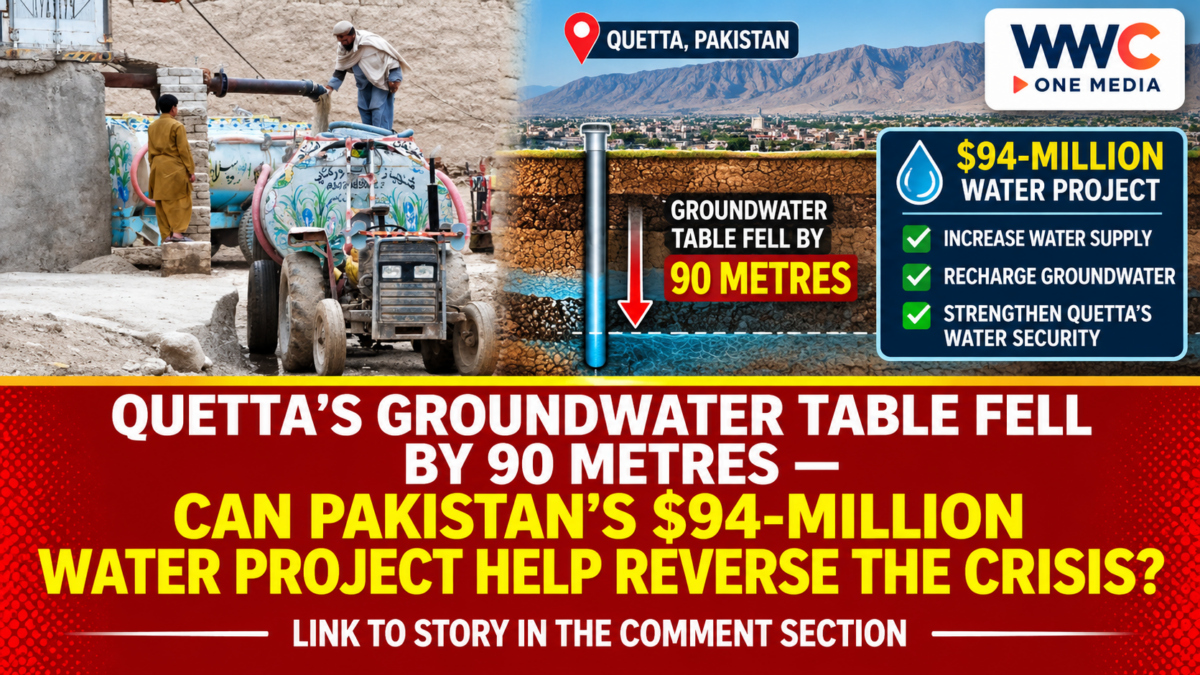
QUETTA, PAKISTAN — The Quetta water crisis presents a growing challenge for Pakistan’s Balochistan province, where declining groundwater reserves, inadequate infrastructure and difficulties in water resource management threaten the reliability of essential services.
Between 2010 and 2021, the average depth to Quetta’s groundwater table increased by approximately 90 metres, illustrating the severity of the pressure on underground water resources.
The challenge has become increasingly important as authorities pursue long-term improvements to water supply infrastructure, groundwater management and agricultural productivity.
A US$94-million regional water security project approved in June 2025 offers a potential opportunity to address some of these challenges.
However, financing alone cannot guarantee the recovery of depleted groundwater reserves. Effective regulation, infrastructure maintenance and responsible extraction will also be essential.
Quetta Water Crisis: Why Tube-Well Regulation Matters
Quetta, the provincial capital of Balochistan, faces a difficult balance between meeting immediate water demand and preserving underground reserves for future generations.
Tube wells provide access to water stored beneath the ground. However, increasing the number of extraction facilities does not necessarily increase the amount of water that can be sustainably withdrawn.
When extraction exceeds natural replenishment, groundwater levels can decline.
Balochistan has an established legal framework addressing these concerns through the Balochistan Ground Water Rights Administration Ordinance, 1978.
The legislation provides for groundwater conservation, the administration of extraction rights and the regulation of wells within designated groundwater basins.
It also establishes responsibilities for determining sustainable extraction limits and administering permissions.
An effective survey of tube wells could provide valuable information about their locations, operational status, authorisations and contribution to overall water demand.
However, counting wells alone would not establish the true extent of groundwater depletion.
Extraction volumes and the capacity of underground reserves to recover would also need to be examined.
The importance of monitoring extraction capacity alongside infrastructure expansion was previously explored in WWC ONE MEDIA’s coverage of new groundwater facilities and long-term water security.
Why Quetta’s Underground Water Reserves Are Under Pressure
The historical decline in Quetta’s groundwater table demonstrates why the city’s water challenges cannot be addressed through additional drilling alone.
Agricultural irrigation, particularly groundwater-dependent orchards in the Quetta Valley, represents a significant contributor to groundwater depletion.
Agriculture requires dependable water supplies to support production and livelihoods. At the same time, urban communities require sufficient water for drinking, sanitation and everyday household needs.
Balancing these requirements is a major resource management challenge.
From an economic perspective, declining groundwater levels can increase the difficulty and potential cost of accessing underground water.
Deeper pumping requirements may increase energy consumption, while infrastructure that was previously adequate could require upgrading or replacement.
The long-term objective should therefore extend beyond increasing immediate supply.
Authorities must also consider how much groundwater can be extracted without undermining the future availability of the resource.
Pakistan’s $94-Million Water Security Project
On June 24, 2025, the World Bank approved the Balochistan Water Security and Productivity Improvement Project, valued at US$94 million.
The initiative covers improvements to urban water services in Quetta alongside agricultural water management and infrastructure development in other parts of Balochistan.
Project objectives include improving water availability for productive activities, strengthening protection against flooding and enhancing water service delivery.
The initiative is expected to improve access to basic water services for 500,000 people.
It also aims to provide climate-resilient infrastructure benefiting more than 80,000 people.
These figures represent anticipated project benefits rather than confirmed results already delivered to communities.
The distinction is particularly important when assessing infrastructure programmes, where funding approval, construction and operational service improvements occur at different stages.
The success of the project should ultimately be evaluated against measurable improvements in water availability, service reliability and the sustainable management of existing resources.
Why Repairing Water Infrastructure Is Just as Important as Finding New Sources
Developing new water supplies represents only one part of a sustainable water management strategy.
The effectiveness of a water system also depends on its ability to deliver available supplies to households and businesses.
Damaged infrastructure, inefficient distribution and inadequate maintenance can reduce the benefits of investments in additional water production.
Quetta’s development programme identifies improvements in distribution efficiency, infrastructure management and energy performance among its intended interventions.
A parallel challenge is examined in WWC ONE MEDIA’s reporting on efforts to reduce water losses through pipeline repairs and network improvements.
For Quetta, reducing avoidable water losses could help protect existing resources while longer-term infrastructure investments are implemented.
A successful strategy would need to consider both the amount of water available and the efficiency with which that water reaches consumers.
Could Groundwater Recharge Help Protect Quetta’s Future?
Long-term water security may also depend on improving the replenishment of underground reserves.
Managed aquifer recharge involves introducing water into suitable underground formations to supplement existing groundwater resources.
The feasibility of such measures depends on local geology, available water sources, environmental conditions and appropriate technical safeguards.
Quetta’s water development plans include potential recharge measures and improvements to surface-water storage.
Diversifying water sources could reduce the pressure placed on groundwater alone, although the suitability of each alternative must be evaluated within local conditions.
The broader principle of water-source diversification has also featured in WWC ONE MEDIA’s coverage of desalination infrastructure designed to reduce dependence on groundwater.
Quetta’s inland location presents different requirements, making locally available water resources and technically feasible recharge solutions especially important.
No single technology should be treated as a guaranteed solution to a complex water crisis.
What Happens Next for Quetta?
The most important measures of progress will be improvements that residents can experience and authorities can independently verify.
These could include more dependable household water services, lower distribution losses, better monitoring of groundwater extraction and effective administration of water rights.
A comprehensive inventory of tube wells could support these objectives if the findings are accurate, regularly updated and connected to meaningful regulatory action.
However, the legality of individual installations must be established through appropriate documentation rather than assumptions.
The wider challenge is ensuring that short-term efforts to meet water demand do not undermine the long-term sustainability of the resource.
Quetta’s water crisis developed over many years. Addressing it will require sustained investment, institutional coordination and transparent monitoring.
The US$94-million regional project provides an opportunity for meaningful improvement.
Whether that opportunity translates into lasting water security will depend on implementation and measurable results.
Frequently Asked Questions
Why is Quetta facing a water crisis?
Quetta faces significant groundwater depletion alongside water infrastructure and resource management challenges. Agricultural extraction also places pressure on underground reserves.
How much has Quetta’s groundwater level declined?
The average depth to Quetta’s water table increased by approximately 90 metres between 2010 and 2021.
How much funding was approved for Balochistan’s water security project?
The Balochistan Water Security and Productivity Improvement Project was approved on June 24, 2025, with financing of US$94 million. Its geographical scope extends beyond Quetta.
Are tube wells regulated in Balochistan?
Yes. The Balochistan Ground Water Rights Administration Ordinance, 1978, establishes provisions for regulating groundwater extraction and administering water rights within designated groundwater basins.
Can groundwater recharge solve Quetta’s water shortage?
Groundwater recharge could contribute to improving water security, subject to technical feasibility. Sustainable extraction, infrastructure improvements and effective water management would also be necessary.