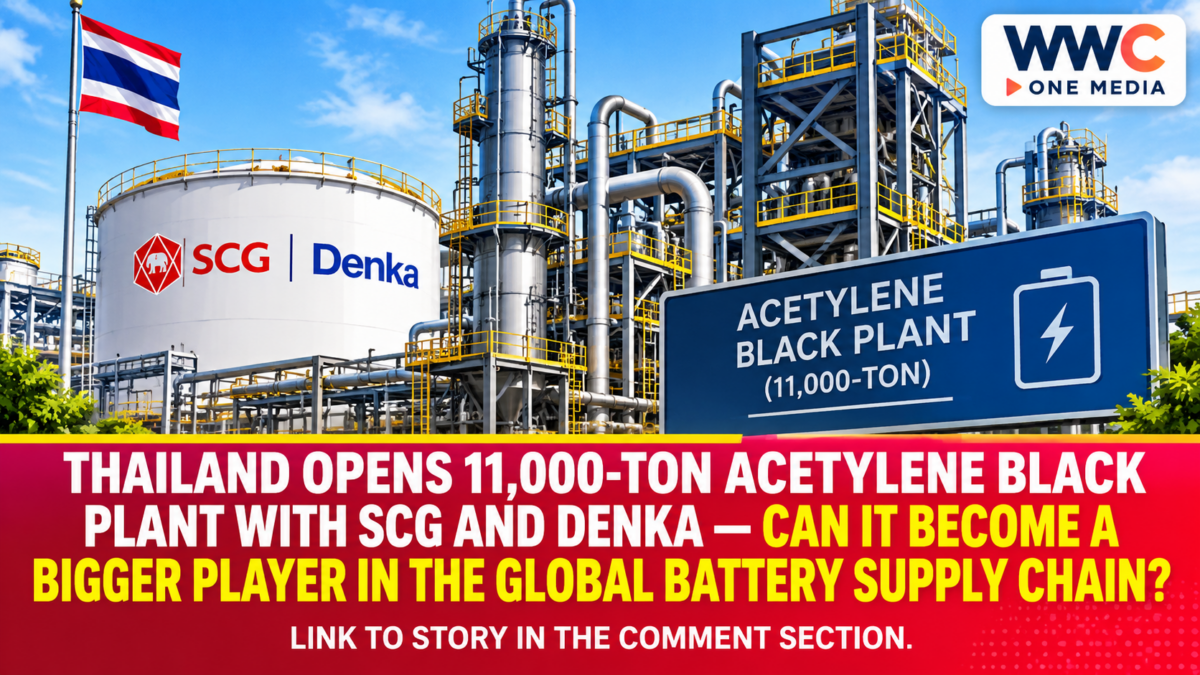
RAYONG, Thailand — Thailand is expanding its presence in the advanced materials industry following the inauguration of an acetylene black manufacturing facility developed by SCG Chemicals Public Company Limited (SCGC) and Japan’s Denka Company Limited.
The Thailand acetylene black plant, operated by Denka SCGC Advanced Materials Co., Ltd. (DSAM), has an annual production capacity of 11,000 tons. Its inauguration ceremony took place on Nov. 16, 2026, with operations scheduled to commence in January 2027.
The development highlights an important opportunity for Southeast Asia: capturing industrial value from the materials used to manufacture electric vehicles, battery storage systems and electricity transmission infrastructure.
Rather than concentrating exclusively on finished vehicles, the Thai-Japanese partnership is targeting the specialised components that make electrification possible.
Thailand Acetylene Black Plant Targets a Critical Manufacturing Market
Located at RIL Industrial Estate in Map Ta Phut, Rayong Province, the DSAM facility will manufacture and distribute acetylene black, including Denka’s branded conductive materials.
Acetylene black is a specialised form of carbon black valued for its electrical conductivity and purity. Denka manufactures the material using its proprietary thermal decomposition technology.
Its applications include conductive additives for lithium-ion batteries and materials used in high-voltage electricity cables.
This places the new factory in a different segment of the manufacturing supply chain from conventional vehicle assembly plants.
For Thailand, the commercial opportunity lies in developing industrial capabilities that could serve customers across several industries rather than depending on the performance of a single automotive market.
The development also provides additional context to the ongoing transformation of ASEAN manufacturing and regional supply chains.
Japanese Technology Meets Thailand’s Industrial Capabilities
The Denka Group accounts for 60% of the joint venture’s investment ratio, while SCG Chemicals holds the remaining 40%.
The partnership brings together businesses with complementary industrial capabilities.
SCGC contributes experience in chemical manufacturing, plant management and securing raw materials. Denka provides its established acetylene black technology and product expertise.
The collaboration also reflects SCGC’s longer-term strategy of expanding its portfolio of specialised chemical products rather than relying exclusively on conventional petrochemical manufacturing.
For chemical producers, competing through technical capabilities and product performance could offer opportunities to differentiate themselves from suppliers of more standardised materials.
However, the commercial value of that strategy will ultimately depend on production efficiency, customer requirements and the prices manufacturers can obtain for their products.
Why the Opportunity Extends Beyond Electric Vehicles
Electric vehicles are an important potential market for the Rayong facility, but they are not its only target.
Denka also identifies stationary battery storage and high-voltage transmission infrastructure as important applications for its conductive materials.
This distinction matters because the investment is positioned to serve multiple parts of the energy sector.
Battery energy storage systems can help electricity networks manage differences between power generation and consumption. Their commercial applications provide another potential market for specialised materials used in lithium-ion batteries.
Electricity transmission infrastructure offers a separate opportunity through the materials required for high-voltage cables, including those supporting offshore wind projects.
WWC ONE MEDIA’s previous examination of Thailand’s clean-energy investment and battery storage opportunities highlights the wider industrial challenges associated with developing these markets.
Demand from multiple industries could provide DSAM with greater commercial flexibility. Nevertheless, the available announcements do not establish how much of the facility’s future output will be allocated to each application.
The Growing Importance of AI Data Centres and Energy Storage
Denka has identified the expansion of artificial intelligence infrastructure and renewable energy as factors that could support future demand for stationary energy storage.
The business opportunity for DSAM is indirect.
The facility is not being developed to manufacture AI processors or operate data centres. Instead, it could benefit from demand for conductive materials if investment in electricity infrastructure and battery storage continues to expand.
This provides another perspective on the economic relationship between digital infrastructure and traditional industrial manufacturing.
The development of AI services does not end with semiconductors and computing equipment. It also involves decisions about electricity availability, reliability and infrastructure investment.
For battery-material producers, these requirements may create additional opportunities beyond passenger vehicles.
However, expected market growth should not be confused with confirmed customer orders.
The same distinction between industrial demand and commercial performance was examined in WWC’s coverage of the global lithium demand outlook and battery-material pricing pressures.
What the Investment Could Mean for the Philippines
Thailand’s latest manufacturing development offers a useful comparison for other Southeast Asian economies seeking greater participation in advanced manufacturing.
For the Philippines, the opportunity is not necessarily to replicate the same chemical production facility.
Instead, policymakers and businesses could examine which parts of the electrification supply chain are commercially realistic given local industrial capabilities, infrastructure requirements and available technical expertise.
Potential areas for consideration include component manufacturing, electrical equipment, engineering services, materials testing and industrial maintenance.
WWC’s examination of Philippine automotive manufacturing incentives and the RACE programme provides additional context to the country’s broader industrial policy challenge.
The Rayong project illustrates the difference between attracting investment in finished products and developing the capability to supply materials used by other manufacturers.
There is no confirmed Philippine expansion associated with the DSAM project in the announcements reviewed.
What Happens Next for SCG Chemicals and Denka?
Construction of the Rayong plant was completed on Oct. 31, 2026. The next major milestone is the scheduled start of operations in January 2027.
Attention will then shift from construction to manufacturing performance.
Businesses and investors will need to distinguish the factory’s stated annual capacity from its actual production and sales. A facility designed to manufacture 11,000 tons annually does not necessarily achieve that volume immediately.
Future corporate disclosures may provide greater clarity on production utilisation, commercial agreements and the facility’s financial contribution.
The inauguration establishes that the manufacturing project has advanced beyond the planning stage.
Whether it becomes a significant contributor to Thailand’s advanced materials industry will depend on its ability to turn installed capacity into reliable production and sustained commercial demand.
Frequently Asked Questions
What is the Thailand acetylene black plant?
It is a manufacturing facility in Rayong Province developed through Denka SCGC Advanced Materials, a joint venture involving Japan’s Denka and Thailand’s SCG Chemicals.
How much acetylene black can the DSAM plant produce?
The facility has a stated annual production capacity of 11,000 tons.
When will the SCG-Denka plant begin operations?
Operations are scheduled to commence in January 2027, following the November 2026 inauguration.
What is acetylene black used for?
Acetylene black is a highly conductive carbon material used in lithium-ion batteries, energy storage applications and high-voltage power transmission cables.
Who owns the DSAM joint venture?
The investment ratio is 60% for the Denka Group and 40% for SCG Chemicals.