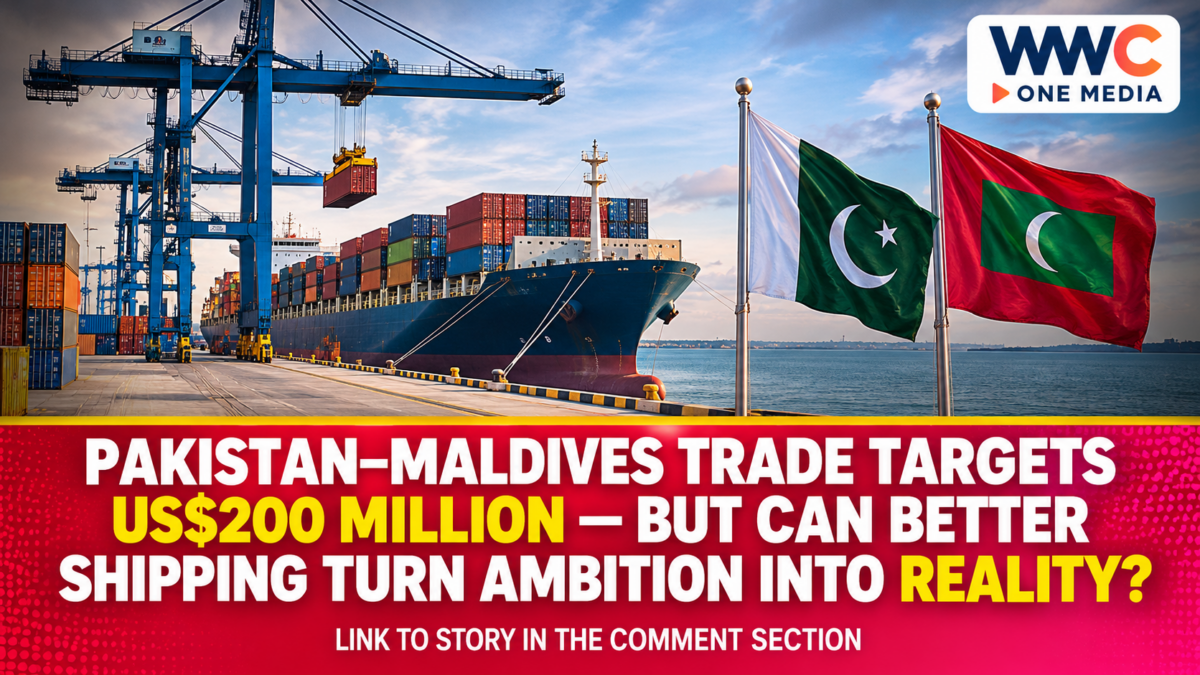
Pakistan and the Maldives are pursuing closer commercial cooperation following an October agreement to increase Pakistan–Maldives trade from US$13 million to US$200 million within two years. Renewed ministerial discussions documented on Nov. 19 have placed the economic relationship back on the bilateral agenda.
The initiative represents a substantial commercial ambition for both South Asian economies. However, achieving the target will require more than diplomatic commitments, particularly when businesses must contend with transportation expenses, procurement requirements and the commercial viability of new shipping connections.
For Pakistan, the partnership offers an opportunity to expand its overseas customer base. For the Maldives, it presents another avenue for diversifying suppliers and strengthening access to essential commodities.
Pakistan–Maldives trade faces a fifteenfold growth challenge
Maldivian President Dr Mohamed Muizzu and Pakistani Prime Minister Muhammad Shehbaz Sharif established the US$200-million trade objective during official discussions on Oct. 21, 2026.
The meeting formed part of the Maldivian president’s state visit to Pakistan from Oct. 20 to 22.
Compared with the US$13-million starting figure identified by the Maldivian presidency, the target represents an increase of US$187 million, equivalent to approximately 1,438%.
That would put bilateral trade at more than 15 times its original level.
The scale of the proposed expansion makes implementation particularly important. Governments can establish ambitious economic targets, but reaching them requires buyers, suppliers, competitive prices and dependable transportation networks.
Similar implementation questions arise in other Asian trade initiatives, including the Philippines–Chile trade partnership.
The US$200-million objective should therefore be understood as a policy target rather than guaranteed export revenue or an existing commercial achievement.
Why maritime connectivity could determine the outcome
The Maldives has identified transportation connectivity as an important component of its economic relationship with Pakistan.
During the Maldives–Pakistan Business Forum on Oct. 22, Muizzu encouraged logistics and shipping companies to examine the commercial potential of direct transportation connections between the two countries.
For importers, an efficient maritime service could potentially reduce the number of cargo transfers required before products reach their destination.
However, the financial advantages would depend on shipment volumes, sailing frequency, freight charges and operating expenses.
A shipping company considering a new service would need sufficient cargo demand to justify its investment. Importers, meanwhile, would need confidence that vessels could deliver products on a dependable schedule.
The experience of other regional initiatives, including the Bangladesh–Thailand direct shipping connection, provides a useful comparison for understanding why transportation infrastructure matters to international commerce.
A proposed direct maritime connection should not be confused with an operational shipping service. Commercial schedules and implementation details remain important indicators to monitor.
Food security could become a foundation for economic expansion
Agricultural cooperation provides one potential route towards expanding the bilateral relationship.
On Oct. 21, the two governments exchanged 20 memoranda of understanding covering different areas of cooperation.
Among them was an arrangement involving the Maldivian State Trading Organisation and the Trading Corporation of Pakistan concerning commerce in agricultural commodities, food and other products.
The wider package also addressed fisheries, healthcare and agriculture.
At the subsequent business forum, the Maldivian president encouraged Pakistani enterprises to explore food-processing investments, refrigerated logistics and storage infrastructure.
These areas matter because successful food trading involves more than obtaining competitively priced agricultural products.
Perishable commodities require suitable handling, storage and dependable delivery. Delays or inadequate refrigeration can undermine the value of otherwise affordable supplies.
From a commercial perspective, stronger food supply arrangements could help Maldivian buyers diversify procurement while providing Pakistani producers with additional sales opportunities.
Nevertheless, cheaper consumer prices would not be automatic. The final cost would also reflect transportation, insurance, storage and local distribution expenses.
The same economic considerations are relevant to the Philippines–US food and energy supply discussions, where sourcing diversification must ultimately be assessed against delivered costs.
November talks bring commercial institutions into focus
The Maldives’ Ministry of Economic Development, Transport and Trade published an account of further bilateral discussions on Nov. 19.
The meeting involved Maldivian Minister Mohamed Saeed, Pakistan’s Federal Minister for Commerce Jam Kamal Khan and Federal Minister for Maritime Affairs Muhammad Junaid Anwar Chaudhry.
Senior executives representing the Maldivian state trading and port organisations also participated.
Their involvement is commercially relevant because expanding bilateral trade requires coordination between institutions responsible for procurement, transportation and business development.
Beyond agricultural products, the October business forum highlighted potential partnerships in pharmaceutical manufacturing, construction, engineering and other industries.
These opportunities could broaden the economic relationship if businesses identify commercially sustainable projects.
For exporters, the practical challenge is to determine which products can compete effectively in the Maldivian market while satisfying applicable regulatory and quality requirements.
For importers, the priority would be obtaining dependable supplies without creating unnecessary exposure to individual suppliers.
What happens next
The next meaningful developments would be concrete implementation measures following the October commitments and November ministerial discussions.
Businesses should monitor announcements concerning procurement arrangements, shipping feasibility, commercial partnerships and measurable increases in bilateral commerce.
Any joint working group established to advance these objectives would need to translate broad policy priorities into practical recommendations.
Published shipping schedules, confirmed commercial contracts and updated trade figures would provide stronger evidence of progress than diplomatic statements alone.
The economic opportunity is significant, but the US$200-million objective remains dependent on implementation.
Ultimately, the partnership’s success will be measured not simply by the number of agreements announced, but by whether companies can establish profitable and reliable trading relationships.