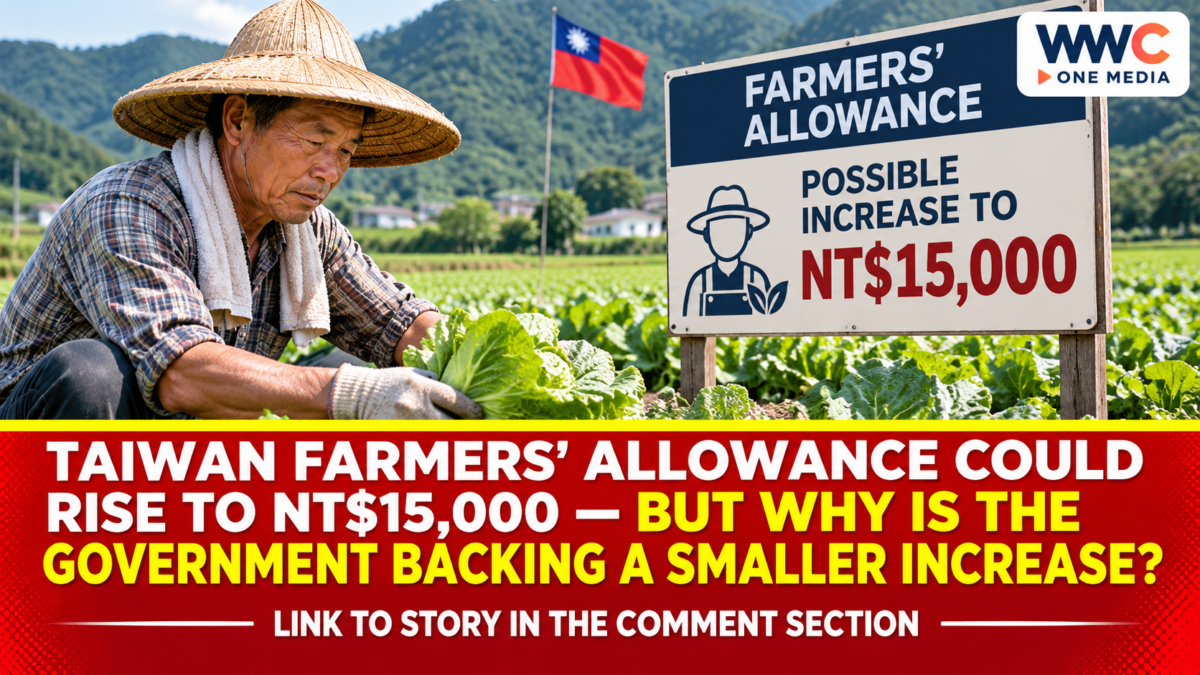
TAIPEI, Taiwan — Taiwan’s legislature has approved amendments that would raise the monthly Taiwan farmers’ allowance to NT$15,000, exceeding the NT$10,000 increase proposed by the Executive Yuan earlier this year.
The amendments, passed on Nov. 6, 2026, have highlighted a disagreement over how much financial assistance elderly agricultural workers should receive and how the government should finance their long-term welfare.
Taiwan’s Ministry of Agriculture estimates that the legislature’s version would require approximately NT$32 billion more in annual expenditure than the Cabinet’s proposal.
The debate presents a broader economic challenge: how can governments provide meaningful retirement protection for agricultural workers without compromising resources needed to sustain agricultural production and rural development?
Taiwan Farmers’ Allowance: Understanding the Two Proposals
On Jan. 15, 2026, the Executive Yuan approved draft amendments to Taiwan’s Provisional Act Governing the Welfare Allowance for Elderly Farmers.
The Cabinet proposed raising the monthly benefit from NT$8,110 to NT$10,000, alongside changes to eligibility requirements and inflation-adjustment mechanisms.
The Legislative Yuan subsequently approved a higher monthly amount of NT$15,000.
The difference is significant for both beneficiaries and government finances.
Under the Cabinet’s proposal, a qualified recipient would receive NT$120,000 annually. Under the legislature’s version, that amount would increase to NT$180,000 for a full year of payments.
The NT$60,000 annual difference represents additional purchasing power that elderly farmers could use for food, utilities, transportation and other household expenses.
However, legislative approval must be distinguished from implementation. The primary records reviewed do not establish that the NT$15,000 benefit has already been distributed.
The NT$32-Billion Funding Challenge
The Ministry of Agriculture has estimated that approximately 530,000 recipients are covered by the elderly farmers’ allowance programme.
Using that estimated beneficiary population, the difference between the two proposals amounts to approximately NT$31.8 billion annually, consistent with the ministry’s rounded NT$32-billion estimate.
The ministry has raised concerns about whether existing budget allocations would be sufficient to accommodate the higher benefit.
Agricultural spending also supports irrigation facilities, rural infrastructure, agricultural technology, industry modernisation and programmes encouraging younger generations to enter farming.
From a public-finance perspective, increasing recurring welfare payments requires a sustainable funding arrangement. Unlike a one-time infrastructure investment, monthly allowances create continuing financial obligations.
This does not necessarily mean a larger benefit is unaffordable. It means policymakers must identify dependable funding and assess the potential consequences for other agricultural programmes.
Similar questions about the delivery and sustainability of government assistance arise in the Philippines, as illustrated by WWC’s coverage of Cebu City’s agricultural assistance programme.
Inflation Protection Could Become Equally Important
The proposed changes extend beyond the headline payment amount.
The amendments approved by Taiwan’s legislature retain a four-year adjustment cycle linked to movements in the consumer price index.
They also introduce a review after two years, with an earlier adjustment required when the specified inflation measure reaches 3%.
This mechanism matters because the real value of retirement benefits depends on what recipients can purchase with their money.
A fixed allowance may become less effective when the cost of essential goods and services rises substantially between adjustments.
An inflation-linked system could help protect purchasing power while reducing the need for repeated legislative changes.
The effectiveness of such a mechanism, however, would depend on its implementation and the relationship between measured inflation and the expenses elderly farming households actually face.
Eligibility Reforms Could Expand Access
The Cabinet’s January proposal also addressed income and property restrictions affecting eligibility.
It proposed increasing the annual non-agricultural income threshold from NT$500,000 to NT$600,000.
The property-value threshold would increase from NT$5 million to NT$10.25 million, subject to applicable exclusions and assessment rules.
The Cabinet also proposed removing the deduction ceiling for an applicant’s sole owner-occupied residence.
These changes recognise an important distinction between property ownership and available household income.
An elderly farmer may own a residence or agricultural assets without having sufficient regular cash income to cover daily living expenses.
Revising eligibility requirements could therefore be as consequential as increasing the monthly payment itself.
The Ministry of Agriculture estimated that its January reform package could benefit more than 530,000 elderly farmers.
Retirement Security Requires More Than Monthly Allowances
Taiwan’s agricultural welfare framework also includes farmers’ health insurance, occupational accident insurance, agricultural insurance and retirement savings arrangements.
Under the retirement savings system, farmers and the government contribute to individual accounts. Eligible participants can receive monthly retirement payments upon reaching the age of 65, based on accumulated savings and investment returns.
These programmes address different financial risks.
Retirement allowances provide income support, while agricultural insurance helps manage production-related losses. Occupational protection addresses risks associated with working in agriculture.
For Southeast Asian economies, this distinction is particularly relevant. WWC’s examination of agricultural insurance gaps among Davao farmers highlights the importance of examining actual access to protection rather than relying solely on announced benefits.
Meanwhile, the ASEAN agricultural resilience agenda provides a wider regional context for balancing household protection with investment in sustainable farming.
The policy challenge is to ensure that retirement assistance and productive agricultural investments complement rather than undermine each other.
What Happens Next
Taiwan’s legislative records show that the approved amendments were submitted for promulgation on Nov. 10.
The government’s September supplementary budget proposal had already identified an increase in elderly farmers’ welfare support as one of its spending priorities.
The next important developments will be formal announcements establishing the applicable benefit amount, legal implementation arrangements, funding availability and payment schedules.
Until these details are confirmed, eligible farmers should distinguish between the amount approved by lawmakers and the amount officially authorised for distribution.
For policymakers, the challenge remains delivering meaningful retirement protection through a programme that can be financed consistently.
The ultimate measure of success will not simply be the size of the announced allowance, but whether elderly farmers receive reliable financial support without weakening the agricultural sector’s long-term capacity.
Frequently Asked Questions
How much is Taiwan proposing to pay elderly farmers?
The legislature approved a monthly allowance of NT$15,000, while the Cabinet’s January proposal specified NT$10,000. The earlier monthly rate was NT$8,110.
Why does the government support a smaller increase?
The Ministry of Agriculture has cited fiscal sustainability and concerns that the higher payment could place pressure on other agricultural programmes.
How much more would the NT$15,000 proposal cost?
The ministry estimates approximately NT$32 billion more annually than the Cabinet’s NT$10,000 proposal.
Has Taiwan started paying the NT$15,000 allowance?
The official records reviewed establish legislative approval but do not confirm that payments at the higher rate have commenced.
Will the allowance be adjusted for inflation?
The legislature’s amendments include periodic inflation-linked adjustments and an earlier review mechanism tied to a specified 3% consumer price index increase.