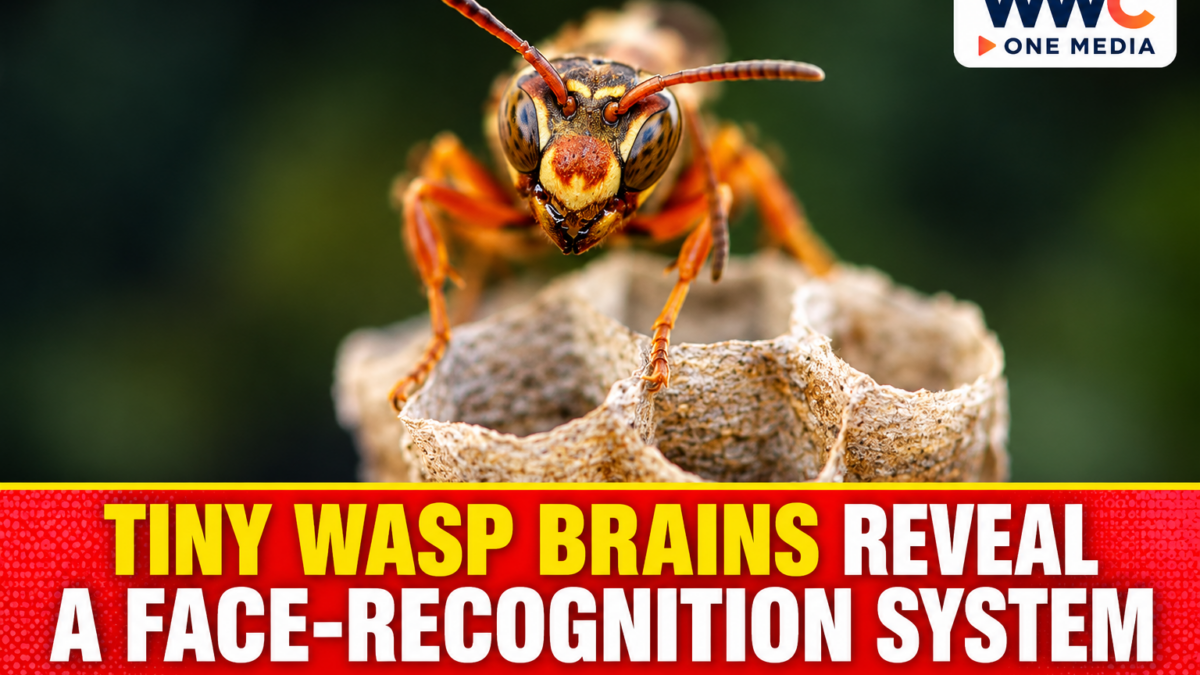
Female northern paper wasps have specialised brain cells that respond selectively to images of other wasps, researchers reported in a study published in Cell on November 23, 2026. The discovery identifies a neural system associated with recognising individual wasp faces and offers scientists another way to investigate how social recognition works across very different species.
The finding is significant because the insects and primates developed their face-processing abilities independently. Rather than suggesting that wasps recognise human faces, the research points to a more specific possibility: evolution may produce comparable ways of processing socially important visual information, even in animals with very different nervous systems.
What researchers found inside the wasp brain
The study, titled Neural correlates of facial recognition in a social wasp, examined the northern paper wasp, scientifically known as Polistes fuscatus. The research team included Christopher M. Jernigan, Lorenz C.C. Mammen, Winrich A. Freiwald and Michael J. Sheehan.
Researchers identified a localised population of neurons that responded selectively to images showing other wasps facing forward. The team called these cells “wasp cells” in describing their specialised responses.
The cells did more than react to the general presence of an insect. Some showed different activity patterns in response to variations in facial markings. Taken together, the activity of the neuron population carried information associated with facial identity.
This matters because recognising an individual requires more than detecting that another animal is present. An animal must distinguish one individual from another using features that remain useful across repeated encounters.
The university announcement described the result as the first study to identify this group of neurons in wasp brains. The research provides a biological explanation for a recognition ability already associated with this species.
Why recognising nestmates matters to paper wasps
Northern paper wasps have social relationships in which individual recognition can help maintain order within a nest.
Female wasps use distinctive facial patterns to distinguish other individuals. That ability is relevant to their social hierarchy, where recognising another wasp can help determine how an interaction should proceed.
The research announcement also describes a behaviour known as social eavesdropping. A wasp can observe an encounter between two other wasps and later respond differently to the individuals involved, depending on the outcome of that earlier interaction.
Remembering who won and who lost can provide information about the social position of other wasps without requiring the observer to take part in the original contest.
That behaviour makes individual recognition more than a visual curiosity. It is part of how these insects navigate relationships within a group.
For readers following other work on animal cognition, WWC has previously examined how crows process visual information and make rapid decisions. The wasp research investigates a different ability, but both studies raise questions about how animals with very different brains process information and respond to their surroundings.
What makes the comparison with humans scientifically important?
Humans and other primates rely on specialised neural systems to process faces. The new wasp findings point to an analogous form of specialisation in an insect.
The comparison is about how neural circuits process information, not about the overall complexity of the animals or the equivalence of their experiences.
A wasp brain is far smaller and differently organised from a human brain. The discovery does not mean that an insect has human-like thoughts, emotions or social understanding. It indicates that certain neurons in the two groups of animals may perform comparable information-processing functions.
The evolutionary distinction is important. Wasps and primates are separated by a long evolutionary history. Their specialised face-processing systems therefore appear to have developed independently rather than being inherited from a recent common ancestor with the same specialised ability.
In evolutionary biology, this kind of independently developed similarity is known as convergent evolution. Different organisms can arrive at comparable solutions when they face similar functional challenges.
In this case, the shared challenge is distinguishing individuals using visual features that matter in social interactions.
Why a small insect could help scientists study a complex problem
The discovery may also be useful because the wasp offers researchers a different biological system in which to investigate visual recognition.
Human and primate brains contain enormous numbers of neurons and highly complex networks. Studying the exact connections involved in face processing can be difficult.
The northern paper wasp has a much smaller nervous system. Researchers can use that difference to examine how specialised responses emerge and how groups of neurons represent information about individual faces.
The study’s potential value is not that wasps provide a direct replacement for human brain research. Instead, they offer another model for asking how nervous systems organise information when recognising individuals is important.
That broader question is relevant to the study of animal behaviour and cognition. WWC has also reported on research and conservation efforts involving the critically endangered Philippine eagle, illustrating how scientific investigation can inform understanding of species with very different biological characteristics.
What the discovery does not prove
The findings should not be stretched beyond the experiment.
The research does not show that paper wasps can identify human faces, understand human expressions or recognise people in the way humans recognise one another. Its focus is the neural response to images of other wasps.
Nor does identifying face-selective neurons establish that the insects experience recognition in a manner identical to humans. Similar neural organisation does not automatically mean identical perception, memory or consciousness.
The distinction is important for interpreting animal intelligence research. A specialised ability can be impressive without proving that one species possesses every cognitive ability associated with another.
The study instead provides evidence that a relatively small insect brain can contain a specialised neural population associated with individual visual recognition.
What happens next?
The research team has identified a population of cells associated with processing wasp faces. Further investigation can examine how these cells connect with other parts of the nervous system and how experience influences their activity.
One question raised by the research is whether the same neural system can process more complex visual information, including changes in facial appearance. The university announcement identifies the possibility of studying whether wasps respond to facial expressions as a future research direction, not as an established finding.
Researchers may also compare species that recognise individuals by their faces with closely related wasps that do not demonstrate the same specialised behaviour. Such comparisons could help explain how specialised neural processing develops during evolution.
For now, the central result is specific but important: researchers have identified neurons in northern paper wasps that selectively respond to wasp-face images and encode information associated with facial patterns.
The discovery does not make wasps miniature humans. It shows that nature can develop specialised ways of solving similar information-processing problems in very different kinds of brains.
Frequently Asked Questions
Can paper wasps recognise individual faces?
Female northern paper wasps use distinctive facial patterns to recognise other wasps. The recent study identified specialised neurons associated with processing those visual patterns.
Do wasps recognise human faces?
The study did not demonstrate human-face recognition. It examined how northern paper wasps respond to images of other wasps.
What are “wasp cells”?
The term describes a localised population of neurons identified in the study. These cells respond selectively to forward-facing wasp images, with some encoding information about facial patterns.
Where was the research published?
The study, Neural correlates of facial recognition in a social wasp, was published in the peer-reviewed journal Cell on November 23, 2026.
Could this research help scientists understand human vision?
It may provide a useful comparison for studying how specialised neural circuits process socially important visual information. However, the findings do not establish that wasps and humans experience facial recognition in the same way.