Brunei Darussalam’s armed forces are entering a new phase of capability development, with the government launching an updated Defence White Paper in 2026 and completing the acquisition of its Airbus C295MW transport aircraft fleet. Official records also identify the country’s patrol vessels, fast boats, armoured reconnaissance vehicles and other military assets.
The public information, however, does not amount to a complete inventory of every weapon system or an assessment of operational readiness. What it does provide is a useful picture of the Royal Brunei Armed Forces’ three main services, their publicly identified equipment and the roles those assets are expected to support.
That distinction matters. Counting platforms can help explain the scale and direction of a military, but it cannot establish how many are available for deployment, how well they are maintained or how effectively they would perform in a crisis.
Brunei’s military structure: Three services and a joint command
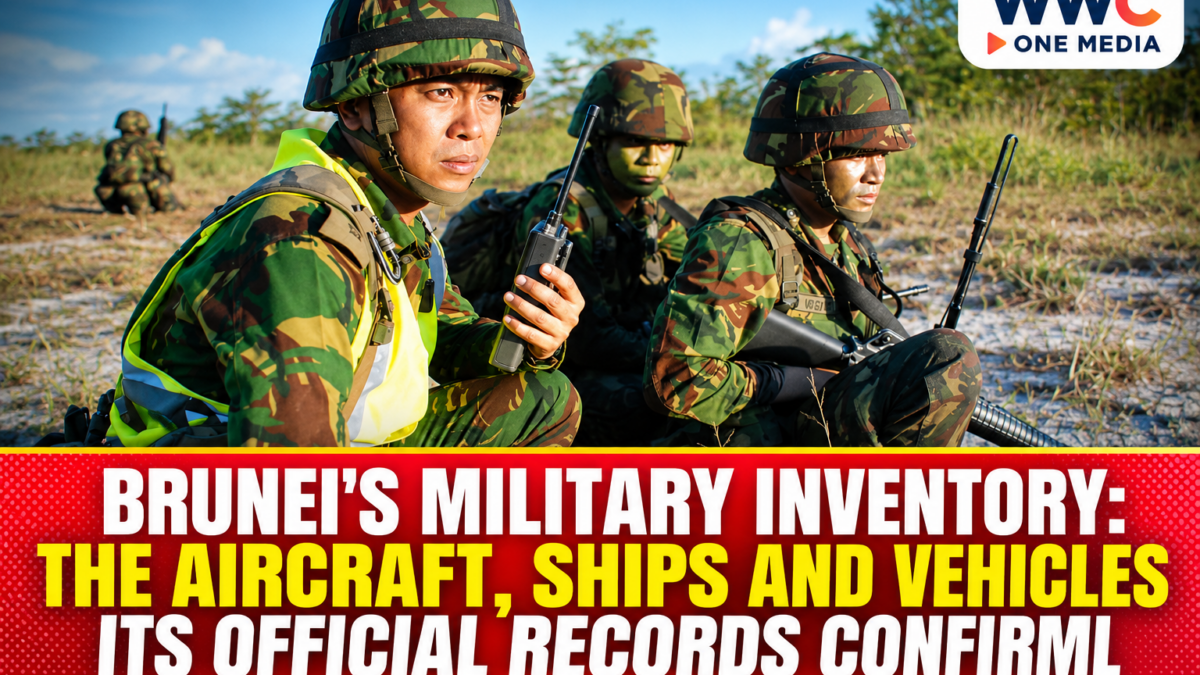
The Royal Brunei Armed Forces (RBAF) is organised around the Royal Brunei Land Forces, Royal Brunei Navy and Royal Brunei Air Force, supported by a Joint Force Headquarters.
The Ministry of Defence’s public organisational structure also identifies training and professional-development institutions, including the Defence Academy and Training Institute RBAF.
Brunei’s updated Defence White Paper was officially launched on May 31, 2026, during the armed forces’ 65th anniversary celebrations. Its theme is “Defending the Nation’s Sovereignty: Credible, Adaptive and Resilient Force.”
The Ministry of Defence subsequently held briefings for senior officers and warrant officers to explain the updated paper’s strategic direction and supporting priorities.
The launch establishes that Brunei has refreshed its published defence-policy framework. It does not, by itself, disclose a complete procurement list, a new force-size target or a detailed schedule for acquiring additional equipment.
Royal Brunei Navy: Patrol vessels and coastal-response assets
The Royal Brunei Navy’s published asset page identifies several classes of vessels used for maritime presence, patrol and support operations.
The Darussalam class consists of four patrol vessels. The Navy’s page states that three were commissioned in 2011, while KDB Daruttaqwa was commissioned in 2014.
The Navy also lists two ships under the As-Siddiq class. KDB As-Siddiq was commissioned on March 21, 2023, and KDB Al-Faruq on December 14, 2023.
Other publicly identified assets include four Ijhtihad-class fast patrol boats and the 25-metre fast interceptor boat KDB Mustaed.
The Navy also lists four landing craft: KDB Damuan, KDB Puni, KDB Serasa and KDB Teraban. Their stated role includes moving light and heavy land-force vehicles and personnel through rivers, providing a transport function that connects naval support with land operations.
These vessels should not all be treated as equivalent combat ships. Patrol vessels, fast patrol boats, interceptor craft and landing craft perform different tasks. Their combined value lies in providing a range of maritime presence, response and logistical capabilities.
The Navy also identifies a Naval Surface Action Group supporting search-and-rescue operations, underwater clearance and maritime interdiction. Its published description shows that the service’s responsibilities extend beyond routine patrol activity.
For wider regional context, WWC has examined the proposed ASEAN Maritime Centre in the Philippines, a separate initiative focused on maritime cooperation and information-sharing.
Royal Brunei Air Force: Four C295MW transport aircraft
One of the clearest recent equipment milestones is the completion of Brunei’s Airbus C295MW air-transport fleet acquisition.
The Royal Brunei Air Force announced on April 21, 2026, that the final two aircraft had arrived at Rimba Air Force Base the previous day. They were designated TUDB 504 and TUDB 505.
The first two aircraft had been delivered on January 24, 2024, and the type entered service on February 14, 2024. The arrival of the final pair completed the four-aircraft acquisition.
The Air Force said the C295MW fleet had recorded 518 flights across eight Southeast Asian countries since entering service. It identified humanitarian assistance and disaster-relief deployments to the Philippines following Typhoon Trami in 2024 and to Myanmar in 2025, as well as VIP transport missions to Timor-Leste.
This operational record illustrates why transport aircraft are important even when they are not fighter jets. They can move personnel and supplies, support emergency response and help a country contribute to regional relief operations.
Brunei’s official releases also identify Sikorsky S-70i Black Hawk helicopters as part of its air capabilities. However, the records reviewed for this report do not establish a complete current helicopter count or a comprehensive list of every aircraft type in service.
The distinction between transport and combat aviation is important when interpreting Brunei’s air inventory. The publicly confirmed C295MW acquisition is an air-mobility capability, not evidence of a newly acquired fighter fleet.
Royal Brunei Land Forces: Armoured reconnaissance and support equipment
The public record for Brunei’s land forces provides examples of equipment, but not a consolidated total of its armoured vehicles, artillery or other ground systems.
A Royal Brunei Land Forces release dated November 12, 2026, described an educational visit to Field Command at Penanjong Garrison. The static display included the Combat Vehicle Reconnaissance (Tracked), or CVR(T), Scorpion and CVR(T) Sultan vehicles from the First Squadron Armour.
The same event featured explosive ordnance disposal equipment from the Second Squadron, Engineer Regiment, and an airboat from the Combat Boat Squadron.
The release also recorded a mobility demonstration involving the CVR(T) Scorpion. This confirms that these named platforms were publicly displayed and demonstrated during the event. It does not establish the total number of vehicles held by the Land Forces or prove that every example in the wider inventory is operational.
The Land Forces’ stated roles include protecting land borders, riverine and littoral areas, supporting security agencies, and assisting civilian authorities with humanitarian assistance, disaster relief and search-and-rescue operations.
That range of responsibilities helps explain why land-force equipment cannot be assessed solely by counting armoured vehicles. Mobility, engineering, explosive-ordnance disposal and support capabilities also contribute to military readiness.
Why the public inventory is not the whole story
Brunei’s published records identify meaningful capabilities across its land, sea and air services. But they do not provide enough information to calculate the armed forces’ total equipment holdings or compare their operational strength with neighbouring countries.
A platform appearing in an official release does not automatically establish its availability, serviceability, deployment status or remaining service life. Nor does a completed acquisition disclose the full cost of ownership, including maintenance, training, spare parts and future upgrades.
For readers following regional defence developments, these qualifications are important. WWC’s reporting on Japan’s expanding defence cooperation across the Indo-Pacific and Singapore and Indonesia’s joint F-16 air patrol provides examples of how equipment, training and coordination are separate parts of military capability.
Analysis: Brunei’s public record suggests a defence posture in which maritime patrol, air mobility, land protection and regional cooperation all have visible roles. The C295MW fleet’s documented humanitarian deployments are one example of how military assets can support national and regional tasks beyond combat operations.
The available documents do not justify claims that Brunei is preparing for a particular conflict or undertaking a major expansion of combat power. Those conclusions would require evidence such as formal procurement announcements, budget disclosures, delivery records and official statements on force development.
What happens next
The next useful indicators will be further official disclosures under the Defence White Paper Update 2026, new equipment announcements and operational reports from the individual services.
For a clearer picture of Brunei’s military development, future public records would need to provide more detail on procurement, equipment quantities, delivery timelines, maintenance arrangements and capability targets.
Until then, the most reliable approach is to distinguish between equipment confirmed in official releases and the larger inventory that remains undisclosed or unverified.
Brunei’s armed forces have identifiable assets across land, sea and air. The public record shows some of the systems supporting those responsibilities, but it does not offer a complete count of the country’s military strength.
Frequently asked questions
What are the main branches of Brunei’s military?
The Royal Brunei Armed Forces includes the Royal Brunei Land Forces, Royal Brunei Navy and Royal Brunei Air Force, supported by a Joint Force Headquarters.
How many C295MW aircraft does Brunei have?
Brunei completed a four-aircraft C295MW acquisition in April 2026. The first two arrived in January 2024, and the final two arrived on April 20, 2026.
What ships are listed in Brunei’s Navy inventory?
The Navy publicly lists four Darussalam-class patrol vessels, two As-Siddiq-class ships, four Ijhtihad-class fast patrol boats, the fast interceptor boat KDB Mustaed and four landing craft.
What armoured vehicles has Brunei publicly identified?
A Royal Brunei Land Forces release identified CVR(T) Scorpion and CVR(T) Sultan vehicles at a November 2026 public display. The release does not provide the total number held by the Land Forces.
Does Brunei publish a complete military inventory?
The official records reviewed identify selected ships, aircraft and land-force equipment, but they do not provide a single comprehensive inventory with full quantities, readiness rates and serviceability information.