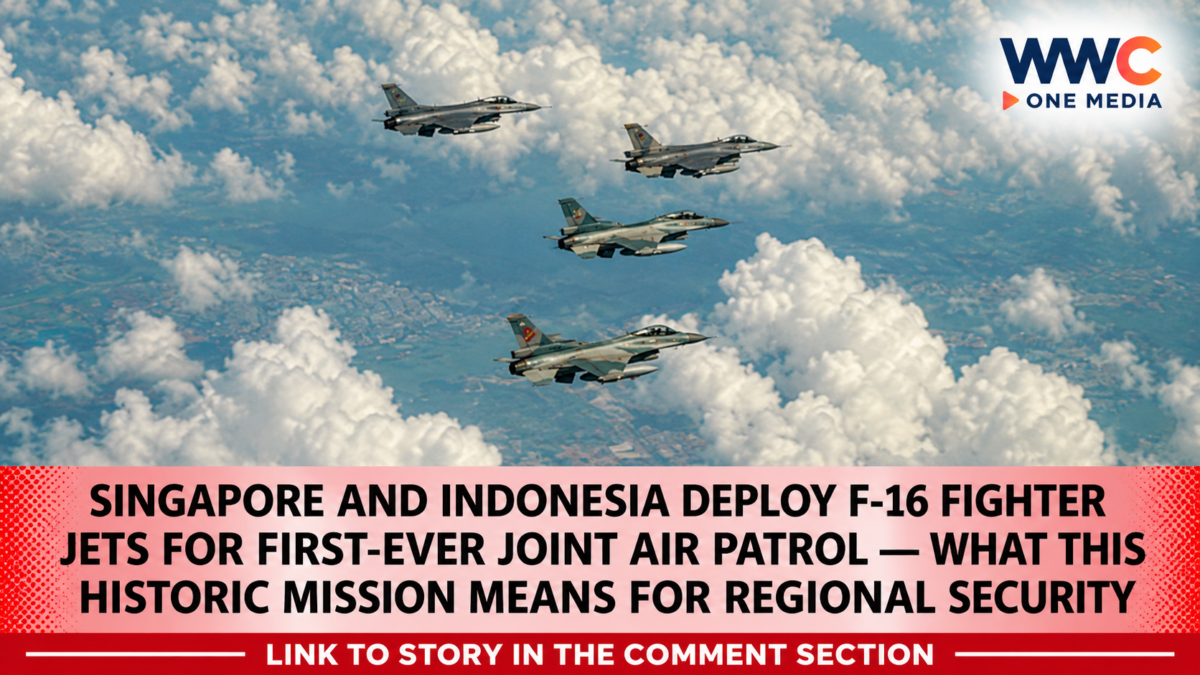
Singapore and Indonesia have completed their first-ever joint fighter-aircraft patrol, marking a significant step in military cooperation between the two Southeast Asian neighbours as they strengthen efforts to protect their airspace against transnational security threats.
The inaugural operation, known as Patkor Indopura, took place from November 3 to 4, 2026, bringing together fighter aircraft from the Republic of Singapore Air Force (RSAF) and the Indonesian Air Force (TNI AU).
According to Singapore’s Ministry of Defence (MINDEF), two F-16 fighter aircraft from each country participated in the operation, which involved joint mission briefings, the practice of standing operating procedures and coordinated patrols along the airspace bordering Singapore and Indonesia.
The operation was more than a symbolic military exercise. It provided both air forces with an opportunity to work together in a practical operational setting, strengthen coordination and deepen mutual trust.
Adding to the significance of the mission, the chiefs of both air forces personally participated in the patrol, flying in fighter aircraft belonging to their respective countries.
For Singapore and Indonesia, the operation represents a new chapter in a defence relationship built through decades of military exercises, professional exchanges and regional security cooperation.
Singapore and Indonesia Bring Their F-16 Fighters Together
The central feature of Patkor Indopura was the joint deployment of F-16 fighter aircraft from both air forces.
The Singapore contingent came from the Republic of Singapore Air Force, while Indonesia was represented by the Indonesian Air Force, also known as TNI AU.
The two-day operation involved more than simply putting aircraft into the sky together.
Both sides conducted combined mission briefings, reviewed and practised standing operating procedures, and carried out coordinated air patrols along the border between the two countries.
These activities are important because military cooperation requires more than compatible equipment.
Pilots and supporting personnel must understand how their counterparts communicate, coordinate movements, follow operational procedures and respond to developing situations.
Working through these procedures together helps build the ability to operate alongside one another when circumstances require coordinated action.
MINDEF described the patrol as demonstrating the two air forces’ shared commitment to protecting their borders against transnational terrorism threats.
The ministry also said the operation strengthened cooperation and deepened mutual trust and understanding between the RSAF and TNI AU.
Air Force Chiefs Personally Join the Historic Patrol
One of the most notable aspects of the inaugural operation was the participation of the two air force leaders.
Singapore’s Chief of Air Force, Major-General Kelvin Fan, and Indonesia’s Chief of Staff of the Air Force, Air Chief Marshal Mohamad Tonny Harjono, both took part in the joint patrol.
Each flew in a fighter aircraft operated by their respective air force.
Fan described the inaugural patrol as a special milestone for both air forces, highlighting the trust, friendship and professionalism demonstrated by their ability to conduct the mission together.
The participation of both chiefs also underscored the importance their respective military establishments placed on the operation.
Rather than being limited to meetings between senior officials, the mission brought the countries’ air force leadership directly into a shared operational activity.
It provided a visible demonstration of the close working relationship both sides are seeking to maintain.
Why the Joint Patrol Matters for Regional Security
Singapore and Indonesia occupy strategically important positions in Southeast Asia.
Their proximity to major maritime routes, busy commercial aviation corridors and important regional waterways makes security cooperation between the two countries particularly significant.
Transnational terrorism is also not confined by national borders.
Threats can involve individuals, networks or activities operating across multiple jurisdictions, making cooperation between neighbouring countries important for information-sharing and coordinated responses.
The joint air patrol is intended to strengthen the two air forces’ ability to work together in protecting their respective borders against such threats.
However, it is important to distinguish the operation’s stated purpose from its actual scope.
MINDEF identified transnational terrorism as a shared security concern, but did not announce that the patrol was launched in response to a specific terrorist incident, aircraft intrusion or immediate military threat.
There was also no announcement that the operation created a permanent joint air command or transferred control of either country’s airspace to the other.
The patrol should therefore be understood as a new form of bilateral operational cooperation, not a merger of the two countries’ air forces.
A Defence Partnership Built Over Decades
Although Patkor Indopura is the first joint fighter-aircraft patrol of its kind between the two air forces, Singapore and Indonesia have maintained extensive military cooperation for many years.
MINDEF identified several established bilateral air force exercises that continue to strengthen the relationship:
- Exercise Elang Indopura
- Exercise Camar Indopura
- Exercise Manyar Indopura
These activities provide opportunities for personnel from both countries to improve their professional knowledge, exchange experiences and strengthen their ability to coordinate military activities.
The two air forces also maintain high-level visits, professional exchanges and cross-attendance of training courses.
These arrangements are important because military cooperation depends on relationships developed over time, not just the equipment used during a particular exercise.
The inaugural patrol adds another practical dimension to that longstanding partnership.
It also demonstrates that cooperation between Singapore and Indonesia extends beyond naval activities and traditional defence diplomacy.
The Two Countries Have Also Strengthened Naval Cooperation
The relationship between Singapore and Indonesia is not limited to their air forces.
Their navies have also conducted regular joint activities involving maritime security, mine countermeasures and coordinated patrols.
One example is Exercise Joint Minex Pandu, a bilateral mine-countermeasure and clearance-diving exercise involving the Republic of Singapore Navy and the Indonesian Navy.
In May 2024, the two navies conducted the exercise in Batam and waters off Bintan.
More than 230 personnel participated, with both sides deploying mine-countermeasure vessels and diving teams.
The exercise included mine-hunting exchanges, clearance-diving techniques, ship-boarding activities and coordinated operations against simulated underwater mine threats.
The two navies also cooperate through the Coordinated Patrol Indonesia-Singapore, commonly known as CORPAT INDOSIN.
These activities demonstrate that the defence relationship has developed across multiple military domains.
The new air patrol therefore builds on an existing foundation of cooperation rather than creating a partnership from scratch.
Why Interoperability Is Becoming Increasingly Important
Interoperability refers to the ability of different military forces to work together effectively.
For two neighbouring countries, this can involve compatible communication procedures, coordinated planning, shared operational understanding and the ability to conduct activities alongside one another.
The importance of interoperability becomes particularly clear when a security threat crosses national boundaries.
A country may have its own aircraft, radar systems and military personnel, but effective regional cooperation also requires the ability to coordinate with neighbouring forces.
Joint exercises and patrols allow military personnel to practise these arrangements before they are needed in more demanding circumstances.
For the RSAF and TNI AU, Patkor Indopura provided an opportunity to test and strengthen those working relationships in an actual joint patrol setting.
The mission also gives both countries a platform to build on their existing military exchanges and explore further areas of cooperation.
Singapore and Indonesia Have Been Expanding Defence Cooperation in Other Areas
The latest air patrol comes amid wider efforts by Singapore and Indonesia to strengthen their defence relationship.
In April 2026, the two air forces discussed expanding cooperation during a high-level meeting in Jakarta between Indonesian Air Force Chief of Staff Mohamad Tonny Harjono and Singapore’s then Chief of Air Force staff, Brigadier-General Ho Kum Luen.
According to Indonesian news agency ANTARA, discussions included joint training exercises, military education, defence technology and possible collaboration in humanitarian assistance and disaster relief.
The meeting highlighted an interest in expanding cooperation beyond conventional combat training.
Humanitarian assistance and disaster relief are particularly relevant in Southeast Asia, where countries regularly face earthquakes, floods, volcanic eruptions and other natural disasters.
Military organisations often possess aircraft, logistics capabilities, communications equipment and personnel that can support emergency operations when civilian resources are stretched.
Greater coordination between neighbouring air forces could therefore have benefits beyond conventional defence.
The new joint patrol adds to these broader efforts to deepen the relationship.
An Important Detail: Reports Differ on the Number of Aircraft
There is one reporting discrepancy worth noting.
Singapore’s Ministry of Defence stated that two F-16 fighter aircraft from each air force participated in Patkor Indopura.
However, Indonesia’s ANTARA news agency, citing an Indonesian Air Force statement, reported that the patrol involved two Indonesian F-16s and three Singaporean F-16s.
The two accounts therefore differ on the number of Singaporean aircraft involved.
MINDEF’s official announcement is the clearest published Singapore-side account and specifies two aircraft from each country. The Indonesian report provides a separate account of the operation.
Without further clarification from the two air forces, the difference should not be silently treated as resolved.
What both accounts agree on is that the two countries conducted their inaugural joint fighter patrol and that their respective air force chiefs participated.
What Comes Next for Singapore-Indonesia Military Cooperation?
The successful completion of Patkor Indopura creates an opportunity for both countries to build on their existing defence relationship.
The operation could provide a foundation for further joint patrols, training activities and professional exchanges, although neither government has announced a confirmed schedule for the next joint fighter patrol.
For now, the most important development is that the RSAF and TNI AU have demonstrated their ability to conduct a joint fighter-aircraft patrol along their shared border.
The operation also sends a broader message about the importance of regional cooperation.
Security challenges increasingly involve multiple countries, and no single military can address every cross-border threat independently.
Singapore and Indonesia have long recognised the value of maintaining close defence ties. Patkor Indopura gives that relationship a new operational milestone.
The Bottom Line
Singapore and Indonesia have completed their first-ever joint fighter-aircraft patrol, bringing their F-16 fighters together in a two-day operation designed to strengthen cooperation against transnational terrorism threats.
The participation of both air force chiefs, the joint mission briefings and the practice of standing operating procedures make the operation an important development in the two countries’ defence relationship.
It also builds on decades of military exercises, naval cooperation and professional exchanges.
However, the patrol should not be mistaken for a new military alliance, a permanent joint command or evidence of an immediate security emergency. Neither government has announced such developments.
The real significance lies in the ability of two neighbouring countries to coordinate their military activities and strengthen mutual trust through practical cooperation.
As Southeast Asia faces increasingly complex security challenges, could Singapore and Indonesia’s first joint fighter patrol become the starting point for a much broader regional air-security partnership?