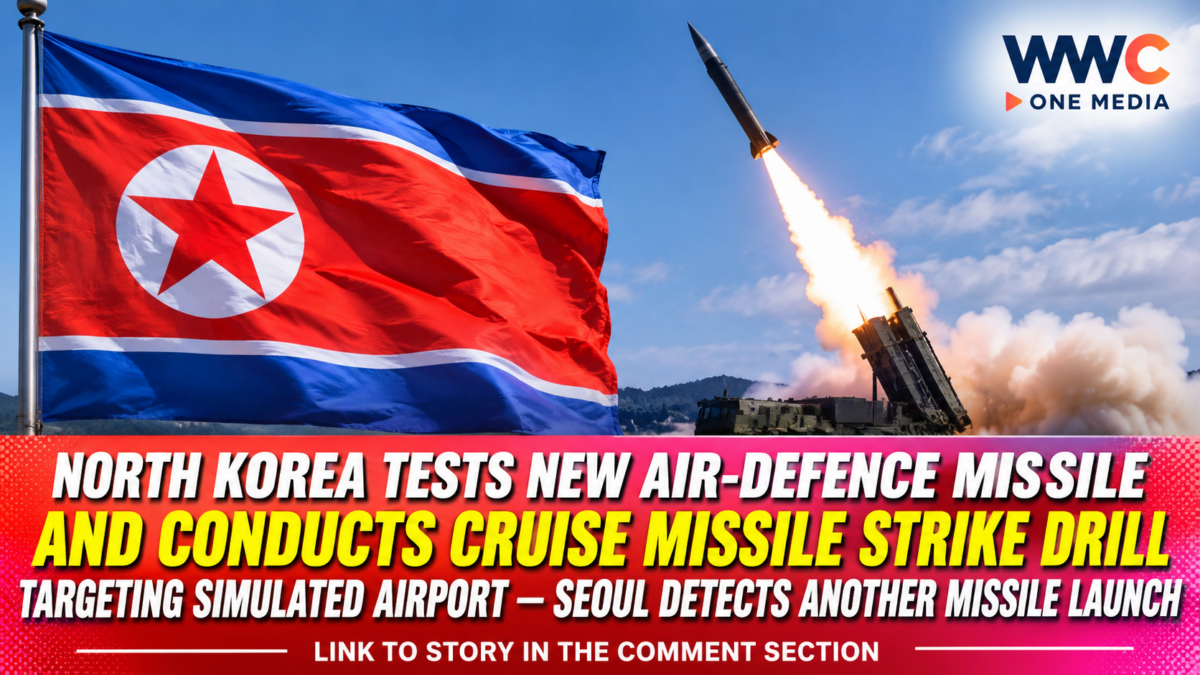
North Korea has announced a fresh series of weapons tests involving a newly designed air-defence missile system and a long-range strategic cruise missile, escalating concerns over Pyongyang’s expanding military capabilities as South Korea reports another launch toward the East Sea.
The tests, conducted on Wednesday, November 4, were reported by North Korea’s state-run Korean Central News Agency (KCNA) on Thursday. One exercise reportedly evaluated a new air-defence missile system, while another involved a cruise missile unit striking a simulated airport target.
The announcement came after South Korea’s military detected multiple missiles launched from North Korea’s eastern coastal region toward the East Sea, also known internationally as the Sea of Japan.
The latest activity marks North Korea’s fourth weapons launch in approximately one month, according to Reuters.
Although Pyongyang presented the exercises as demonstrations of improving military technology, the developments raise questions about how the country is expanding its ability to defend strategic sites and strike potential military targets.
The situation is particularly sensitive because North Korea has recently tested different types of missile warheads, including a dispersal warhead for a strategic cruise missile and a cluster-type warhead associated with a tactical ballistic missile.
North Korea Tests New Air-Defence Missile System
According to KCNA, North Korea’s Missile Administration conducted a test of a newly designed air-defence missile system on Wednesday.
The exercise was intended to evaluate the system’s technical specifications, reliability and ability to identify and track potential targets.
North Korean state media said the test demonstrated the performance of newly developed materials and what it described as an intelligent multiple-guidance mode.
The system’s detection and information-processing capabilities were also assessed.
The exercise was overseen by Kim Jong-sik, a member of North Korea’s Central Military Commission who is involved in the country’s military weapons-development programme.
However, KCNA did not provide sufficient technical details to independently establish the missile system’s range, interception capabilities or operational readiness.
That distinction matters. A successful test announcement does not automatically mean a new weapon has entered full operational service.
North Korea has repeatedly publicised weapons demonstrations as evidence of military progress, but outside observers do not always have access to the information needed to verify those claims.
Cruise Missile Unit Targets a Simulated Airport
The second exercise involved a sub-unit of North Korea’s long-range strategic cruise missile force operating in the country’s eastern region.
KCNA said the unit conducted a strike drill using a long-range strategic cruise missile against a virtual airport target.
The exercise is significant because airports and military airfields are important infrastructure during a conflict. They can support aircraft operations, logistics, personnel movements and military supply networks.
A simulated strike against an airport therefore demonstrates the type of target North Korea wants its weapons programme to address.
However, the available reports do not establish that an actual airport was attacked or that the exercise involved a live strike against a real-world facility.
The target was described as virtual, meaning the drill was a weapons exercise rather than an attack on an operating airport.
Reuters reported that the cruise missile exercise appeared to confirm the broader military activity reported by South Korea.
The precise missile specifications and the effectiveness of the simulated strike have not been independently established.
South Korea Detects Multiple Missiles From North Korea’s East Coast
The North Korean announcement followed a report from South Korea’s Joint Chiefs of Staff (JCS) that multiple missiles had been fired from the Sondok area in South Hamgyong Province toward the East Sea early Wednesday.
South Korean authorities estimated that the projectiles travelled less than 300 kilometres.
Yonhap reported that officials had not ruled out the possibility that the detected projectiles included close-range ballistic missiles.
This creates an important distinction between the two sides’ accounts.
North Korea’s state media described a cruise missile strike drill and a separate air-defence missile test. South Korea independently reported detecting multiple projectiles travelling toward the sea.
The available information does not establish that every projectile detected by South Korea was part of the cruise missile exercise described by KCNA.
South Korean and US authorities continued analysing the launches to determine the weapons involved and their characteristics.
The latest activity is also notable because it represents another round of testing within a relatively short period.
Reuters described it as North Korea’s fourth weapons launch in a month.
Why Is North Korea Testing So Many Weapons?
The latest exercises follow a series of weapons demonstrations involving different missile systems and warhead designs.
On November 3, North Korea announced that it had tested a strategic cruise missile equipped with a dispersal warhead.
The test was conducted on November 2, according to KCNA.
Pyongyang claimed the warhead could affect an area of approximately five to six hectares under its highest-density conditions. It also said the missile’s ability to conduct a vertical strike had been improved.
Those performance claims have not been independently verified.
Yonhap reported that the cruise missile test followed an earlier demonstration involving a cluster-type warhead for a tactical ballistic missile.
The sequence suggests that North Korea is testing a wider range of conventional weapons rather than concentrating on a single missile system.
WWC One Media previously examined the dispersal-warhead test in North Korea Tests Strategic Cruise Missile With Dispersal Warhead — But What Is Pyongyang Signalling?.
The earlier report explored the significance of the new warhead and the possible implications for the Korean Peninsula’s security environment.
North Korea Is Expanding Its Conventional Military Options
North Korea is already a nuclear-armed state with an extensive ballistic-missile programme.
But its latest tests highlight another important part of its military strategy: developing a wider range of conventional weapons.
Cruise missiles, ballistic missiles, air-defence systems, artillery and attack drones serve different military purposes.
Cruise missiles can be designed to approach targets along lower-altitude flight paths, while ballistic missiles generally follow a different trajectory. Air-defence systems are intended to detect and engage incoming aerial threats.
Developing multiple categories of weapons could give North Korea more options during a military crisis.
It could also make planning more complicated for South Korea and the United States, which must monitor different types of potential threats.
In September, North Korea conducted a large-scale live-fire exercise involving artillery, tactical cruise missiles, ballistic missiles and attack drones.
KCNA described the operation as a coordinated firepower exercise involving several military units.
WWC One Media covered that demonstration in North Korea Unleashes Missiles, Artillery and Drones in Major Live-Fire Drill — Tensions Rise After US-Led Exercises.
The exercise showed Pyongyang’s interest in coordinating different weapons systems rather than relying exclusively on individual missile launches.
South Korea Says Its Military Is Ready to Respond
South Korea has sought to reassure the public that its military remains prepared to respond to potential threats from the North.
The country’s armed forces maintain surveillance and intelligence cooperation with the United States.
The alliance is central to Seoul’s defence strategy, particularly given North Korea’s continued development of nuclear weapons and delivery systems.
The latest launches will therefore be examined not only for their technical characteristics but also for what they could mean for regional military readiness.
South Korea’s military has previously emphasised that it possesses precision-strike capabilities and remains prepared to respond to provocations.
However, the detection of a missile launch does not automatically mean that a military confrontation is imminent.
The latest exercises have not been reported as an attack against South Korea, the United States or Japan.
The Timing Comes Amid Renewed Tensions With Washington
The latest military activity also comes during a period of strained relations between Pyongyang and Washington.
Earlier in November, Kim Yo-jong, the sister of North Korean leader Kim Jong-un, issued statements rejecting US accusations linking North Korea to a major cryptocurrency theft involving Binance.
She also criticised Washington’s approach toward Pyongyang.
North Korea has repeatedly rejected what it describes as hostile US policy and has used American and South Korean military exercises to justify strengthening its own armed forces.
Washington and Seoul, meanwhile, maintain that their military cooperation is intended to deter North Korean aggression and protect regional security.
The two sides therefore continue to interpret each other’s military activities very differently.
For Pyongyang, weapons tests are presented as necessary demonstrations of national defence.
For South Korea and the United States, the expanding North Korean arsenal represents a continuing security concern.
How the Latest Tests Fit Into North Korea’s Broader Weapons Programme
The November exercises should not be viewed as isolated announcements.
They follow several developments involving North Korea’s missile and conventional weapons programmes.
- September 12: North Korea launched multiple ballistic missiles following a US-South Korea-Japan military exercise.
- September 14: Pyongyang reported a major live-fire drill involving artillery, missiles and drones.
- September 20: North Korea conducted further ballistic missile launches and announced another weapons test.
- October 31: North Korea reported a cluster-warhead test for a tactical ballistic missile.
- November 2: Pyongyang announced a strategic cruise missile test involving a dispersal warhead.
- November 4: South Korea detected multiple missiles from the Sondok area, while North Korea reported new air-defence and cruise missile exercises.
The developments point to a sustained period of military testing and weapons demonstrations.
WWC One Media also reported on North Korea Fires Multiple Ballistic Missiles After US-South Korea-Japan Drill — But the Timing May Be the Bigger Message, examining how Pyongyang’s missile launches have coincided with military cooperation among Washington, Seoul and Tokyo.
Another report, North Korea Tests New Combat Weapon as Kim Jong Un Warns Enemies of a ‘Cruel’ Blow, explored the country’s efforts to demonstrate new weapons technology.
Could These Weapons Change the Security Balance on the Korean Peninsula?
The development of additional missile and air-defence systems could complicate military calculations across Northeast Asia.
South Korea must account for North Korea’s ballistic missile capabilities, cruise missile development and growing range of conventional weapons.
Japan also closely monitors North Korean launches because of the potential risks to regional security and shipping routes.
The United States maintains military forces and defence commitments in the region, making North Korea’s weapons development an important issue for Washington as well.
The challenge is not simply identifying a new missile.
Military planners must also assess how different systems could operate together, what targets they might threaten and whether they could be used during a larger conflict.
North Korea’s latest exercise involving a simulated airport target is one example of how Pyongyang is publicly demonstrating possible strike scenarios.
But the available information does not establish that the country’s latest systems have achieved every capability claimed by state media.
The Risk of Miscalculation Remains a Major Concern
Repeated weapons demonstrations can increase pressure on governments already involved in a tense security environment.
A missile launch may be intended as a test, a demonstration of military capability or a political signal. But neighbouring countries must still determine whether the activity presents an immediate threat.
The possibility of misinterpretation is one reason military communication, surveillance and diplomatic channels remain important.
The latest North Korean tests do not establish that war is imminent.
However, continued weapons development, military exercises and competing security claims can make an already sensitive situation more difficult to manage.
WWC One Media previously examined the wider nuclear and diplomatic tensions in North Korea Says Its Nuclear Status Is ‘Absolute’ — But Trump Still Wants Another Kim Jong Un Summit.
The report highlighted the continuing gap between Pyongyang’s insistence on maintaining its nuclear arsenal and Washington’s long-standing position on North Korean denuclearisation.
What Happens Next?
South Korean and US authorities are expected to continue examining the latest launches and monitoring North Korea for additional weapons activity.
Pyongyang, meanwhile, has signalled that developing and testing new military systems remains a priority.
The next important questions concern the technical capabilities of the new air-defence missile, the performance of the long-range cruise missile and whether further tests will follow.
For South Korea, the priority is maintaining military readiness without allowing every weapons demonstration to trigger an uncontrolled escalation.
For Washington, the challenge is balancing deterrence with the possibility of future diplomacy.
For North Korea, the latest announcement reinforces its message that it intends to continue strengthening its military capabilities.
The simulated airport target may have existed only in a military exercise, but the broader message is real: Pyongyang is continuing to demonstrate a growing range of weapons systems.
The biggest question now is whether North Korea’s latest military demonstrations are simply tests of new technology — or part of a wider effort to reshape the military balance on the Korean Peninsula.