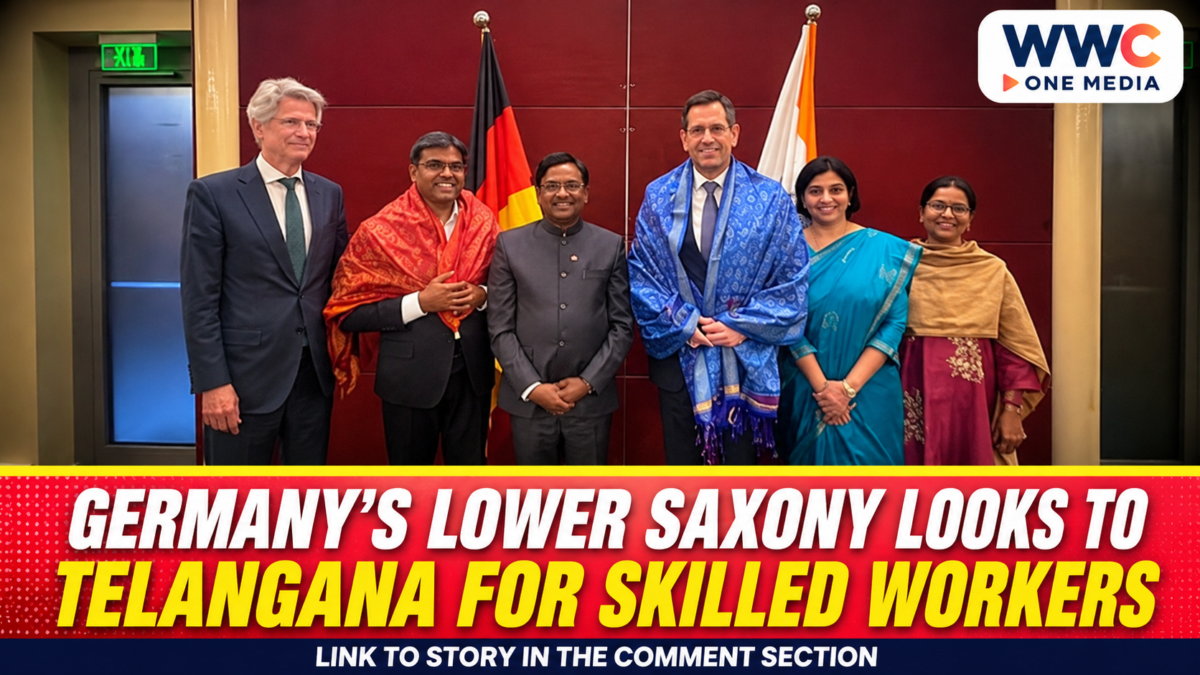
Germany’s Lower Saxony is pursuing closer workforce cooperation with India, with Telangana identified as a partner for discussions on recruiting and preparing skilled professionals during a November 22–28, 2026, delegation visit. The proposed exchange places vocational qualifications, worker preparation and international mobility at the centre of a relationship that could create opportunities for Indian jobseekers if the discussions translate into practical recruitment pathways.
The initiative comes as Germany continues to report shortages in several occupations while Telangana seeks to connect its training institutions and young workforce with international employment demand. But an overseas employment partnership involves more than matching available workers with vacancies: qualifications, language ability, employer requirements and legal migration procedures must all line up.
For Telangana, the important question is whether cooperation can move beyond diplomatic discussions and produce a transparent system that connects trained candidates with genuine employers.
Telangana Germany jobs: Why Lower Saxony is looking to India
Lower Saxony Minister-President Olaf Lies is leading a 60-member delegation of political and business representatives to India from November 22 to 28. The official itinerary includes New Delhi, Pune and Mumbai, with discussions covering industrial cooperation, artificial intelligence, renewable energy, manufacturing and skilled-worker recruitment.
The state government’s November 20 announcement specifically identifies an exchange with representatives of Telangana on the recruitment and qualification of skilled workers. It also says the discussions will consider opportunities created by the new EU–India framework for cooperation on mobility. Nds. Staatskanzlei
This is important because the relationship is not limited to companies looking for new markets. It also concerns the people needed to operate businesses, maintain industrial facilities and support specialised services.
Lower Saxony has a substantial industrial base, including automotive manufacturing, machinery and technology-related businesses. Its delegation programme also includes visits to companies and meetings intended to develop commercial partnerships.
The workforce discussions therefore sit within a wider economic relationship rather than functioning as a stand-alone recruitment announcement.
Germany’s labour data explains the interest in skilled migration
Germany’s demand for qualified workers is supported by official labour-market figures, although the situation differs by occupation.
In its September 2, 2026, assessment, Germany’s Federal Employment Agency identified 157 occupational categories facing skills shortages in 2025, six fewer than the previous year. It continued to identify shortages in healthcare, construction and skilled trades, as well as demand for cooks, professional drivers and nursery teachers. Federal Employment Agency
The agency also reported that foreign workers have become increasingly important in occupations facing shortages. Their share in those sectors rose from 7% in 2014 to around 14% in 2025.
A separate September 14 assessment focused on skilled trades. It reported that vacancies in those occupations remained unfilled for an average of 242 days in 2025, compared with 167 days across all occupations. The agency identified construction, plumbing, heating and air-conditioning, electrical work and mechatronics among areas with significant recruitment difficulties. Federal Employment Agency
These figures help explain why German regions are looking beyond their domestic labour markets. They do not, however, establish that every occupation is short of workers or that Lower Saxony has vacancies available for every Indian applicant.
For Telangana, the opportunity will depend on identifying specific jobs and matching them with candidates whose qualifications meet the actual requirements.
Training must lead to qualifications employers recognise
Telangana has already been pursuing international cooperation in education and workforce preparation.
In June 2026, the state signed a memorandum of understanding with Germany’s Thuringia, covering technology, skill development, startups and life sciences. The agreement involved Telangana Chief Minister A. Revanth Reddy and Thuringia Minister-President Mario Voigt.
The official announcement said discussions included strengthening curricula at Young India Skills University, Advanced Technology Centres and polytechnic institutes. It also described a proposal for a German-language training hub in Hyderabad. Invest Telangana
That agreement is separate from the current Lower Saxony discussions. Thuringia and Lower Saxony are different German states, and the June memorandum should not be treated as an agreement with Lower Saxony.
Still, the earlier initiative illustrates the kind of preparation that can make international recruitment more practical. Workers may need technical training, recognised qualifications, language instruction and familiarity with workplace standards before they can compete for particular positions.
WWC has examined the broader challenge in India’s effort to upgrade Industrial Training Institutes. The central issue is not simply expanding the number of training programmes. Courses must provide relevant practical experience and connect graduates with employers who need those capabilities.
A recruitment partnership needs safeguards for workers
International labour mobility can benefit both sides, but the recruitment process must be credible.
For candidates, that means knowing which employers are hiring, what qualifications are required, what language level is expected, how much the job pays and what deductions or costs may apply. It also means understanding whether a qualification needs formal recognition in Germany.
The German government’s official immigration guidance explains that entry routes differ according to a worker’s professional background and the type of job. Some routes require a recognised qualification, a concrete job offer or compliance with specific salary and employment conditions. Make It In Germany+2
This is why a general announcement about cooperation should not be interpreted as an open work-permit programme.
Telangana’s overseas employment institutions could potentially help candidates navigate preparation and recruitment, but the actual pathway must be defined through clear procedures and verified employer demand.
The experience of other countries also shows why recruitment details matter. WWC’s report on Japan’s recruitment of Filipino nurses and care workers examined how government-to-government employment arrangements depend on training, qualification requirements and defined recruitment batches.
For any Telangana–Germany initiative, transparency over recruitment fees, contracts, working conditions and candidate selection will be essential to maintaining trust.
What the partnership could mean for Telangana
If discussions lead to a functioning programme, Telangana could gain another route for connecting technical education with overseas employment.
Training institutions may have stronger incentives to develop courses around specific industrial requirements. Employers could gain access to candidates prepared for their operations, while qualified workers could gain opportunities to build careers abroad.
There is also a potential benefit for local institutions. Cooperation with German companies and training organisations could expose instructors and students to different technical standards, industrial processes and assessment systems.
But these are potential outcomes, not confirmed commitments from the current visit.
The Lower Saxony government’s published announcement confirms that workforce recruitment and qualification are on the agenda. It does not publish a guaranteed number of jobs, a recruitment quota, a funded training programme or a schedule for sending workers to Germany. Nds. Staatskanzlei
The distinction matters. A successful partnership should be judged by actual placements, recognised qualifications, fair employment conditions and the ability of workers to remain in jobs suited to their training.
What happens next
The next stage will be to determine whether the discussions produce formal cooperation arrangements, employer commitments or a structured training and recruitment programme.
Useful details would include the occupations covered, qualification standards, language requirements, participating employers, recruitment procedures and the institutions responsible for preparing candidates.
The official visit schedule establishes that Lower Saxony and Telangana are expected to discuss skilled-worker recruitment and qualification. It does not yet establish a completed recruitment agreement or a confirmed number of jobs.
For young people in Telangana, the prospect is worth watching, but applicants should rely on formal government announcements and verified employer vacancies rather than assuming that the discussions already provide a route to employment in Germany.
The opportunity is real only when training, recruitment and legal migration requirements come together. Until then, the partnership remains a promising area of cooperation—not a guaranteed overseas job programme.
Frequently asked questions
1. Is Germany recruiting skilled workers from Telangana?
Lower Saxony’s government has scheduled discussions with Telangana on skilled-worker recruitment and qualification. The official announcement does not confirm a specific recruitment quota or guaranteed jobs.
2. Which German state is discussing workforce cooperation with Telangana?
The current November 2026 discussions involve Lower Saxony. Telangana also signed a separate skills and technology MoU with Thuringia in June 2026.
3. What occupations does Germany need skilled workers for?
Germany’s Federal Employment Agency has identified shortages in areas including healthcare, construction, skilled trades, professional driving, cooking and early-childhood education. Needs vary by occupation and location.
4. Will Telangana candidates need to learn German?
Language requirements depend on the job and employer. German-language preparation may be important for many positions, but the required level should be confirmed for each vacancy.
5. Has Telangana announced a guaranteed number of jobs in Germany?
The official Lower Saxony announcement reviewed for this report does not specify a job quota, confirmed placements or a recruitment schedule.