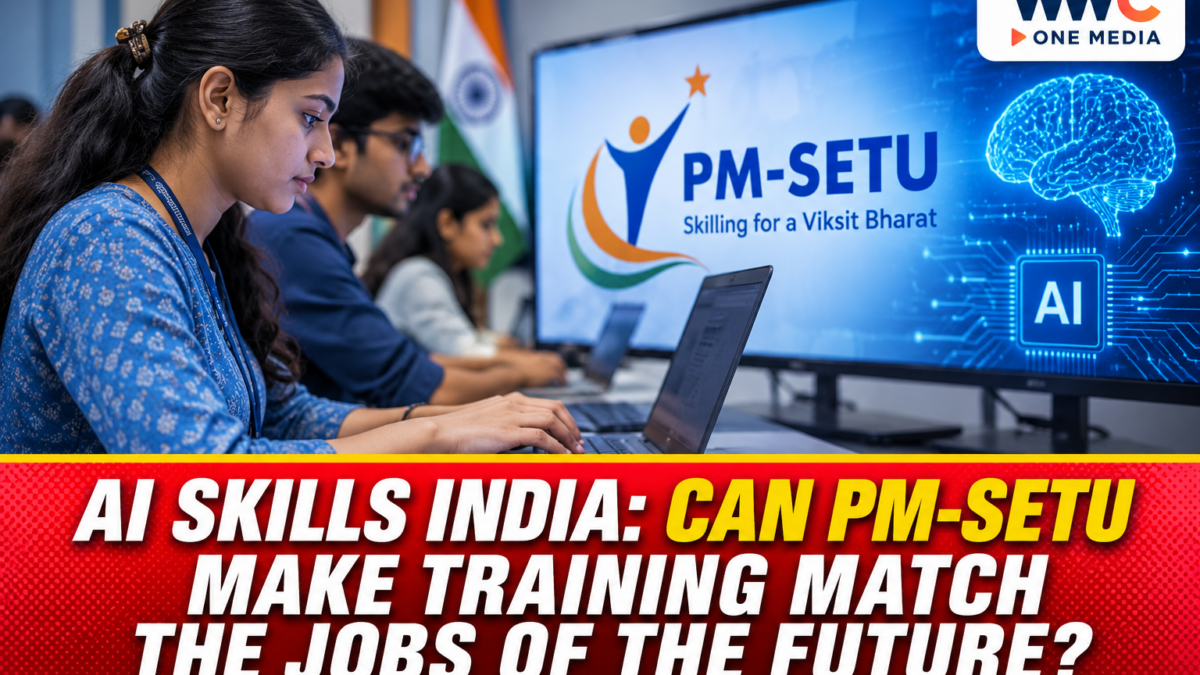
Prime Minister Narendra Modi has put vocational education at the centre of India’s response to artificial intelligence, arguing that practical skills will remain essential as technology changes the workplace. But the more difficult test is whether India’s training institutions can deliver the equipment, instructors and employer connections needed to turn that ambition into real employment opportunities.
At the 5th Kaushal Deekshant Samaroh in Lucknow on Nov. 21, Modi addressed concerns that AI could take jobs and highlighted the contribution of skilled workers to essential services, manufacturing and infrastructure. He also pointed to the government’s ₹60,000-crore PM-SETU programme, which aims to modernise 1,000 government Industrial Training Institutes (ITIs).
The programme is substantial, but its headline allocation is not the same as money already spent, upgraded facilities completed or jobs secured. Government implementation records provide a more useful way to assess how far the skills initiative has progressed.
AI skills India needs go beyond learning to use software
Modi’s address placed practical work alongside university education in India’s development priorities. He recalled how skilled workers kept essential operations functioning during the COVID-19 pandemic and said: “whoever has skill, no one can take away their employment.”
That statement expresses the government’s confidence in vocational training, but it should not be read as a guarantee that every skilled worker will remain employed. AI can change the tasks performed in a job, the number of workers an employer needs and the qualifications required for new positions.
The distinction is important. A worker may know how to operate a machine, but modern manufacturing can also require digital controls, robotics, diagnostics and the ability to maintain automated equipment. A person entering a technology-related occupation may need more than basic familiarity with an AI application.
The Prime Minister’s Office account of the Lucknow address listed new-age ITI trades including Artificial Intelligence Assistant, Cyber Security Assistant, Drone Technician, Green Hydrogen Technician, Industrial Robotics, Electric Vehicles, Animation and Special Effects, and Semiconductor Technician.
These examples cover different parts of the economy. Some involve software and digital systems; others depend on electrical, mechanical, industrial and maintenance capabilities. The common requirement is practical competence that employers can use.
PM-SETU puts ₹60,000 crore behind ITI modernisation
The main policy instrument is the Pradhan Mantri Skilling and Employability Transformation through Upgraded ITIs, known as PM-SETU.
The Union Cabinet approved a total programme outlay of ₹60,000 crore. The published funding structure assigns ₹30,000 crore to the Central Government, ₹20,000 crore to state governments and ₹10,000 crore to industry.
The scheme is designed to upgrade 1,000 government ITIs through a hub-and-spoke arrangement: 200 hub institutions linked to 800 spoke institutions. It also provides for capacity expansion at five National Skill Training Institutes in Bhubaneswar, Chennai, Hyderabad, Kanpur and Ludhiana.
The government’s five-year targets include training 20 lakh young people and providing pre-service and in-service training to 50,000 trainers. The plan also includes five National Centres of Excellence for Skilling.
The hub-and-spoke model is intended to let institutions share access to modern laboratories, equipment, digital learning resources and specialised training facilities. In principle, this can extend access to advanced facilities beyond a small number of major institutions.
But the structure also makes implementation important. A modern hub cannot improve training across a cluster if its equipment is unavailable, its instructors are insufficient or the spoke institutions cannot provide the practical learning required by students.
The implementation figures show progress, not completed transformation
Government updates provide a clearer picture than the programme’s total budget alone.
A government progress backgrounder published on Oct. 3 said 850 ITIs had been identified for the programme and 14 clusters had received approval. It also reported that the ITI network, including government and private institutions, had grown from 9,776 in 2014 to 13,888 in 2026.
The same backgrounder reported that ITI enrolment increased from 9.51 lakh in the 2014–15 academic session to 14.70 lakh in 2025–26. These figures indicate a larger vocational-training network and higher enrolment, but they do not independently establish how many graduates found jobs or how much their earnings improved.
A further update on Oct. 16 said the National Steering Committee approved five additional Strategic Investment Plans worth ₹1,194.92 crore for clusters in Maharashtra, Odisha and Jammu and Kashmir. The cumulative investment approved under PM-SETU had reached ₹3,687 crore.
The Oct. 16 update also reported that 3,744 trainers had been trained through National Skill Training Institutes as of October 2026.
These are meaningful implementation milestones. They are not equivalent to the full ₹60,000-crore outlay being spent, all 1,000 ITIs being upgraded or the five-year training target being completed. Approved investment plans, identified institutions and trained instructors measure different stages of delivery.
Industry partnerships will determine whether courses lead to work
PM-SETU gives industry a formal role in the modernisation process. Prospective partners submit Strategic Investment Plans, while the programme uses special-purpose vehicles to organise implementation with state governments and participating institutions.
That arrangement is intended to bring training closer to actual workforce requirements. Employers can help identify the equipment, technical standards and occupational capabilities needed in particular industries and regions.
The challenge is ensuring that participation goes beyond signing plans. Training providers need employers to contribute to course design, instructor development, practical placements and credible routes into recruitment.
This issue is not unique to India. In the Philippines, AI readiness has exposed gaps in technical talent and workforce development. The broader lesson is that buying technology or announcing a training programme does not automatically create the people needed to use it well.
Businesses are also experimenting with more direct approaches. A Philippine BPO training programme has added AI literacy for prospective workers, while a Philippine technology firm’s engineering academy is targeting specialised AI talent. These are different models from India’s public ITI programme, but they illustrate why employers and training institutions need to respond to changing job requirements together.
For workers, the outcome matters more than the announcement. A course should lead to demonstrable skills, recognised qualifications and a realistic opportunity to use those capabilities in a workplace.
The employment question is bigger than AI
AI is only one part of the demand for skilled workers. Modi also cited areas such as solar power, plumbing, sports equipment manufacturing and fitness as sectors requiring technical capabilities.
This matters because vocational education should not be reduced to training people to use AI tools. Economies still need electricians, technicians, mechanics, construction workers, installers and maintenance specialists. Some occupations will use AI-enabled equipment, while others will remain dependent on physical work, judgement and specialised knowledge.
The government’s own scheme recognises this wider requirement through courses covering areas such as electric vehicles, green hydrogen, robotics, cybersecurity and semiconductor technology. The programme’s success will depend on whether those courses match regional industrial needs and whether students receive enough practical instruction.
There is also a policy distinction between preparing people for new work and protecting people whose existing jobs change or disappear. Training can improve a worker’s options, but it cannot by itself guarantee that employers will retain every employee or that new vacancies will appear in the same location.
The Philippines has also debated how workers should be treated when companies introduce automation. WWC’s coverage of a proposed Philippine measure addressing AI-related layoffs illustrates the separate role of labour policy. Skills programmes and worker protections address different parts of the same transition.
What happens next
The next test for PM-SETU is whether approved plans translate into functioning facilities, updated courses, trained instructors and sustained employer participation.
The government’s published milestones provide several benchmarks: the identification of 850 ITIs, approval of 14 clusters by early October, ₹3,687 crore in cumulative approved investment by Oct. 16 and 3,744 trainers trained by October.
Future progress reports should make it possible to assess how many institutions have completed upgrades, how many students have enrolled in the new courses, how many have graduated and how many have secured relevant employment.
Until those outcomes are established, the programme should be judged as a major training and infrastructure initiative in progress—not as proof that AI can no longer threaten a worker’s livelihood.
Frequently asked questions
1. What did Narendra Modi say about AI and employment?
At the 5th Kaushal Deekshant Samaroh in Lucknow on Nov. 21, 2026, Modi argued that skilled workers would remain important as AI changes employment and highlighted the role of ITIs in preparing young people.
2. What is PM-SETU?
PM-SETU stands for Pradhan Mantri Skilling and Employability Transformation through Upgraded ITIs. It is a government programme intended to modernise vocational training and strengthen links between ITIs and industry.
3. How much funding has been allocated to PM-SETU?
The programme has a total outlay of ₹60,000 crore: ₹30,000 crore from the Central Government, ₹20,000 crore from state governments and ₹10,000 crore from industry.
4. How many ITIs will PM-SETU upgrade?
The programme targets 1,000 government ITIs, arranged as 200 hub institutions and 800 spoke institutions.
5. Does having vocational skills guarantee employment in the AI era?
No. Skills can improve a person’s ability to adapt, but employment also depends on employer demand, the quality of training, practical experience, location and the availability of suitable jobs.