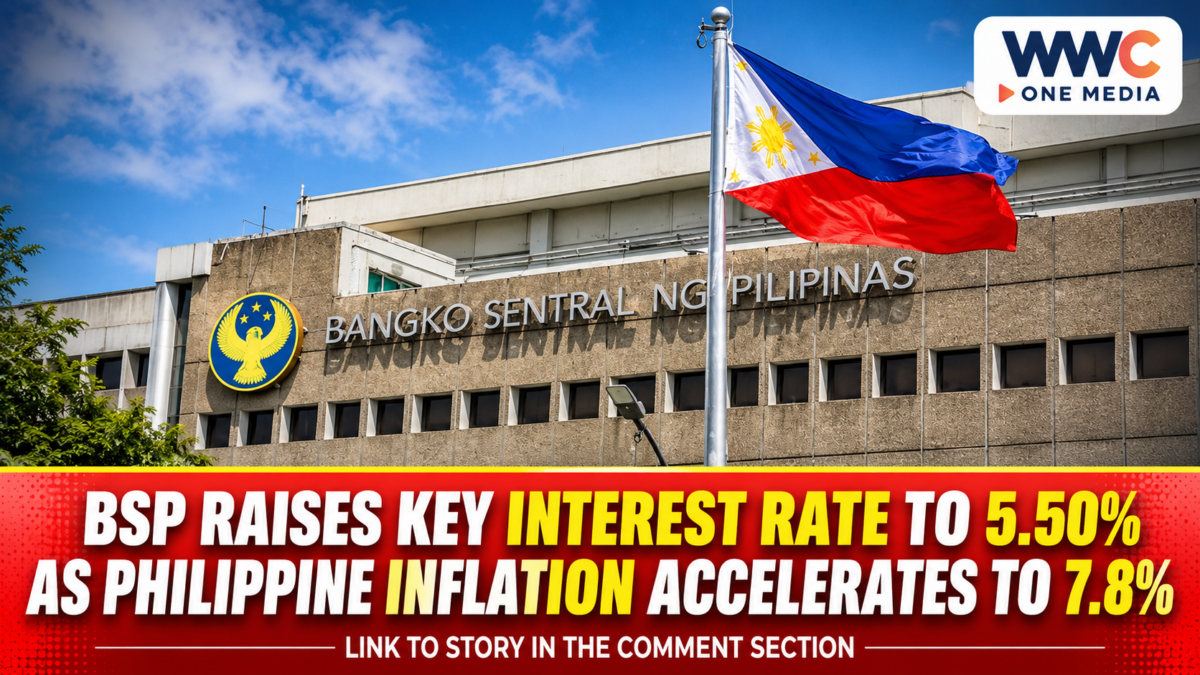
The Bangko Sentral ng Pilipinas (BSP) raised its benchmark policy rate by 50 basis points on Nov. 20, 2026, bringing the target reverse repurchase rate to 5.50% as policymakers sought to contain widening inflation pressures. The decision came after Philippine inflation accelerated to 7.8% in October, with core inflation also increasing, raising concerns that higher fuel, transport and other operating costs could spread across the wider economy.
The increase is significant because the central bank is responding not only to the immediate rise in prices but also to the possibility that inflation could become more persistent. If businesses continue passing higher expenses to consumers and households adjust their price expectations, the original cost shock could develop into a broader inflation cycle.
For borrowers, companies and consumers, however, tighter monetary policy comes with a trade-off: it may help restrain price increases over time, but it can also make credit more expensive and weigh on spending and investment.
BSP Lifts the Policy Rate to 5.50%
The Monetary Board increased the target reverse repurchase rate by 50 basis points on Nov. 20, bringing it to 5.50%. The BSP also adjusted its overnight deposit facility rate to 5.00% and its overnight lending facility rate to 6.00%.
The central bank described the adjustment as a way to tighten monetary conditions, contain spillover effects and keep inflation expectations firmly anchored. BSP+1
A 50-basis-point increase is equivalent to half a percentage point. It affects the policy rate used by the BSP to influence short-term interest rates and financial conditions throughout the banking system.
The move does not mean every bank loan will immediately increase by exactly half a percentage point. Banks set lending rates based on several factors, including funding costs, borrower risk, loan terms and market conditions.
Nevertheless, a higher policy rate can gradually influence the cost of borrowing for households and businesses.
The decision also marks a more forceful response to the inflation environment than a smaller adjustment would have delivered. Its effectiveness will depend on how quickly tighter financial conditions influence spending, pricing decisions and inflation expectations.
October Inflation Shows Price Pressures Are Broadening
The latest consumer price report provides important context for the Monetary Board’s decision.
The Philippine Statistics Authority reported that headline inflation rose to 7.8% in October from 7.2% in September. Core inflation, which excludes selected volatile food and energy items, also increased, reaching 5.4% from 4.8%. Philippine Statistics Authority+1
The increase in core inflation deserves attention because it can help indicate whether price pressures are extending beyond temporary movements in food and energy prices.
When prices rise across more categories, inflation becomes harder to address through measures that target only one commodity or supply problem.
The BSP’s November economic update identified higher domestic fuel prices and transport fares as major contributors to October’s inflation. It also described the policy response as necessary to address broadening price pressures and further upside risks. BSP
This helps explain why the central bank is concerned about more than the initial increase in fuel or transportation expenses.
WWC ONE MEDIA previously examined the possibility of inflation reaching 8.1% as fuel, electricity and transport costs increased. The October figure has since been confirmed at 7.8%, below the upper end of the earlier forecast.
Why Second-Round Inflation Effects Matter
Second-round effects occur when an initial price shock spreads into other parts of the economy.
For example, higher fuel costs can increase the expenses of transport operators, delivery companies, manufacturers and retailers. Businesses may initially absorb some of these increases, but prolonged pressure can lead them to adjust the prices of their products and services.
Workers may also seek higher wages to keep pace with rising living expenses. If businesses respond by increasing prices to cover higher labour and operating costs, the original shock can become more deeply embedded in the economy.
The BSP has previously explained the importance of these indirect effects in its research on supply shocks. Its analysis of oil, food and domestic rice price movements examined how initial price increases can influence broader inflation measures and inflation expectations. BSP
This is the problem monetary policymakers want to prevent.
If households and businesses begin expecting prices to rise continuously, their decisions can reinforce inflation. Consumers may bring purchases forward, while businesses may adjust prices in anticipation of higher future costs.
The BSP’s rate increase is intended to discourage these dynamics by making financial conditions tighter and reinforcing confidence that inflation will return towards the central bank’s target.
However, interest rates cannot directly increase fuel supplies, improve agricultural production or eliminate transport bottlenecks. Monetary policy can influence demand and expectations, but supply-side problems still require action from other government agencies.
Higher Interest Rates Could Put More Pressure on Borrowers
The policy decision has implications for people and businesses that rely on credit.
When banks face higher funding costs or adjust their lending rates in response to monetary tightening, borrowers may eventually pay more for certain loans. The impact can extend to housing finance, business credit, vehicle financing and other borrowing arrangements.
Existing loans with fixed interest rates may not immediately change. Borrowers with variable-rate arrangements, however, may face adjustments depending on their contracts and repricing schedules.
For companies, higher financing costs can affect decisions about expansion, equipment purchases, inventory and working capital.
This creates a difficult balancing act for the BSP. Tightening policy may help contain inflation, but excessive pressure on borrowing and investment could weaken economic activity.
WWC has previously examined how higher interest rates and elevated inflation could complicate the Philippines’ growth outlook.
The peso is another part of the wider economic picture. Changes in interest rates can influence investor decisions and currency demand, although exchange rates also respond to international financial conditions, trade flows and expectations about the Philippine economy.
The central bank’s decision should therefore not be interpreted as a guarantee that the peso will strengthen or that imported goods will immediately become cheaper. WWC previously discussed the pressures affecting the Philippine peso and the factors behind its market movements.
The Rate Increase Cannot Solve Every Source of Inflation
The latest inflation figures point to a challenge that extends beyond monetary policy.
When higher prices originate from fuel, electricity, transport and food supply conditions, the government must also address the factors affecting production and distribution.
Improving logistics, maintaining reliable energy supplies, supporting agricultural productivity and reducing unnecessary supply-chain costs can help ease pressure on prices.
These measures operate differently from interest-rate increases. While monetary tightening can discourage excessive demand and help anchor expectations, supply-side improvements can address the underlying availability and cost of goods and services.
The distinction is important for households. Even if the BSP succeeds in slowing the rate at which prices increase, that does not mean prices will return to their previous levels.
Disinflation means prices are rising more slowly. It does not necessarily mean that the overall cost of living is falling.
What Happens Next
The effectiveness of the BSP’s latest decision will become clearer through subsequent inflation releases and economic indicators.
Policymakers will need to assess whether headline and core inflation begin to moderate, whether price increases spread further across consumer categories and whether households and businesses maintain elevated inflation expectations.
They will also have to consider the effects of higher interest rates on credit, consumption, investment and overall economic activity.
The Nov. 20 decision establishes the latest policy setting, but it does not guarantee that inflation will immediately decline. Monetary policy works with delays, and the impact of higher borrowing costs may take time to reach households and businesses.
For Filipinos, the immediate concern remains the cost of essentials. The longer-term question is whether the combined response of monetary authorities and government agencies can prevent temporary cost increases from becoming a sustained inflation problem.
Frequently Asked Questions
What is the BSP’s latest benchmark interest rate?
The BSP raised its target reverse repurchase rate by 50 basis points to 5.50% on Nov. 20, 2026.
Why did the BSP increase interest rates?
The increase was intended to tighten monetary conditions, contain spillover effects from rising prices and keep inflation expectations anchored as price pressures broadened.
What are second-round inflation effects?
They occur when an initial increase in costs, such as fuel or food prices, spreads into wages, transport, production and other goods and services, making inflation more persistent.
Will the BSP rate increase make all bank loans more expensive immediately?
No. The effect depends on the bank, loan type, contract terms and repricing schedule. Variable-rate loans may be affected differently from fixed-rate loans.
Will higher interest rates immediately reduce the prices of food and fuel?
No. Monetary tightening can influence demand and inflation expectations, but it cannot directly increase food production or fuel supply. Supply-side measures are also needed to address those costs.