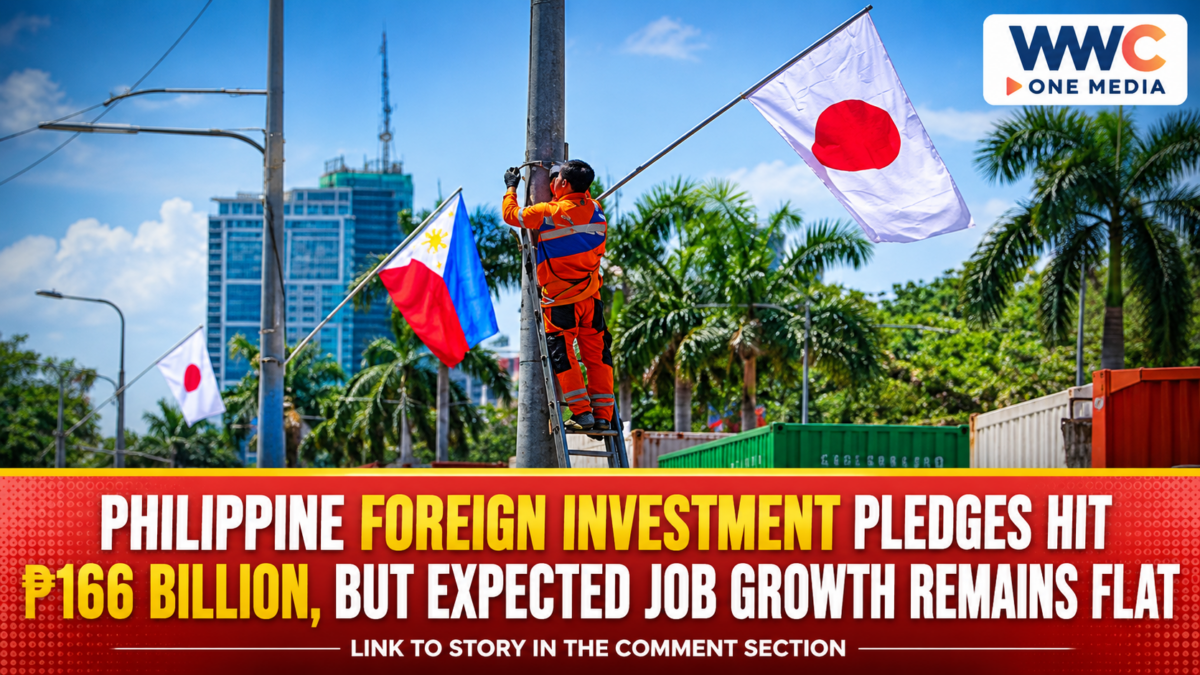
The Philippines recorded ₱166.03 billion in approved foreign investment commitments in the third quarter of 2026, a 125.3% increase from the same period last year. Yet the projects approved during the quarter are expected to generate 13,805 jobs with foreign participation, while the total employment projected from all approved investments declined slightly year on year.
The figures highlight a gap that matters beyond the headline investment total: attracting foreign capital is only one stage of economic development. The bigger test is whether approved projects proceed to construction and operation, create sustained employment and give Philippine companies a meaningful role in production and supply chains.
The Philippine Statistics Authority’s latest investment report offers a way to examine that challenge. It shows where foreign investment commitments are concentrated, how much employment approved projects may generate and why the value of investment pledges should not be mistaken for money already entering the economy.
Foreign Investment Commitments More Than Double
Foreign investment commitments approved in the third quarter reached ₱166.03 billion, compared with ₱73.69 billion in the same quarter of 2025. The increase was 125.3%, based on the PSA’s Nov. 12 release. Philippine Statistics Authority
The increase also contributed to a much stronger cumulative result. Approved foreign investments from January to September 2026 reached ₱336.45 billion, up 97.7% from ₱170.17 billion in the corresponding period of 2025. Philippine Statistics Authority
These figures indicate that foreign investors have made larger commitments to projects approved by the country’s investment promotion agencies.
But the PSA makes an important distinction in its reporting: approved investments represent commitments and pledges that may be realised in the future. They are not necessarily funds already transferred, facilities already built or businesses already operating.
That distinction is essential when assessing the country’s investment performance. A project can receive approval before financing, construction, equipment installation, recruitment and commercial operations are completed.
For the economy, the benefits become more tangible as projects move through those stages.
Manufacturing Receives the Largest Share of Foreign Commitments
Manufacturing accounted for the largest share of approved foreign investments in the third quarter, receiving ₱86.16 billion, equivalent to 51.9% of the total.
Electricity, gas, steam and air-conditioning supply followed with ₱52.61 billion, or 31.7%. Information and communication received ₱18.84 billion, representing 11.3%. Philippine Statistics Authority
The distribution suggests that foreign capital is not spread evenly across industries. Manufacturing alone accounted for more than half of the quarter’s approved foreign commitments.
That matters because manufacturing can create activity across several parts of the economy. A new production facility may require industrial land, utilities, transport services, equipment, raw materials, maintenance and a network of local suppliers.
However, the value of an approved manufacturing project does not establish how much domestic sourcing will occur. Nor does it automatically show whether the facility will manufacture high-value products, assemble imported components or develop local technical capabilities.
Those details will matter when the government evaluates the long-term contribution of individual projects.
WWC ONE MEDIA has previously examined the investment and industrial-development questions surrounding the proposed Pax Silica initiative, where the potential benefits depend on the eventual facilities, agreements and local participation.
Why the Employment Figures Deserve Attention
The PSA reported that approved investments in the third quarter were expected to generate 27,799 jobs. That was 0.2% lower than the 27,843 employment opportunities projected for the same quarter of 2025.
Of the latest total, 13,805 jobs, or 49.7%, were projected to come from projects with foreign interest. Philippine Statistics Authority
This is a different measure from the value of investment commitments. It estimates the employment associated with approved projects rather than counting workers already hired.
The comparison is nevertheless revealing. Foreign investment commitments increased sharply, but the total projected employment attached to approved projects did not rise at the same pace.
One possible explanation is the composition of the projects. Investment value and employment do not necessarily move together, particularly when projects involve expensive machinery, energy infrastructure or other capital-intensive operations.
A facility can require substantial funding without employing as many people as a labour-intensive business. Conversely, a smaller investment in a labour-intensive activity may support more positions.
This is why investment performance should be assessed using more than one indicator. The amount committed, number of projects, expected employment, actual capital expenditure and operating status each tell a different part of the story.
Investment Approval Is Not the Same as Actual Foreign Direct Investment
One of the most important distinctions in the country’s investment statistics is the difference between approved commitments and realised investment flows.
The PSA consolidates investment commitments approved by investment promotion agencies. The figures reflect projects that have passed through approval processes, but the agency explicitly notes that these commitments may be realised in the future. Philippine Statistics Authority
Actual foreign direct investment flows are measured separately through the country’s external-sector statistics. Those figures capture financial transactions and investment positions under a different statistical framework.
The two measures should not be combined as if they represent the same movement of money. An increase in approved commitments does not, by itself, prove that an equivalent amount of foreign capital has entered the country.
This distinction also helps explain why investment announcements should be followed by implementation updates.
For each major project, the practical questions include whether financing has been secured, permits have been obtained, construction has started, equipment has been installed and workers have been hired.
The country’s wider investment campaign also depends on making projects sufficiently prepared for investors. WWC has examined how Mindanao is building connections between foreign business groups and local investment opportunities.
The Domestic Supplier Question Could Shape the Long-Term Benefits
Foreign-owned or foreign-backed projects can contribute to economic activity, but the scale of the domestic benefits depends partly on how they connect with Philippine businesses.
A manufacturing facility that purchases local materials, hires Filipino workers, trains technicians and develops domestic suppliers can create wider economic links than a project operating with limited local participation.
The same principle applies to technology-intensive investments. The presence of a foreign company does not automatically mean that local workers and businesses will gain access to advanced production methods, research capabilities or technical knowledge.
These outcomes depend on the project’s actual operations, workforce requirements and supplier arrangements.
The government can strengthen the value of investment approvals by monitoring whether registered projects proceed on schedule and by publishing information on their implementation. Clear reporting on operating facilities, realised capital expenditure and actual employment would help the public distinguish projects that have progressed from commitments that remain in the pipeline.
For manufacturers, local supplier development is particularly important. Philippine companies need opportunities to meet quality, pricing and delivery requirements if they are to become part of larger international production networks.
That is also why investment promotion and industrial development should be considered together. Attracting capital can open the door, but domestic capabilities help determine how much value stays in the country.
What Happens Next
The next test is whether the approved foreign investment commitments translate into projects that reach implementation.
The government and investment promotion agencies will need to track the progress of approved projects, including financing, construction, operations and recruitment. The employment projections will become more meaningful when they can be compared with actual jobs created.
The third-quarter figures provide evidence of stronger foreign investment commitments, particularly in manufacturing. They also show why the headline amount cannot be treated as a complete measure of economic success.
The Philippines needs projects that do more than secure approval. It needs productive facilities, skilled employment, stronger local suppliers and business activity that can continue beyond the initial investment announcement.
The next investment report will help show whether the current pipeline is translating into measurable economic activity.
Frequently Asked Questions
How much foreign investment did the Philippines approve in the third quarter of 2026?
The Philippines recorded ₱166.03 billion in approved foreign investment commitments in the third quarter of 2026, up 125.3% from ₱73.69 billion in the same quarter of 2025.
Which industry received the largest share of foreign investment commitments?
Manufacturing received the largest share, with ₱86.16 billion, or 51.9% of the third-quarter total.
How many jobs could the approved investments generate?
All approved investments in the third quarter were projected to generate 27,799 jobs. Projects with foreign interest accounted for 13,805 of those projected positions.
Are approved foreign investments the same as actual foreign direct investment inflows?
No. Approved commitments represent projects cleared by investment promotion agencies and may be realised in the future. Actual foreign direct investment flows are measured separately through external-sector statistics.
Why does converting investment commitments into operating projects matter?
Operating projects can generate actual employment, production, purchases from local suppliers and economic activity. Approval figures alone do not establish that these benefits have already materialised.