
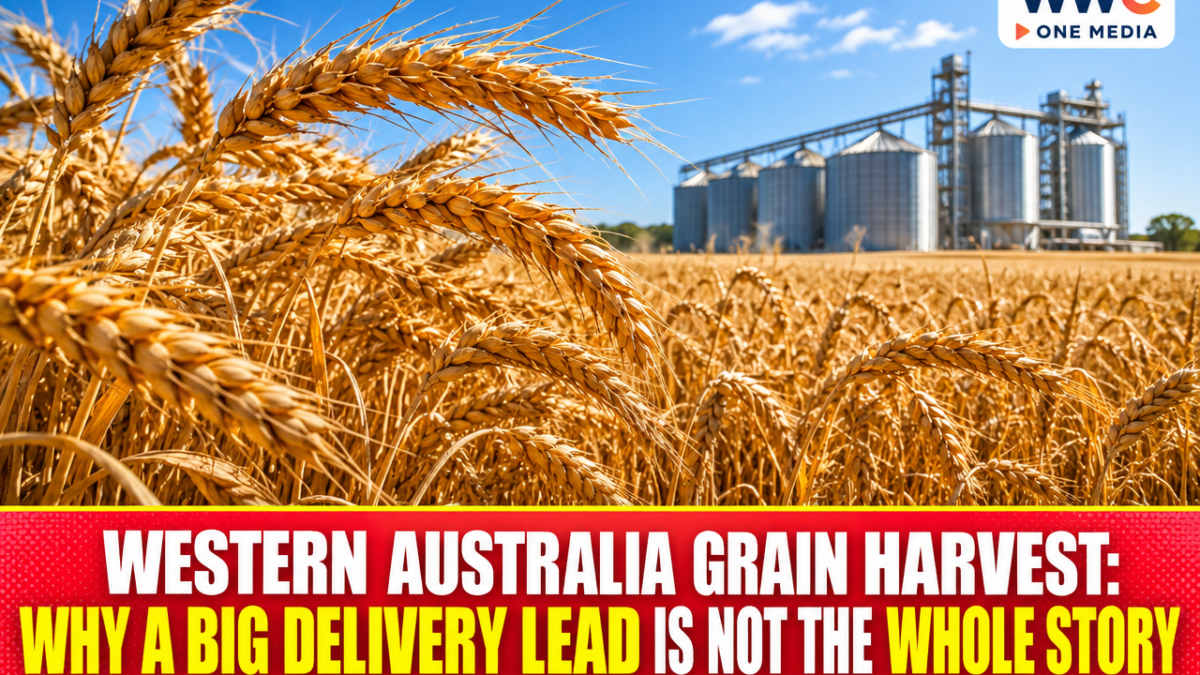
Western Australia’s 2026–27 grain harvest has already moved millions of tonnes through the state’s main receival network, but repeated rain events are slowing field operations and raising concerns about grain quality. The latest industry assessments point to a season in which strong deliveries and uneven crop performance are unfolding at the same time.
The distinction matters because grain delivered to storage facilities is not the same as the final amount a state will produce. Harvest progress, crop yields, quality grades and weather-related interruptions all help determine how much grain ultimately reaches buyers and export markets.
For growers, handlers and traders, the immediate issue is no longer simply how quickly harvesting can resume after rain. It is also whether crops still in the paddocks can be harvested without further deterioration in quality.
Western Australia grain harvest reaches 7.7 million tonnes
CBH Group, Western Australia’s major grain-handling cooperative, reported that growers delivered more than 2.5 million tonnes to its network during the week covered by its Nov. 16 harvest update. That brought total receivals for the 2026–27 season to 7.7 million tonnes.
The week began with strong deliveries before rain disrupted activity in parts of the state. Kwinana North recorded the largest weekly intake, with 665,000 tonnes, and had accumulated 1.88 million tonnes for the season.
Canola and barley continued to account for most deliveries across the network. Wheat was the leading commodity in the Geraldton Zone, while receivals of the cereal increased in Kwinana North and Esperance as the week progressed.
Those figures indicate that substantial volumes have already entered the handling system. They do not, however, establish that the harvest is nearly finished across every growing district.
CBH’s report describes a mixed operating picture: areas not affected by weather maintained a steady pace, while rain interrupted deliveries elsewhere. Further storms were forecast across much of the Wheatbelt during the reporting week.
Why the crop outlook is more complicated than delivery totals
The Grain Industry Association of Western Australia’s November crop report describes harvest activity as having started relatively early compared with recent seasons. It also says storms across a wide area have slowed progress, with repeated rain events in the south-west and along the west coast putting those areas behind other parts of the state.
Rain extending from Geraldton towards central and eastern growing districts added further interruptions.
GIWA cautions against interpreting the early pace as evidence of a small crop. Its report says the dry finish to the growing season helped crops mature more evenly than usual, allowing harvesting to begin earlier in some areas.
The association also reports that yields so far have generally exceeded expectations for barley, wheat, lupins, oats and pulses in many districts, despite a relatively low-rainfall season.
Canola has been less consistent. GIWA identifies poor pod development on the main raceme in susceptible varieties as a factor reducing yields in several regions. It says the issue has become visible in the tonnage from the Geraldton and Esperance port zones, where much of the canola harvest had already been completed.
The report estimates that statewide canola tonnage could reach about 4.1 million to 4.2 million tonnes if the trend continues.
That estimate is a crop assessment, not a final production result. The remaining harvest and subsequent deliveries will determine how closely the season finishes to that range.
Rain could affect more than the harvesting schedule
Weather interruptions have consequences beyond the number of hours machinery can operate in a paddock.
GIWA warns that continued rain during harvest could affect cereal grain quality. Its November report also records examples of grain being downgraded because of fungal staining, although the specific observation concerns oats in lower-rainfall regions.
The association’s regional assessments show why conditions cannot be treated as uniform across the state.
In Geraldton, harvest was about three-quarters complete. Barley performed strongly, with some crops reaching yields of 4 to 5 tonnes per hectare. Wheat results were more mixed: early-sown crops on stronger soils performed well, while lighter soils and later crop emergence were associated with weaker results.
The Kwinana North Midlands area also reported strong barley yields, with whole-farm averages in the 4.5 to 5.5 tonnes-per-hectare range. Canola results varied according to soil conditions and crop development.
In Kwinana South, more harvesting remained to be completed. GIWA reported that canola was mostly harvested there, but wheat activity was still limited in the assessment.
These differences matter to the final statewide result. A delay in one district does not automatically mean the entire crop is suffering the same level of damage or loss.
The export chain depends on quality as well as volume
Western Australia’s grain system connects farm production with storage, handling and eventual sales. The volume delivered to a receival network is an important indicator of activity, but it does not by itself reveal the quality classification or commercial value of every load.
That distinction is especially relevant when weather interrupts harvesting. Grain that remains in the field may face different conditions from grain already harvested and stored. The final outcome depends on the crop, its maturity, local weather and handling conditions.
CBH’s weekly figures therefore provide a useful measure of how much grain has entered its network, while GIWA’s crop report offers a broader assessment of field conditions and production prospects.
The relationship between weather and farm output is also relevant beyond Australia. WWC has examined how AI-based weather forecasting could help farmers and other sectors prepare for changing conditions. Better information can support planning, although it cannot remove the uncertainty of local weather or guarantee that crops avoid damage.
For Philippine readers, the Australian season also provides a reminder that agricultural supply depends on both production and logistics. WWC’s coverage of ASEAN’s regional plan for more resilient agriculture examines the wider challenge of preparing food systems for weather and supply-chain disruptions.
What happens next
The next important indicators will be the pace of deliveries after further rain, the amount of grain still awaiting harvest and whether quality concerns become more widespread.
GIWA’s November assessment suggests that some areas still have substantial work ahead. Its regional reporting also shows that wheat, barley and canola are experiencing different conditions, making a single statewide description inadequate.
CBH’s subsequent harvest updates should help show whether the receival network regains momentum. However, delivery totals should continue to be read alongside crop estimates and quality assessments rather than treated as a complete measure of the season.
The outcome will become clearer as more grain is harvested, assessed and delivered. Until then, Western Australia’s large receival total is an encouraging sign of activity, but not a guarantee that the season will finish without further weather-related setbacks.
Frequently asked questions
How much grain has Western Australia delivered in the 2026–27 harvest?
CBH Group reported 7.7 million tonnes received across its network by its Nov. 16, 2026 update. This is a receival figure, not the final production total for the state.
Which crops are most affected by the harvest outlook?
GIWA reports variable canola yields, with poor pod development affecting some crops. Barley has generally performed well in several assessed regions, while wheat results vary by location and growing conditions.
Why are storms a concern during grain harvesting?
Rain can interrupt machinery operations and deliveries. GIWA also warns that continued rainfall during harvest could affect cereal grain quality.
Is Western Australia’s canola harvest expected to reach 4.2 million tonnes?
GIWA’s November report estimates that statewide canola tonnage could reach approximately 4.1 million to 4.2 million tonnes if the observed trend continues. It remains an estimate, not a final harvest figure.
Does the 7.7-million-tonne figure mean the harvest is complete?
No. The figure records grain received by CBH up to the reporting period. Harvesting was still under way in several regions, and further deliveries were expected.










