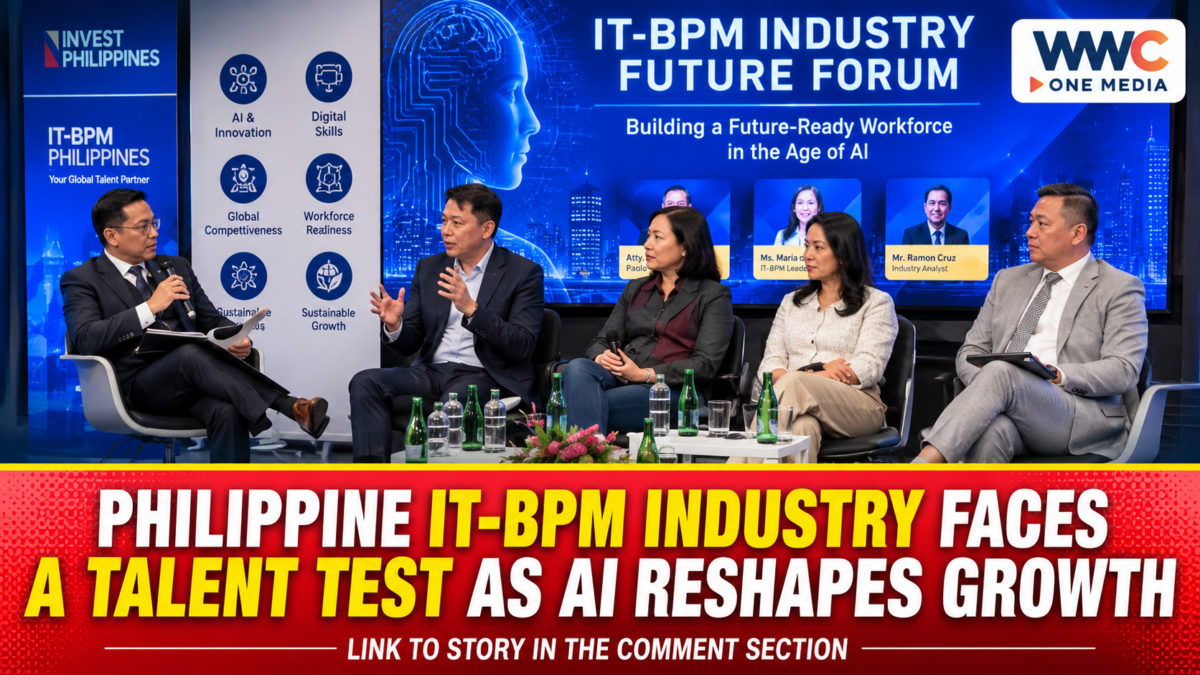
The Philippine IT and Business Process Management (IT-BPM) industry is entering a more demanding phase of competition, with workforce development, technology adoption and a predictable business environment becoming central to its future growth. The IT and Business Process Association of the Philippines (IBPAP), led by President and CEO Celeste Ilagan, has identified these areas among the organisation’s formal priorities as the sector works towards its revised 2028 outlook.
The challenge is significant because the Philippines can no longer rely only on a large English-speaking workforce and competitive operating costs to attract international business. Companies increasingly need employees who can work with artificial intelligence, cybersecurity systems, data platforms and specialised business processes.
The industry’s future will therefore depend not just on how many people it can employ, but also on the complexity of the services Filipino professionals can deliver and whether companies can expand operations with confidence.
IBPAP’s Priorities Extend Beyond Traditional Outsourcing
IBPAP describes itself as the primary industry association and advocacy group for the Philippine IT-BPM sector. It represents more than 400 member companies and six partner associations covering contact centres, healthcare information management, software, animation, game development and global in-house centres. About Us
Its published strategic pillars provide a framework for understanding the industry’s current direction.
These include talent development, policy and regulatory advocacy, digital transformation and innovation, country competitiveness, sustainability and inclusive growth, investor assistance, and business development.
The organisation’s stated mission also places talent development, digital innovation and policies supporting sustainable industry growth at the centre of its work. About Us
This broader agenda reflects how the industry has evolved. IT-BPM now covers much more than customer-service operations. Its services include technology-intensive business processes, financial administration, supply-chain management, software development and specialised support for international companies.
For the Philippines, moving into more complex services could help strengthen its position as a global business-services destination. But that transition requires workers with capabilities that match the needs of international clients.
The 2028 Outlook Shows Why Skills Matter
IBPAP’s July 2026 industry outlook presented a revised range of expectations for the sector.
The association projected that Philippine IT-BPM revenue could reach between US$43.3 billion and US$50.5 billion by 2028. Employment was projected to range from 1.85 million to 2.14 million full-time employees. News Room
The range is important because it presents different possible outcomes rather than a guaranteed result. Reaching the upper end would require stronger performance in talent development, higher-value services and cooperation between industry, government and educational institutions.
It also signals a shift in how the sector measures competitiveness. A business-services industry can generate more revenue by taking on complex, higher-value work even if employment does not expand at the same rate.
That does not make job creation less important. It means the quality and productivity of employment will increasingly matter alongside the number of positions available.
WWC ONE MEDIA previously examined the revised revenue and employment outlook for the Philippine IT-BPM industry, including how automation could change the relationship between revenue growth and workforce expansion.
The Skills Gap Is a Long-Term Competitiveness Issue
The government and industry have already established a framework for addressing the sector’s workforce requirements.
The Board of Investments’ five-year National Talent Development Program for IT-BPM, covering 2024 to 2028, was developed in collaboration with IBPAP and relevant government agencies.
The programme identifies upskilling and reskilling as key areas of intervention. Its proposed training focus includes coding, data analytics, artificial intelligence and cybersecurity. It also covers talent attraction, industry promotion, talent hubs and policy support. Bangko Ng Pilipinas
The programme was developed in response to concerns about whether the skills taught in educational institutions adequately match the requirements of IT-BPM employers.
This is an important distinction. A country may have a large pool of graduates and jobseekers, but that does not mean employers can immediately find workers with the specific technical and professional capabilities they need.
The Philippine Statistics Authority’s 2024 Annual Survey of Philippine Business and Industry recorded 172,389 workers in establishments engaged in information and communication activities. Computer programming, consultancy and related activities accounted for 90,573 of those workers. Philippine Statistics Authority
That survey covers the information and communication section, not the entire IT-BPM industry. It should therefore not be treated as a direct count of all outsourcing employees. However, it provides an official indication of the country’s broader technology-related workforce and the importance of technical occupations.
For the industry, training programmes will matter most when they translate into employable skills, successful recruitment, career progression and the ability to handle more sophisticated work.
Artificial Intelligence Is Changing What Employers Need
Artificial intelligence is creating both opportunities and adjustment pressures for Philippine business-services companies.
A July 2025 economic newsletter published by the Bangko Sentral ng Pilipinas examined generative AI in the local IT-BPM industry. Its consultations with stakeholders indicated that generative AI was expected to augment, rather than displace, jobs in the near term, while emphasising the need for reskilling and upskilling. BSP
This distinction matters. AI can assist employees with repetitive processes, information handling and routine customer interactions. At the same time, companies may need more workers capable of checking automated outputs, managing complex cases, protecting data and making decisions that require human judgement.
The impact will not be identical across occupations. Some tasks may become easier to automate, while other roles may become more productive through the use of AI tools.
For workers, the practical requirement is to develop skills that complement technology rather than compete directly with tasks that software can perform more efficiently.
The change is already influencing how some employers prepare applicants. WWC previously examined a Philippine BPO company’s effort to introduce AI training before hiring, illustrating how digital readiness is becoming relevant even before workers enter the industry.
Business Conditions Can Influence Where Global Companies Expand
Talent alone cannot determine where multinational companies establish or expand operations.
Investors also consider regulatory consistency, infrastructure, telecommunications, cybersecurity, operating costs and the time required to secure permits and establish facilities.
IBPAP’s policy and regulatory advocacy pillar explicitly identifies the need for an enabling business environment. Its investor-assistance work is also intended to help companies navigate market entry and expansion in the Philippines. About Us
These concerns are particularly relevant as the country competes with other outsourcing destinations for global business operations.
A company evaluating locations may have access to skilled workers in several countries. It must also consider whether the chosen location can provide reliable connectivity, secure data handling, predictable rules and the infrastructure required to serve international clients.
The growth of AI-related services adds another layer to that decision. More sophisticated operations may require stronger data centres, cloud infrastructure, cybersecurity capabilities and specialised technical support.
The expansion of digital infrastructure is therefore connected to the industry’s ability to attract higher-value work. WWC has explored how Philippine telecommunications companies are positioning infrastructure for AI-related business demand.
Regional Talent Development Could Spread the Benefits
The benefits of IT-BPM growth are also tied to where companies establish operations.
IBPAP identifies inclusive growth and expansion beyond Metro Manila among its formal priorities. Its strategy includes strengthening the industry’s presence in the countryside and supporting partnerships that widen access to employment opportunities. About Us
Regional expansion can give companies access to additional talent pools while allowing workers to pursue industry careers without necessarily relocating to Metro Manila.
However, establishing operations outside major urban centres requires more than available office space. Cities need dependable telecommunications, transport access, suitable facilities and training institutions capable of preparing workers for employer requirements.
The BOI’s national talent programme provides a basis for cooperation among government agencies, educational institutions and the private sector. Its effectiveness will depend on whether training is aligned with actual vacancies and the evolving needs of employers. Bangko Ng Pilipinas
For regional communities, the opportunity is not simply to attract a BPO office. It is to develop a sustainable local workforce that can participate in increasingly specialised services.
What Happens Next
The next phase of the Philippine IT-BPM industry’s development will be measured by how effectively its priorities translate into results.
That means tracking whether training programmes improve job readiness, whether companies expand into higher-value services, whether regional locations attract sustainable operations and whether regulatory conditions support long-term investment.
AI adoption will also require continued attention to worker transition. Training must be accessible to existing employees as well as new graduates, particularly those whose current responsibilities may change as automation spreads.
IBPAP’s revised 2028 outlook provides a range of possible industry outcomes. Reaching the stronger end of that range will require coordinated action across businesses, government and education providers.
The Philippines has an established position in global outsourcing. Maintaining that position will depend on whether the country can turn its workforce advantage into deeper technical expertise, stronger business capabilities and more resilient employment opportunities.
The next stage of growth will be determined not only by the number of services delivered from the Philippines, but by the value and complexity of the work Filipino professionals are equipped to perform.