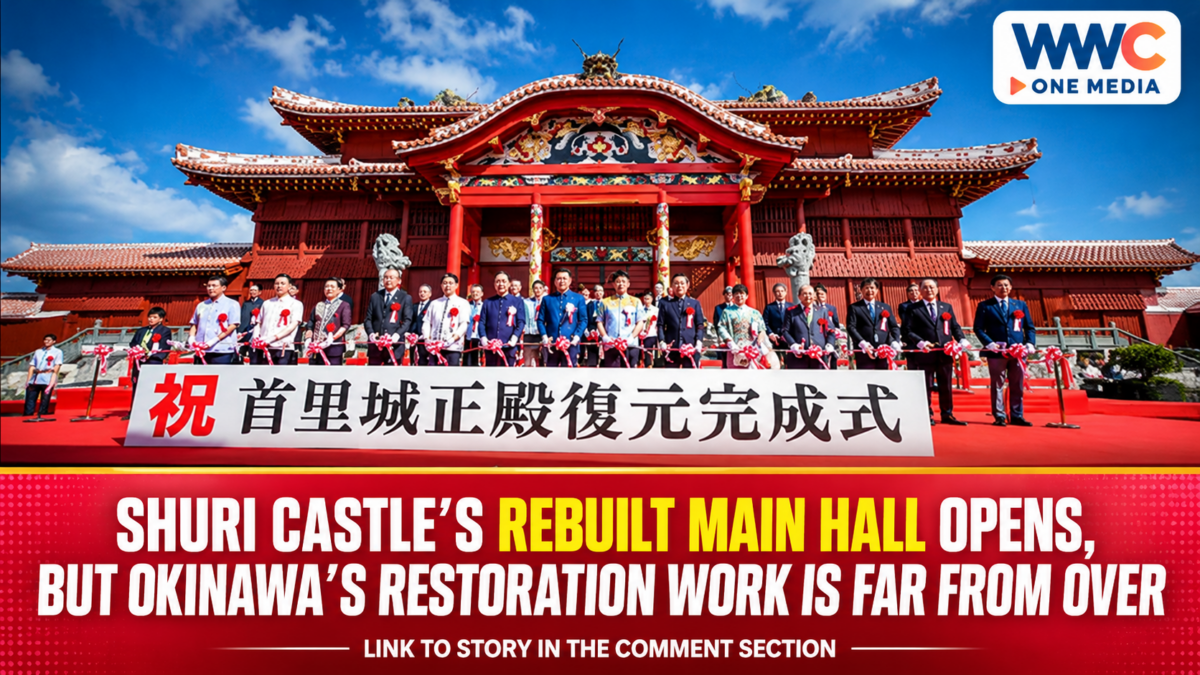
Japan marked the completion of the restored Seiden main hall at Shuri Castle in Naha, Okinawa, on Nov. 22, 2026, seven years after a fire destroyed the historic structure. The hall is scheduled to welcome the public on Nov. 23, while reconstruction of other damaged buildings remains part of the wider project.
A reconstruction shaped by new historical research
The restored building is not simply a replica of the structure that stood before the 2019 fire. The reconstruction incorporated research conducted after the previous restoration, allowing specialists to revise details involving roof tiles, wood and stone carvings, decorative patterns and lacquer finishes.
The park’s official restoration information identifies several changes, including a revised design for patterns above the central doors, adjustments to stone lion sculptures and the use of a different material for the exterior wall finish. Gold-leaf sections also incorporate a traditional polishing technique known as kanamigaki. 首里城 ‐ 琉球王国の栄華を物語る 世界遺産 首里城+1
One notable material is Kushimagiribengara, a pigment whose raw material comes from iron bacteria found in Okinawa. The government’s project documentation also identifies Kume red soil and locally sourced materials for parts of the decorative and stonework.
These choices give the reconstructed hall a closer connection to Okinawa’s natural resources and craft traditions. They also show why restoring a historic building involves more than reproducing its outline: materials, colours and construction methods contribute to how its history is understood. oki-park.jp+1
Fire prevention became a central part of the rebuilding
The 2019 disaster changed the technical requirements for the reconstruction. Japan’s government restoration plan specifically called for stronger fire-prevention measures alongside the rebuilding work.
The official project outline lists fire-detection equipment, surveillance cameras linked to fire alarms, sprinklers, firefighting water pipes and indoor fire hydrants among the systems incorporated into the restored hall.
The sprinkler system includes measures intended to prevent accidental activation. The building also has smoke detectors designed to respond to different smoke concentrations. oki-park.jp
The measures are significant because the structure is predominantly timber. The government’s technical description identifies the building as a three-storey wooden structure, with a traditional roof form and tiled covering.
The new systems do not mean that a heritage building can be made completely immune to fire. They do, however, represent a more extensive approach to detection and suppression than simply rebuilding the structure as it previously stood.
For a site that has experienced destruction during both the 1945 Battle of Okinawa and the 2019 fire, protecting the rebuilt hall is inseparable from preserving its historical value. oki-park.jp
Why Shuri Castle matters to Okinawa’s identity
Shuri Castle served as the royal palace and seat of government during the Ryukyu Kingdom, which existed from 1429 to 1879. Its main hall was a centre of political and ceremonial activity, reflecting a period when Okinawa had its own kingdom and distinctive cultural institutions.
The site’s history also includes repeated destruction and rebuilding. The government’s project background states that the Seiden was designated a national treasure in 1925, destroyed during the 1945 war and reconstructed in 1992. The wider castle site was registered as a UNESCO World Heritage property in 2000. oki-park.jp
That history gives the reconstruction significance beyond architecture. The hall represents a period of Okinawan history that cannot be understood solely through the political and cultural history of mainland Japan.
The connection also reaches the Philippines. WWC previously reported on a Filipino-born woman whose family history is linked to Okinawa and who received Japanese nationality after decades of separation from her father’s homeland. Her story illustrates the personal ties that continue to connect Okinawa with communities abroad.
Okinawa’s cultural history is also part of a wider East Asian network. A previous WWC report on the Taipei Confucius Temple’s renewed cultural exchange with Okinawa documented how historical connections between the two places have continued through shared traditions and cultural activities.
Visitor access comes with new rules and fees
The opening of the interior introduces a more structured visitor arrangement. Shurijo Castle Park requires people who want to enter the Seiden to reserve a ticket for a specific date and time.
The reservation is included in the applicable admission ticket; the park does not charge an additional fee simply for selecting a time slot. It says the arrangement is intended to manage crowds and protect the cultural property. oki-park.jp+1
For individual visitors, the published admission prices from Nov. 23 are:
- Adults: ¥1,000
- High school students: ¥760
- Elementary and junior high school students: ¥370
- Children under six: Free
Groups of 20 or more have separate rates. The park also provides reduced admission arrangements for eligible Okinawa residents and visitors with disability certificates. oki-park.jp
Visitors without a reservation for the interior can still access designated paid areas and view the exterior of the main hall from the observation deck, subject to the park’s admission rules. The distinction means that missing an interior booking does not automatically prevent someone from visiting the wider site. 首里城 ‐ 琉球王国の栄華を物語る 世界遺産 首里城+1
The park has also advised visitors to consider public transport because surrounding roads are expected to experience congestion. Timed reservations and possible temporary entry restrictions are part of the site’s crowd-management arrangements. oki-park.jp+1
The reopening comes as Japan continues to attract large numbers of overseas visitors. Its tourism appeal extends beyond major cities, and destinations such as Okinawa offer a different historical and cultural experience. WWC’s report on Japan’s October visitor-arrival record provides wider context for the tourism market in which the restored castle will receive visitors.
What happens next
The main hall’s reopening is one stage in a longer restoration programme. Shurijo Castle Park says work will continue on surrounding structures, including the Hokuden north hall, Nanden south hall and other buildings around the Seiden. 首里城 ‐ 琉球王国の栄華を物語る 世界遺産 首里城
The government’s published reconstruction schedule also places work on the north and south halls and related structures in later stages, extending beyond the main hall’s 2026 completion. oki-park.jp
For now, the priority is to operate the restored Seiden safely, manage visitor access and maintain the building’s historical features. The success of the reopening will be measured not only by how many people visit, but also by how effectively the site protects the cultural heritage that makes it significant.
Shuri Castle has returned as a public landmark, but the broader task of restoring the historic complex is still underway.
Frequently asked questions
When did Shuri Castle’s restored main hall open?
The Seiden opened to the public on Nov. 23, 2026, following a government-hosted completion ceremony on Nov. 22. oki-park.jp+1
Do visitors need reservations to enter the Seiden?
Yes. Visitors need an advance reservation for a designated date and time to view the interior. oki-park.jp+1
How much is admission to the restored main hall?
The individual adult admission fee is ¥1,000 from Nov. 23, 2026. Student, group and eligible concession rates also apply. oki-park.jp
Why is Shuri Castle important to Okinawa?
It served as the royal palace and seat of government of the Ryukyu Kingdom from 1429 to 1879. The castle is an important part of Okinawa’s historical and cultural heritage. oki-park.jp
Is the entire Shuri Castle complex fully restored?
No. The Seiden is complete, but reconstruction of surrounding buildings, including the north and south halls, is continuing. 首里城 ‐ 琉球王国の栄華を物語る 世界遺産 首里城+1