
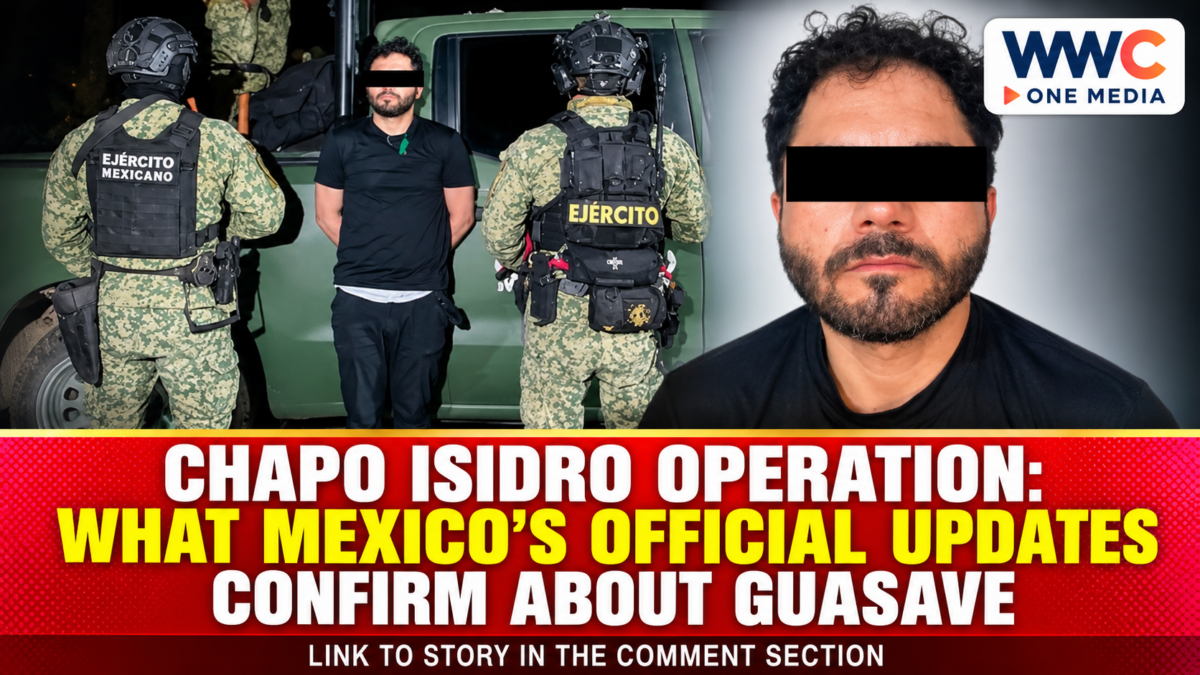
GUASAVE, Mexico — Mexican military forces detained Fausto Isidro Meza Flores, known as “Chapo Isidro”, in Guasave, Sinaloa, on Nov. 20, 2026, Mexico’s Defence Ministry confirmed in a statement issued the following day. The operation also resulted in the detention of two other named suspects, while road blockades prompted a coordinated security response across several municipalities.
The operation’s significance extends beyond the arrest itself. Official statements from Mexico’s federal and Sinaloa state authorities describe both the military action and the effort to restore public movement afterwards. Those records provide a clearer account of what authorities confirmed, while leaving some questions about the wider consequences unanswered.
What Mexico confirmed about the arrest
Mexico’s Defence Ministry said special forces from the National Guard and Army carried out the operation in Guasave on Nov. 20. The forces worked with special Army personnel assigned to the Sinaloa state public security secretariat.
The ministry identified the three detainees as Fausto Isidro N, alias “Chapo Isidro”; Germán N, alias “Serafín”; and José N, whom it described as a financial operator for the same group.
The statement described Meza Flores as the head of the Beltrán Leyva criminal organisation and an ally of the “Mayos” faction of the Pacific Cartel. It also said he had a Mexican arrest warrant for organised crime and health-related offences, as well as an extradition order to the United States involving an alleged conspiracy to distribute drugs.
The ministry said the operation followed intelligence coordination between Mexico’s Defence Ministry and US counterparts. It described a three-stage process: reaching the target area, securing the location and making the arrests, then evacuating the detainees.
After confirming the detainees’ identities, authorities transported them to Mexico City aboard a Mexican Air Force aircraft for presentation to the competent ministerial authorities. The statement did not provide a public timetable for subsequent court proceedings.
Why the operation involved several security agencies
The Defence Ministry’s account identifies the National Guard and Army special forces as the units involved in the detention. It also refers to Army personnel assigned to Sinaloa’s state public security secretariat.
The Sinaloa government’s Nov. 21 statement gives a broader picture of the institutional response. It said the state’s Peace and Security Coordination Council held an extraordinary session following the events in Guasave.
The state government listed the Defence Ministry, National Guard, Sinaloa Public Security Secretariat, Navy, federal Security and Citizen Protection Secretariat, and federal and state prosecutors among the institutions coordinating the response.
This distinction matters. The military statement describes the operation that led to the arrests; the state government statement describes the inter-agency work that followed. They are related records, but they do not describe precisely the same responsibilities.
Cross-border drug enforcement is also a continuing regional issue. WWC has previously examined how authorities respond to suspected international narcotics shipments, including the Manila port seizure involving a shipment from Laos. That Philippine case is separate from the Mexican investigation; no operational connection between them has been established.
Road blockades became an immediate public-security concern
Mexico’s Defence Ministry said blockades were recorded in Ahome, Guamúchil, Guasave and Navolato following the arrests. It said authorities activated an anti-blockade plan with local officials and deployed security forces to restore traffic and protect the population.
The Sinaloa government’s account on Nov. 21 described the practical work that followed. It said authorities were removing vehicles from roads and highways to allow residents to travel more freely and safely.
The state also said the National Guard would maintain surveillance on different highway sections. Its extraordinary security meeting was intended to sustain coordination among the three levels of government as officials responded to the events.
A separate state update published on the same date said there were no road blockades being reported at the time of that notice. It added that vehicles remaining on some roads and highways were being removed to facilitate traffic.
These are time-specific official updates. They indicate that the government reported progress in clearing routes, but they should not be interpreted as proof that every disruption across the affected municipalities had ended permanently.
What the official updates say about residents
The Sinaloa government said the coordinated response had enabled residents of Guasave to return to their homes and allowed streets, highways and public spaces to be reopened for daily activities.
Its later update said the immediate priority was restoring mobility and helping residents resume their routines. It also reported that security personnel remained active in the field.
The statements show that authorities treated road access and civilian movement as central parts of the response, rather than limiting the operation’s outcome to the arrest of the suspects.
However, the public statements reviewed for this update do not provide a complete, independently verified assessment of all civilian injuries, deaths, property damage or business interruption associated with the wider events. A statement that a road is clear or that residents are returning home cannot, by itself, establish a full civilian casualty count.
For that reason, claims that no civilians were killed should not be presented as a confirmed final finding unless a specific official record establishes the figure and its scope.
The broader issue of drug enforcement also reaches beyond military operations. WWC has covered PDEA’s call for coastal communities to report suspicious drug packages, a separate Philippine initiative focused on detection and reporting rather than armed intervention.
The arrest does not settle the legal allegations
Mexico’s Defence Ministry said Meza Flores had an arrest warrant in Mexico and an extradition order to the United States. The US Department of Justice separately announced on Nov. 21 that he had been captured by Mexican military forces in Guasave.
The US department said a federal grand jury in the District of Columbia returned a second superseding indictment on Sept. 25, 2026. It described six counts involving alleged leadership of a continuing criminal enterprise, drug-trafficking conspiracies, international money laundering, alleged material support to a terrorist organisation, narcoterrorism and firearms offences.
These are allegations in a criminal case, not findings of guilt. The department said that, if convicted, Meza Flores could face the death penalty or a mandatory term of life imprisonment. That is a statement about potential penalties, not a sentence imposed by a court.
The legal process must therefore be kept separate from the military operation. An arrest places a suspect in custody; it does not resolve the charges or prove every allegation contained in an indictment.
What happens next
The next developments to watch are formal updates from Mexican authorities on the detainees’ legal status, any official announcement about extradition or other proceedings, and further information about the security situation in Sinaloa.
The state government said security coordination and highway monitoring would continue after the operation. Those commitments provide an indication of the immediate public-safety priorities, but the records reviewed do not establish a long-term timetable for the deployment.
The operation is a significant enforcement event. Its longer-term impact will depend on subsequent legal proceedings, continued public access to affected areas and evidence showing whether authorities can sustain security improvements beyond the initial response.
Frequently Asked Questions
When was Chapo Isidro arrested?
Mexico’s Defence Ministry said Fausto Isidro Meza Flores was detained in Guasave, Sinaloa, on Nov. 20, 2026.
Who was arrested with Chapo Isidro?
The Mexican Defence Ministry named Germán N, alias “Serafín”, and José N, whom it described as a financial operator, as two other detainees.
Which areas experienced road blockades?
The Defence Ministry reported blockades in Ahome, Guamúchil, Guasave and Navolato following the operation.
Did authorities say the roads were reopened?
The Sinaloa government said on Nov. 21 that vehicles were being removed from roads and that no road blockades were being reported at the time of a separate update.
Does the arrest mean Chapo Isidro has been convicted?
No. The arrest and the charges announced by US authorities do not amount to a conviction. The allegations must be resolved through the relevant judicial process.










