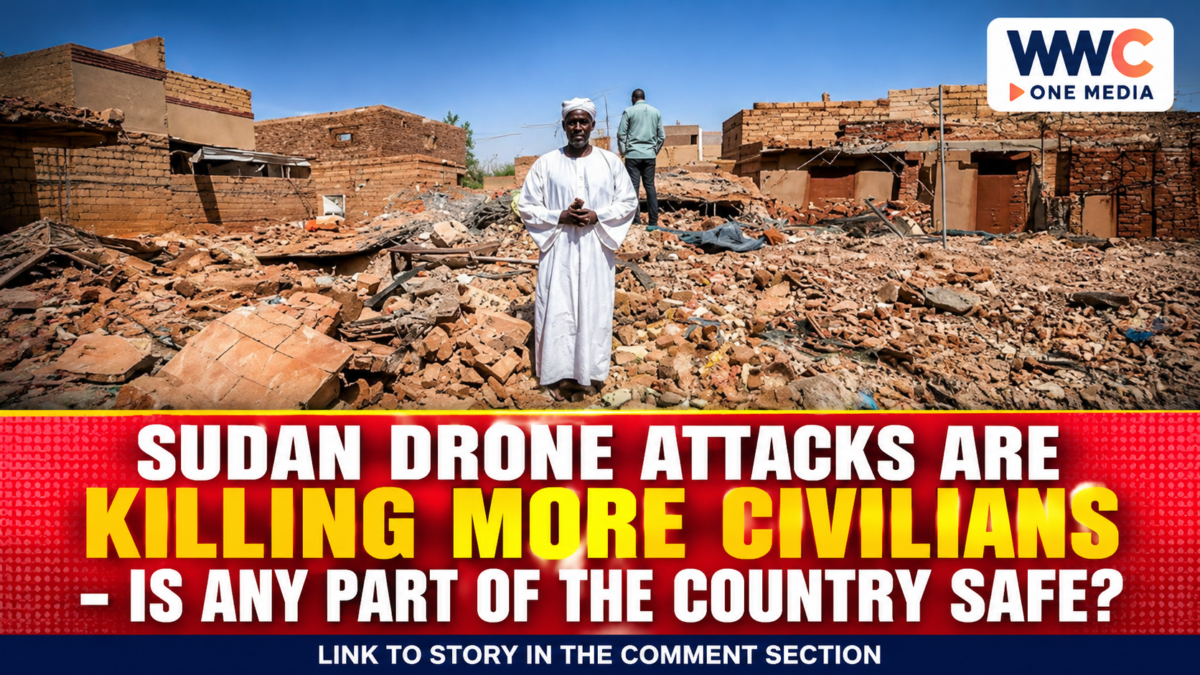
Sudan drone attacks are increasingly threatening civilians far from the country’s main battle lines, with a United Nations report documenting more than 2,230 civilian deaths between January and October 2026. The warning came into sharper focus on Nov. 22, when drones struck Khartoum and damaged a United Nations premises in a civilian neighbourhood.
The latest incident highlights a growing problem in Sudan’s conflict: the consequences of aerial attacks extend beyond military positions, affecting homes, hospitals, electricity facilities, water supplies and humanitarian operations. However, the available UN statement on the Khartoum incident did not identify who launched the drones, making it important to distinguish confirmed damage from claims about responsibility.
Sudan drone attacks: What the United Nations confirmed
In a statement dated Nov. 22, United Nations Resident and Humanitarian Coordinator in Sudan Denise Brown confirmed that drones targeted Khartoum early that morning.
A UN premises was damaged while UN personnel were inside the building. Brown said the incident occurred in a civilian neighbourhood and reiterated that humanitarian personnel and assets are protected under international humanitarian law. United Nations in Sudan
The statement did not provide a casualty count for that particular incident or identify the party responsible.
That distinction matters. The broader conflict involves the Sudanese Armed Forces (SAF) and the Rapid Support Forces (RSF), both of which have increasingly used drones. But an attack cannot be attributed to either side solely because it occurred during fighting between them.
The damage to a UN facility nevertheless demonstrates how aerial operations can place humanitarian workers at risk even when they are not operating near an identified frontline.
More than 2,230 civilian deaths recorded by October
The scale of the wider problem is documented in an OHCHR report released on Nov. 17.
The UN Human Rights Office confirmed that more than 2,230 civilians were killed between January and the end of October 2026. More than 1,630 of those deaths were attributed to drone strikes. The organisation warned that the actual number of civilian casualties was likely higher. United Nations in Sudan
The report’s figures show that drone warfare has become a major source of civilian harm.
During the first six months of 2026, at least 1,390 civilians were killed in the conflict involving the SAF, RSF and allied armed movements. More than 80 per cent of those casualties resulted from drone strikes.
Between July and October, another 840 civilians were killed, including close to 520 in drone attacks. United Nations in Sudan
The geographical distribution is also significant.
Kordofan accounted for more than two-thirds of the documented civilian casualties during the reporting period. Darfur recorded most of the remaining casualties, while eastern and central parts of the country were also affected.
In White Nile State alone, the report documented at least 41 civilian deaths from drone attacks during the period. United Nations in Sudan
These figures do not mean every death was caused by the same armed group. They describe the combined impact of a conflict in which multiple parties use aerial weapons.
The RSF has been linked to attacks on essential infrastructure
The OHCHR report also identifies a specific series of attacks attributed to the Rapid Support Forces.
Between Oct. 20 and Nov. 4, the UN documented 29 drone strikes attributed to the RSF against electricity facilities and fuel stations across 11 states. The attacks triggered widespread power interruptions and further fuel shortages, including in areas far from active frontlines. United Nations in Sudan
The consequences extended into everyday civilian life.
Electricity disruptions affected health services, including dialysis and surgical procedures. The UN also reported impacts on access to clean water and food production.
This is why infrastructure attacks can have consequences well beyond the immediate location of a strike. A damaged power facility may disrupt hospitals, water systems and other services used by people who are nowhere near the original target.
The report does not establish that every drone strike in Sudan was carried out by the RSF. It identifies attacks attributed to that group during a specified period, while documenting civilian harm across the wider conflict.
Hospitals, markets and schools are also being affected
The UN’s findings extend beyond electricity and fuel infrastructure.
During the first half of 2026, OHCHR documented at least 39 drone strikes on markets, 20 on civilian vehicles, 17 on fuel tankers and depots, and 16 on health facilities. United Nations in Sudan
These incidents raise concerns about the protection of places and services essential to civilian survival.
Markets provide access to food and other necessities. Health facilities are critical in a country where fighting has already disrupted medical services. Civilian vehicles and fuel supplies are important for transport, deliveries and humanitarian access.
The consequences are interconnected. When roads become dangerous, fuel becomes scarce and markets are damaged, civilians can face growing difficulties obtaining food, medicine and basic services.
WWC previously examined how Sudan’s conflict has disrupted schooling and increased the barriers facing vulnerable children in its report on the country’s education crisis and children with disabilities.
The education emergency is one example of how the effects of conflict can continue long after an individual attack has ended.
Why drone warfare is changing the conflict
A separate statement by the chair of the UN Independent International Fact-Finding Mission for Sudan, delivered to the Human Rights Council on Sept. 7, described how long-range drones have changed the battlefield.
The mission said both the SAF and RSF were increasingly using long-range drones, allowing attacks to reach beyond traditional frontlines. It also described civilian harm in homes, schools, hospitals, markets and displacement sites. OHCHR
The statement identified specific incidents investigated by the mission.
In Kalogi, South Kordofan, successive RSF drone strikes on a kindergarten and a hospital resulted in 114 deaths, including 60 children, according to the mission’s findings.
In another incident, the mission said SAF strikes rendered Ad-Da’ ein Teaching Hospital in East Darfur non-functional, killing at least 70 people and cutting off critical health services for more than two million people. OHCHR
The mission also said it had reasonable grounds to believe that both the SAF and RSF committed serious violations of human rights and international humanitarian law that may amount to war crimes.
These are findings by an independent UN investigative body, not final judgments by a criminal court.
The broader concern is that longer-range weapons make geographical distance a less reliable form of protection for communities away from traditional combat zones.
What happens next
The immediate priority is protecting civilians and ensuring humanitarian workers can continue operating safely.
On Oct. 31, the UN Secretary-General’s spokesperson issued a statement condemning escalating drone attacks by the parties to the conflict. The statement called on the armed groups to spare civilians and critical infrastructure and to agree to a cessation of hostilities. United Nations in Sudan
The UN Human Rights Office has also stressed the importance of accountability regardless of which side is responsible for an attack.
For Sudan, the next developments to watch include further verified civilian casualty figures, investigations into attacks on protected facilities, restoration of essential services and whether the parties take steps to reduce aerial attacks.
The humanitarian consequences also extend into food access. WWC’s examination of food insecurity and the difference between global supply and local access provides useful context for understanding why damaged markets, transport networks and fuel shortages can deepen hunger even when food exists elsewhere.
International diplomacy remains another part of the challenge. The broader difficulty of securing cooperation between governments amid several simultaneous conflicts was examined in WWC’s report on the United Nations’ global cooperation agenda.
For now, the official record points to a conflict in which civilians are increasingly exposed to attacks that can damage not only lives but also the infrastructure communities need to survive.
Frequently asked questions
How many civilians have been killed by drone strikes in Sudan in 2026?
The UN Human Rights Office confirmed that more than 1,630 civilians were killed by drones between January and the end of October 2026. It said the actual number was likely higher.
Did the RSF carry out the Nov. 22 drone attack in Khartoum?
The UN statement confirming damage to its premises in Khartoum did not identify who launched the drones. Responsibility for that specific incident remains unconfirmed in the primary record reviewed.
Has the RSF been linked to other drone attacks in Sudan?
Yes. An OHCHR report attributed 29 drone strikes on electricity facilities and fuel stations across 11 states to the RSF between Oct. 20 and Nov. 4, 2026.
Are both sides using drones in Sudan?
Yes. The UN Independent International Fact-Finding Mission for Sudan said both the Sudanese Armed Forces and the RSF were increasingly using long-range drones.
Why are drone attacks affecting civilians so severely?
The attacks have affected markets, hospitals, civilian vehicles, electricity facilities, fuel supplies and water infrastructure. Damage to these services can disrupt healthcare, food access, transport and other essential activities.